When a window sash drops after you release the handle, the problem is almost never the glass and almost never the frame: it is the holding system between them. Counterbalances, friction shoes, tilt units, and gas struts are load-rated service items, and they fail in predictable ways. This article maps which mechanism holds your sash, why it stops holding, what repairs actually last, and how specifiers keep the failure out of new projects.
Part of our window operation and comfort series for contractors, facility teams, and architects evaluating hardware life and sash support.
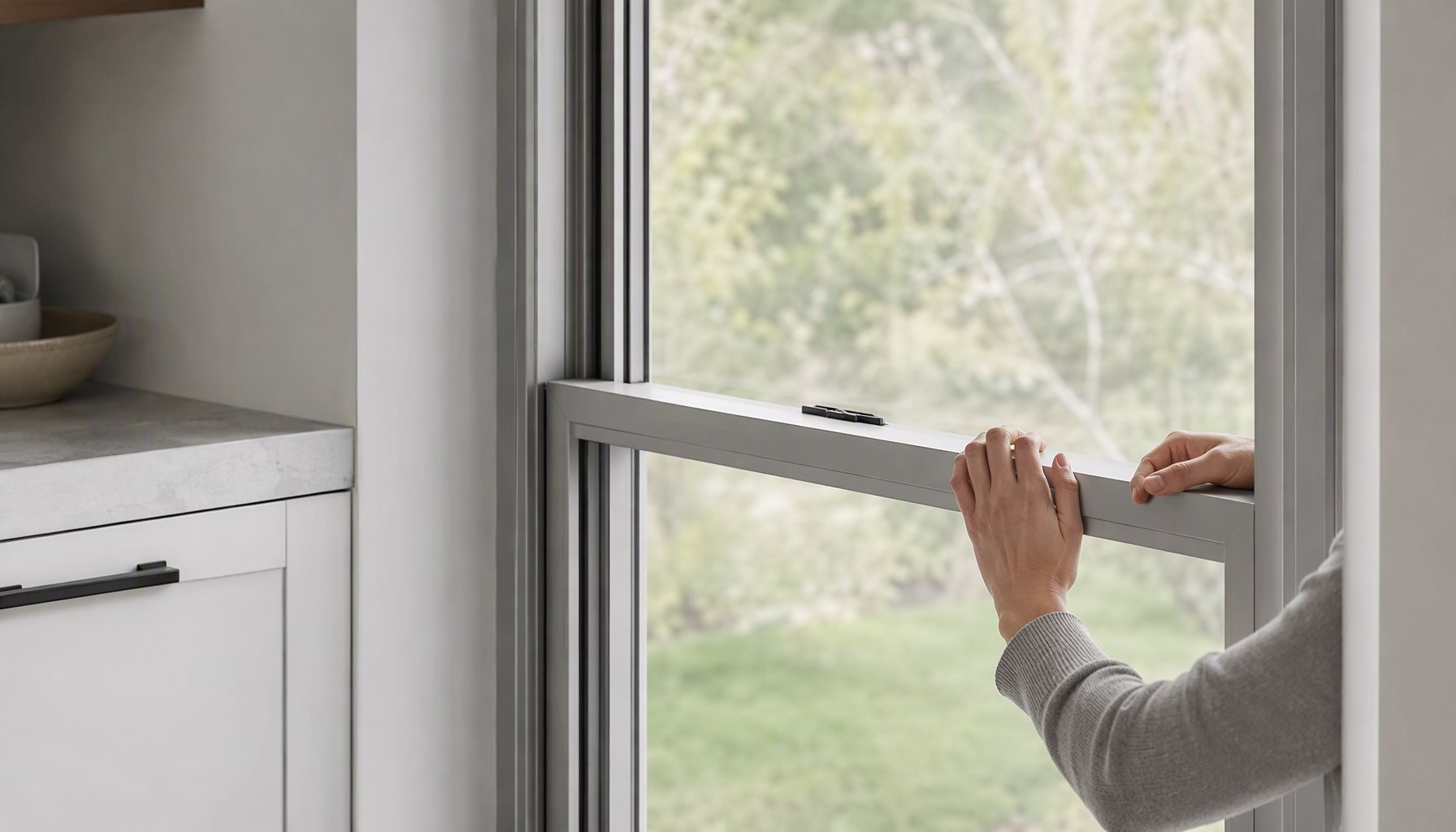
Quick Comparison: What Holds Your Sash Up
| Holding System | Where It Is Found | How It Fails |
|---|---|---|
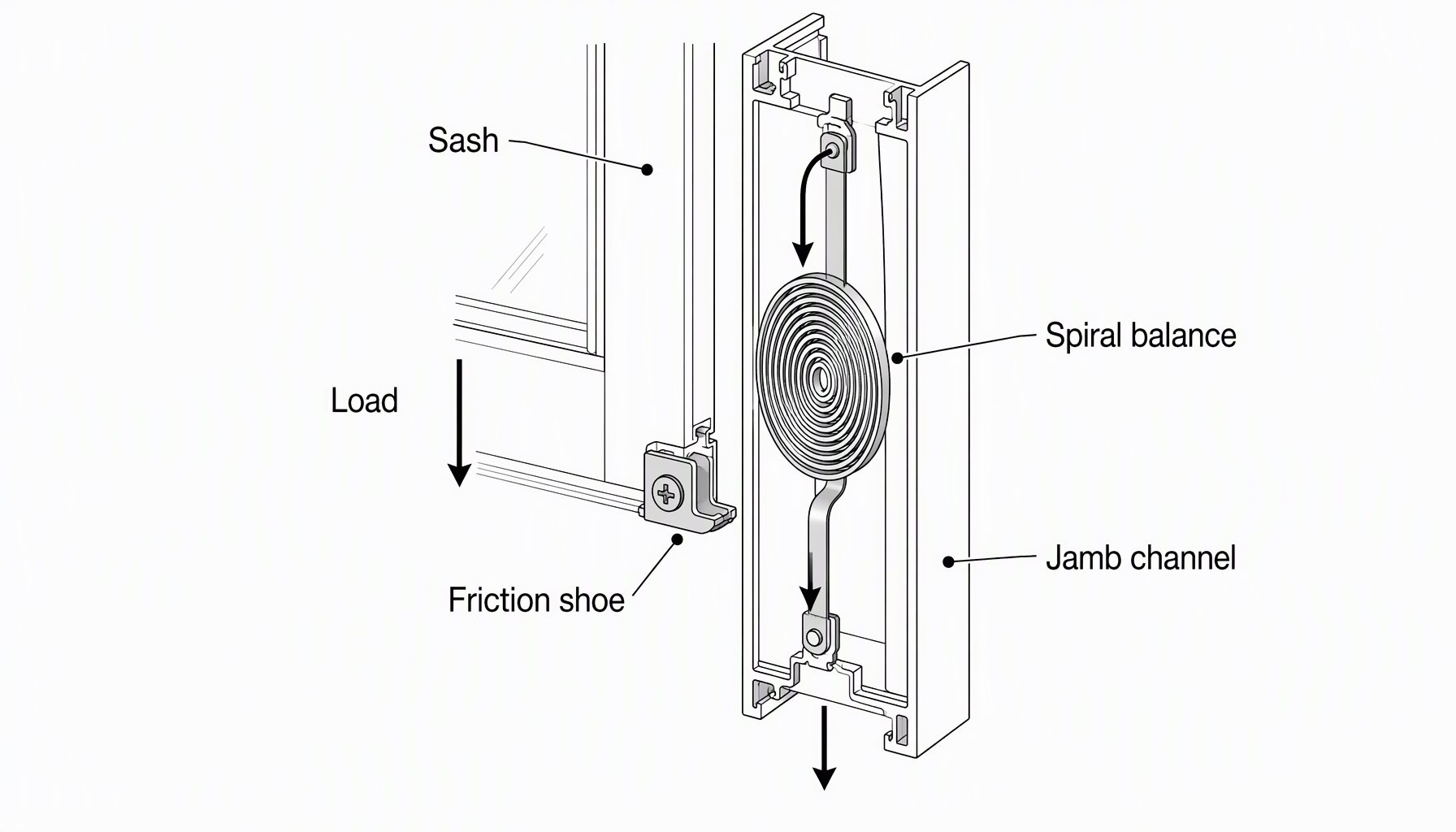
| Spiral or coil balances in the jambs | Double-hung and vertical sliding units | Torque relaxation, broken ends, shoes worn oversized |
| Friction shoes or tilt units | Vertical sliding sashes that tilt for cleaning | Spring fatigue or worn cam surfaces lose clamping force |
| Gas struts or constant-force supports | Tilt-turn and top-hung assemblies | Pressure loss or arm wear lets the sash drift down |
Why a Window Sash Drops
Every holding system is a force match. The balance or support is rated to carry a specific sash weight across a defined travel range, and the window is only stable when that rated force equals the actual load. Three things break the equality: the support weakens, the load increases, or the geometry changes so the support no longer acts through its designed lever.
Support weakening is the normal aging path. Spiral balances lose torque as the coil relaxes through thousands of small load cycles. Friction shoe springs sag and their contact faces polish smooth. Gas struts lose pressure slowly past their service life. None of these fail as a sudden event; they graduate, which is why the first sign is usually a sash that stays up at the top of its travel but creeps down in the lower half, where the remaining force margin is smallest. A window sash drops gradually before it drops quickly.
Load increase is the less obvious cause. Heavier glass packages, added laminates, or field-painted sash weight changes all raise the load above the balance rating that was selected at fabrication. Re-glazing a sash without revisiting the hardware selection is a classic route to a dropping sash within a few years. Geometry change comes from frame movement: if the jamb where a balance channel sits deforms even slightly, the balance binds or jumps its retainers, and the sash loses its support on one side. That asymmetry is also what makes a dropped sash appear crooked rather than merely low.
It is worth stating what does not hold a sash: the lock. Meeting locks secure a closed position; they were never designed to arrest a falling load. Using an overtightened lock to substitute for failed balances loads the keep and the stile, and it hides a problem that will finish as either a jammed open window or a sash coming down on someone’s hands.
Diagnosis Before Parts: Four Checks
First, identify the system. Open the sash partway and look into the jamb channels: a visible coil or wire in a slot means spiral or constant-force balances; a pivoting block at the sash side means tilt units; a diagonal arm under the sash on a top-hung unit means struts.
Second, test symmetry. Support the sash and release one side: if it stays on one jamb and falls on the other, one balance has failed and the survivor has been carrying double the design load, so both should be replaced together as a set.
Third, check travel position dependence. A sash that holds near full-up but drops when opened suggests a support whose force curve has flattened, or a channel that is dirty at the lower positions. Cleaning and re-seating sometimes recovers travel-position symptoms; it never recovers a relaxed coil.
Fourth, weigh the sash history. When a window sash drops soon after a glazing change, treat it as a rating mismatch until proven otherwise. If the glazing was changed in the field, or the unit is a bespoke large sash, hardware rating mismatch remains a live suspect, not just wear. A balance that is the correct part for the wrong load will fail early every time.
Repairs That Last and Repairs That Do Not
| Symptom | Likely Cause | Effective Action |
|---|---|---|
| Sash drifts down from mid travel, crooked | One balance failed, pair loaded unevenly | Replace balances as a matched pair to the series spec |
| Sash drops straight down, both sides weak | General torque relaxation across the set | Full set replacement; verify rating against actual sash weight |
| Dropping started after reglazing | Load exceeds original hardware range | Re-specify support for new weight or restore original glass package |
| One side binds or jumps its channel | Jamb deformation from installation or structure | Correct the frame condition first; balances over a bent jamb fail again |
| Tilt-turn sash drifts in tilt position | Gas strut pressure loss or arm wear | Strut replacement to the sash weight class |
What does not work: adding a third-party sash lock or clip to hold a failing sash, tightening friction shoes past their range to make a day of it, or replacing one balance of a matched pair. Balance replacement is inexpensive relative to the alternative, which is a large glass sash losing its support at height. For any sash over comfortable hand-support weight, treat the work as a two-person task and use proper sash support during service.
How Specifiers Keep Balance Failures Out of the Job
The control point is the weight-to-hardware relationship, fixed at the order, not at the site. Three lines of specification do most of the work. First, cap sash weight: require that each operable sash’s weight, including the exact glass package, falls inside the published range of the balance system installed in the profile series. Second, keep the tested configuration: performance classifications verified under the fenestration industry standards framework apply to the specimen family that was tested, and a sash resized or re-glazed outside that envelope has no claim on those results. Third, write serviceability into the submittal: balance access, replacement part numbers, and the procedure the manufacturer expects, so facility teams are not improvising with wrong-range parts later.
Two adjacent spec questions belong in the same review. Egress and operating requirements are set by the adopted code, and a sash that cannot be held open at a required position is a compliance conversation as much as a comfort one; the residential code text referenced locally is maintained on ICC Codes Online. And because a dropping sash also breaks seal compression, projects may see secondary water ingress or draft symptoms before anyone connects them to hardware.
Decision Guide: Service, Rebalance, or Replace
| Project Requirement | Recommended Choice | Why |
|---|---|---|
| Sound frames, original glazing, worn balances | Matched-pair balance replacement to series spec | The design condition still holds; only the consumable reached end of life |
| Field-reglazed sashes now dropping | Re-specify support for measured sash weight | Correcting the load-to-rating mismatch prevents immediate recurrence |
| Jamb deformation or racked assembly | Frame correction or unit replacement before hardware work | Balances installed into distorted geometry re-fail on their own schedule |
| New large-sash project | Lock sash weight and hardware range in the order confirmation | A bespoke sash is a hardware engineering item, not a catalog line |
Related system pages: tilt-turn hardware behavior, sliding sash details, and the sizing reference for how sash dimensions drive weight.
Frequently Asked Questions
Is it dangerous when a window sash drops during operation?
Potentially yes. A glazed sash is heavy, and a failing support can go from creeping to free-fall. Until service, keep the sash closed and locked, and do not rely on the lock to arrest downward motion.
Can I adjust friction shoes instead of replacing balances?
Tightening shoes can add drag for a short time, but clamping friction is not the same as carrying force, and over-tightened shoes scar the jamb channel. Adjust within the manufacturer’s stated range or replace.
Should balances be replaced in pairs?
Yes. A sash is supported by a set, and the surviving members of an aged set are already carrying load beyond their share. Replacing one member on an old set typically buys weeks, not years.
Why did my sash start dropping after new glass?
Because the load side of the equation changed. Laminated, thicker, or larger insulated packages add weight the original hardware range was not selected for. Balance re-selection belongs in any re-glazing scope.
How long do window balances last?
There is no fixed number. Life depends on sash weight against the rated range, cycle frequency, cleanliness of the channel, and exposure. Specifying hardware inside its published range is what converts “how long” from a guess into a design condition.
Does a dropping sash also affect weathertightness?
Yes, indirectly. A sash that no longer sits in its designed position compresses its seals unevenly, which opens paths for air and water. If the unit also shows leaks, evaluate hardware first and drainage details second.
What information does a manufacturer need for a balance complaint?
Series identification from the order or label, sash dimensions and glass build-up, how many units, and the symptom pattern across them. A job-wide pattern points to load or geometry, not manufacturing defects.
Send Your Sash Schedule for a Hardware Range Review
If sash weight and hardware life matter on your project, send your drawings, opening schedule, glass packages, and location. We can check every operable sash against its balance range and flag configurations that leave the tested envelope before production. Start from the windows hub or use the contact page; our QC records show how hardware is verified on the line.