What Privacy Glass Windows Actually Block
Privacy glass windows are glazed so that a viewer on the other side cannot resolve detail through them. That is the whole mechanism: not a barrier, but a loss of resolution. Obscured glazing stops the eye from forming an image, and everything else follows from that — how far away the observer stands, how much light falls on each side of the glass, and whether the surface scatters light uniformly or in a pattern.
Because privacy glass windows work by an optical mechanism rather than a physical one, the specification has to be honest about what privacy glazing does not do. It does not make the unit safer, it does not change its thermal rating by itself, and it does not add acoustic mass. The glass-selection logic for a facade — vision glass versus opaque panels, build-up ladders by zone — is developed for curtain walls in curtain wall glazing selection; this article stays on the residential and light-commercial window case, where the question is usually one or two elevations rather than a whole skin.
Four Ways to Make Glass Obscure, and What Each Costs
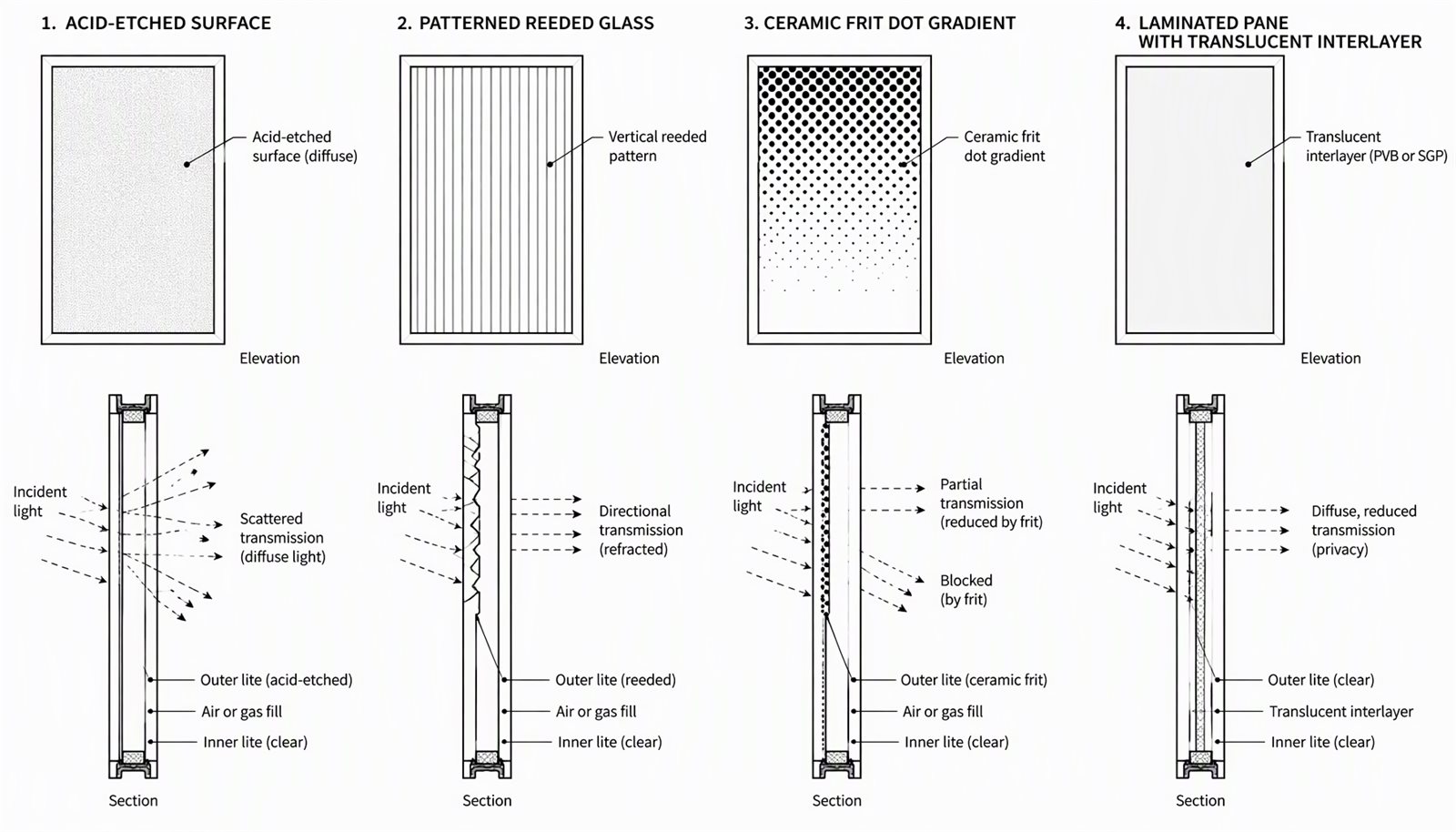
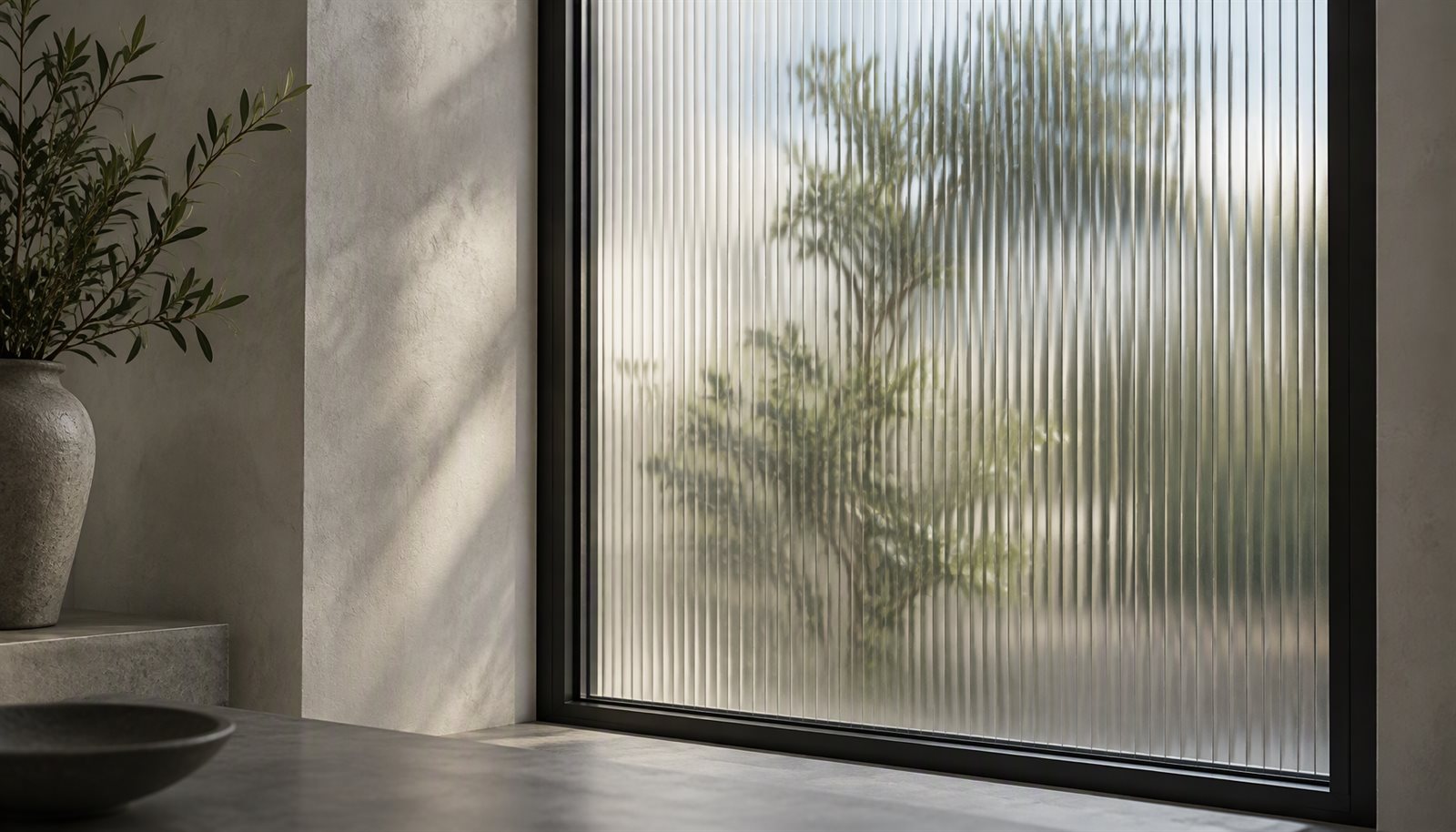
Surface texture is the first family. Acid-etched or sandblasted glass scatters light across the whole pane, which gives even obscurity at every viewing distance and a soft, uniform daylight. Patterned rolled glass does the same job with a formed surface — reeded or fluted — and trades evenness for a directional blur that distorts shapes while still letting light through at an angle.
Applied coatings are the second family. A frosted film is bonded or applied to the interior face of the pane; it is reversible, it can be replaced, and its life depends on the adhesive and the UV load it sees. Reflective and mirrored films are the same category with a different effect: they do not obscure by scattering, they work on a light differential, which means they behave well in daylight and poorly at night when the interior is lit and the exterior is dark.
Ceramic frit is the third family. A fired-on enamel pattern, usually a dot or gradient, blocks detail where the frit is dense and leaves clear glass where it is not. It is durable because it is fired into the surface, and the same technology is what makes opaque spandrel glass read as a solid panel — the definition and build-up of that material is in spandrel glass detail.
Laminated interlayers are the fourth. A white or translucent interlayer inside a laminated pane obscures the view while the glass surfaces stay smooth and cleanable, which solves the fingerprint problem that an exterior-etched bathroom window has. This family also carries the safety and hold-in-frame behavior of laminated glass, which the other three do not automatically provide.
| Method | What it is strong at | What it gives up |
|---|---|---|
| Etched or sandblasted surface | Even obscurity, soft uniform daylight | Oil marks show, and the surface cannot be locally repaired |
| Patterned reeded or fluted glass | Directional blur with high light transmission | Distorts the view rather than removing it; read the pattern at distance |
| Frosted or reflective film | Reversible, low cost to change, works on existing glass | Adhesive and UV life; differential films reverse at night |
| Ceramic frit pattern | Fired durability, designed gradient and cut-off | Reduces transmitted light where the pattern is dense |
| Translucent laminated interlayer | Smooth cleanable surfaces, retains laminated behavior | Cost and weight of a laminated build-up |
Daylight, View and the Trade You Are Making
Every obscuring method changes how much light arrives and how much of the outside is still legible; the two move independently. Window properties are one part of the opaque-envelope trade-off, and a privacy glazing shifts that balance on the elevation where it is used. A reeded pane can pass nearly as much light as clear glass while resolving nothing. A dense frit gradient passes little light in the band where it is printed. A frosted surface scatters, which reduces how much light reaches the deep part of a room even when the total transmission looks acceptable.
Where the project has a daylight requirement, the number to read is visible transmittance on the residential rating label, which is produced for the rated configuration of the whole product — so an obscure glass change is a configuration change, and the label that was submitted has to belong to the unit that ships. The solar side of that same label is discussed in low-E argon glass, because a privacy glazing that also has to earn its keep on a hot elevation is a different order than a frosted bathroom pane.
Durability, Cleaning and the Surface That Gets Touched
Obscured glass fails in the hand, not the weather. An etched or sandblasted exterior surface in a bathroom or a pool enclosure collects skin oil and cleaning residue in its microtexture, and once that staining sets it cannot be polished out without changing the appearance of the pane. Patterned glass puts the texture on one face, so specifying which face the pattern sits on — inside the insulated unit or out — decides whether the texture is protected behind a sealed cavity or exposed to the hose.
Film-based privacy is the reverse case: the glass is untouched, and the film is the wear layer. Edge lift, adhesive yellowing and cleaning-agent damage are all film failures on a sound pane, which is why a film specification belongs with a stated replacement interval in the maintenance documentation rather than hidden in a finish note. Frame finishes at the same opening have their own field-care rules, covered in painting aluminum window frames.
What Obscured Glazing Does Not Change
Privacy does not change the code status of the opening. A bedroom window that serves as an emergency escape and rescue opening still has to meet the residential code’s clear opening, height and operating requirements whatever is on the glass, and the glazing-location rules that decide where tempered or laminated glass is required are read from the same document — the building-planning chapter of the International Residential Code — not from the privacy finish. Similarly, a frosted pane in a door sidelight does not become a fire-rated or forced-entry assembly because it hides the view.
Acoustics follow the same logic. Sound isolation comes from mass, damping and a sealed assembly, which is why the acoustic specification is treated in soundproof aluminum windows and not assumed here. A translucent laminated interlayer happens to add damping, so it can contribute — but a film on a clear pane does not make a quiet window.
What to Specify: Decision Matrix
| Project Requirement | Recommended Choice | Why |
|---|---|---|
| Street-facing ground floor, view out still wanted | Reeded or fluted patterned glass, one elevation only | Passes light and blurs detail instead of deleting the view |
| Bathroom or pool enclosure with heavy contact | Translucent laminated interlayer with smooth faces | Texture stays out of the room side and cleaning does not fight the surface |
| Existing installation, reversible requirement | Frosted film with a documented replacement interval | The pane is untouched and the specification can be walked back |
| Privacy band with daylight kept above it | Ceramic frit gradient | Fired durability and a designed cut-off height rather than a whole frosted pane |
| Privacy that switches with occupancy | Switchable laminated interlayer | Clear-to-opaque on demand; requires power and a stated default state |
| Grid appearance as well as obscuration | Grilles between the glass with a frosted pane behind | Divided-light look without a surface that has to be cleaned between bars |
Privacy Glass Windows Questions
Are privacy glass windows the same as frosted glass?
Not exactly. Frosted is one method — a scattered surface. Privacy glazing also covers patterned glass, film, ceramic frit and a translucent interlayer inside a laminated pane, and each behaves differently at distance, at night and under cleaning.
Does obscured glass still let in daylight?
Usually yes, and in some patterns almost fully. What drops is resolution, not necessarily quantity; the number that tells you the difference is visible transmittance on the rating label for the configuration ordered.
Why does my one-way mirror film stop working at night?
Because it never obscured anything — it relied on the brighter side being the reflecting side. When the interior is lit and the exterior is dark, the differential reverses and the effect inverts. Scattering methods do not have that failure.
Can frosted glass be cleaned without marking it?
With the right products, yes, but an exterior-etched surface in a contact-heavy location will mark. Specifying which face carries the texture, or moving the texture into an interlayer or the cavity, is the durable answer.
Does a privacy glazing change the window’s energy rating?
It changes the configuration, so the rated value has to be re-issued for what ships. A frit or a translucent interlayer affects transmitted light and can shift the whole-product values; the thermal and solar behavior of the glass build-up itself is what the label documents.
Is switchable privacy glass worth it?
Where an opening genuinely needs both states and the power can be run to the frame, it works well and the specification question is the default failure state, not the concept. Where the need is one static elevation, a laminated interlayer or frit is simpler and cheaper over the life of the unit.
Do divided lights give privacy?
Only visually, and only a little. Grilles break up the image but do not scatter light; if the goal is obscuration, the pane behind the grid still has to be specified for it. The grid types themselves are covered in Tudor windows.
Send the Elevation, Not Just the Glass Note
Lansen specifies obscured glazing into thermally broken aluminum window systems: patterned and etched panes, fired frit gradients, translucent laminated interlayers and switchable build-ups, with the rating re-issued for the configuration that ships. Send the elevations where privacy is required, the room side and face the texture should sit on, and the daylight you are trying to keep, and we will review the glass build-up against the frame and hardware before production. See the range at our window hub or send drawings through the contact page.