Most failed jobs in painting aluminum window frames are not paint failures. They are preparation failures. A field-applied liquid coating is only as good as the surface it was put on, and an in-service aluminum frame carries contamination that a factory line never sees: chalked resin from the original coating, road or construction grit, cleaning residues, silicone splash from neighboring joints, and oxidation in the corners a brush never reaches. Get the prep right and a refinished frame looks and performs credibly; skip it and the new film lifts in sheets.
First, Know What You Are Painting Over
The existing finish decides the preparation sequence. An architectural aluminum frame in service is usually one of three things, and they behave very differently under a brush.
| Existing Surface | What It Does to a New Coating | Preparation Implication |
|---|---|---|
| Mill finish (uncoated extrusion) | Reactive bare metal; contamination embeds quickly and oxidation returns fast | Clean, abrade and prime before any color coat; do not leave bare metal exposed between steps |
| Anodized surface | Integral oxide layer with high surface energy loss once it is contaminated or sealed | Non-destructive abrasion and a bonding primer; aggressive sanding destroys the anodic layer unevenly |
| Factory powder coat | Hard, cross-linked film; sound areas are stable, chalked areas are loose pigment | Remove chalk and glaze, abrade to a mechanical key, prime the abraded areas the same day |
| Old liquid paint from a previous refinish | Unknown chemistry and adhesion; the weakest layer controls the result | Lift or abrade loose film and confirm compatibility before recoating over it |
What the original coating system was, and what its warranty says about field-applied work, is a separate question from how to prepare it; the factory-side mechanism is explained in powder coated aluminum windows durability. A field refinish does not reproduce a baked, cross-linked factory film, and nobody should pretend it does.
Preparation Is the Whole Job
Sequence matters more than product choice. This is the part of painting aluminum window frames that decides the result; every step below exists to remove something that would otherwise sit between the substrate and the new film.
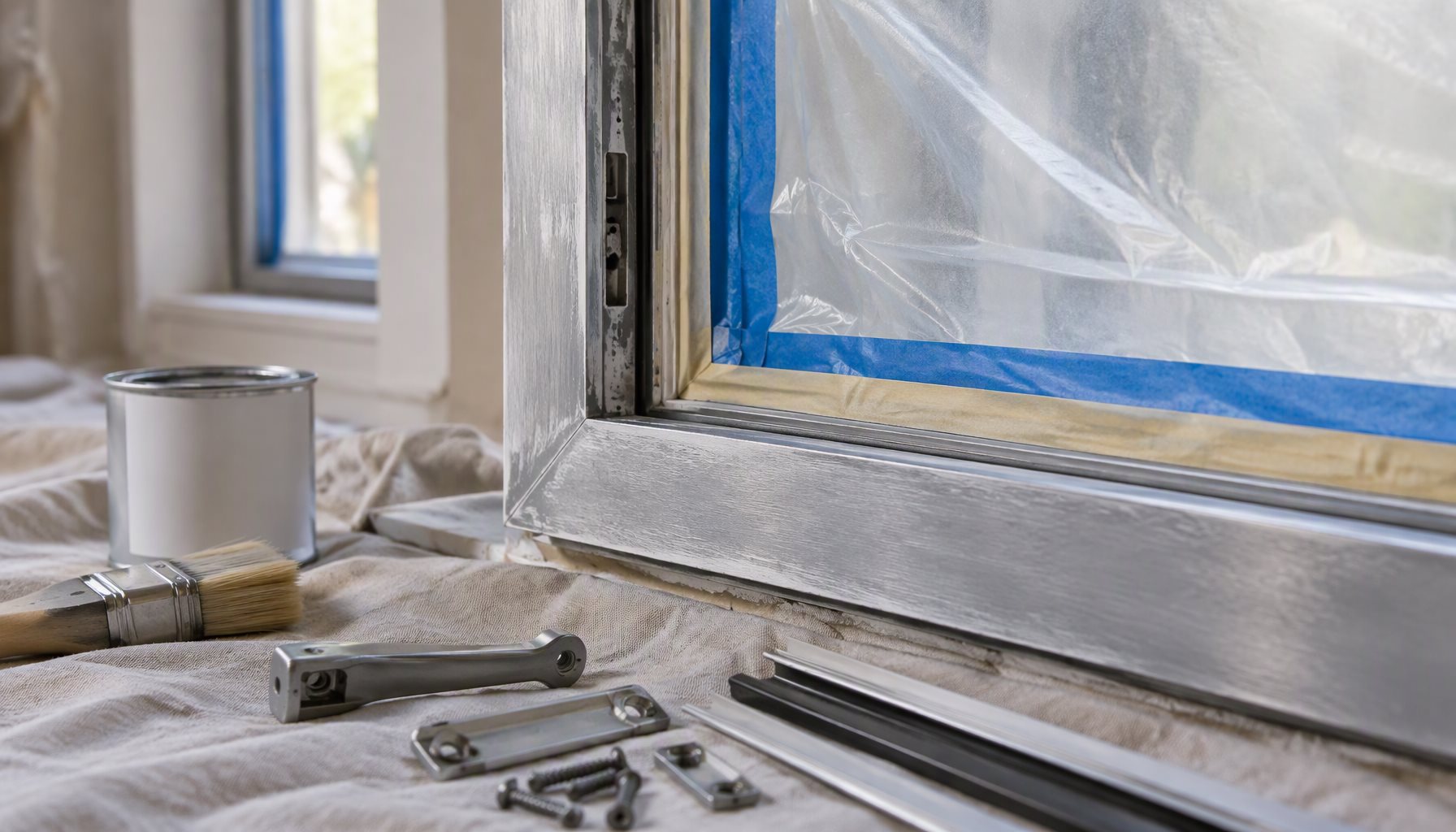
- Remove or mask the movable parts. Hardware, operators, handles and locks come off where the design allows; the wear-part inventory for sliding units is covered in aluminum sliding window parts. Glazing beads come out where they can be replaced cleanly.
- Protect the glass and the seals. Glass is masked with film; gaskets and the insulating glass unit edge are masked, not merely worked around. Coating on an elastomeric seal hardens it, and paint bridging a unit’s edge seal is not a repair.
- Wash before you abrade. Loose contamination ground into a surface becomes part of the finish; a detergent wash and clean-water rinse removes the bulk of it.
- Remove silicone and wax with a solvent wipe before the first sanding pass. Silicone is the classic cause of craters and fish-eyes, and it cannot be sanded away — it has to be dissolved and lifted.
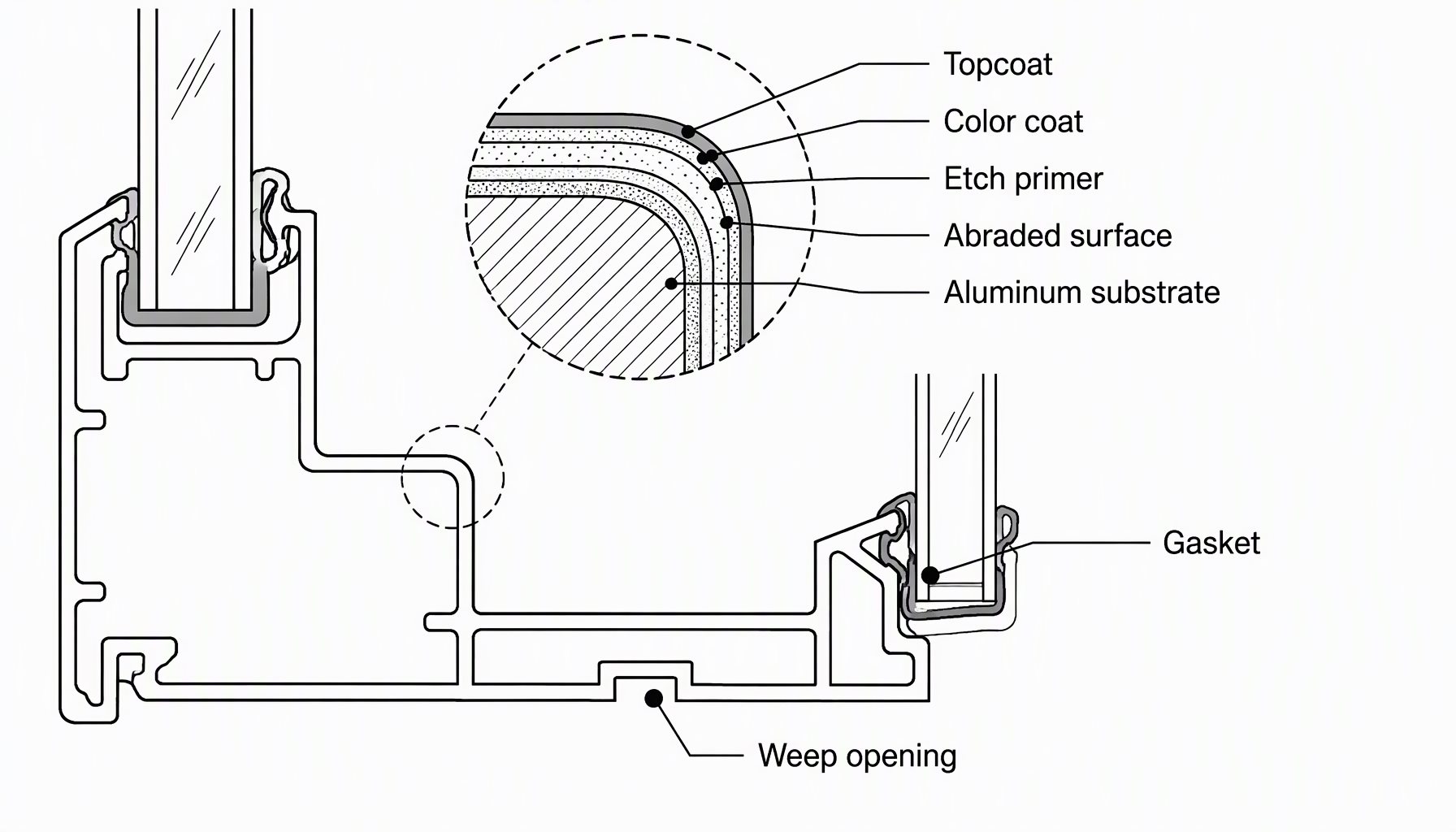
- Abrade to a mechanical key across the whole surface — corners, cap edges and rebate included — then remove the dust before priming.
- Keep the drainage functional. Weep openings are not cosmetic; coating them shut turns a refinish into a water problem.
Primer on Aluminum Is Not Optional
Bare or abraded aluminum needs a primer formulated for the metal. Etching and wash-type primers bond to a reactive surface rather than sitting on it, and they are the difference between a finish that survives a season and one that lifts at the first scratch. Where an existing factory coating is sound and merely abraded, a bonding primer over the abraded areas is the standard route; where chalking exposed bare metal, the primer is doing a different job.
Primer is also where false economy shows. Spot-priming the visible faces and leaving the rebate, cap edges and sill underside uncoated reproduces the very failure pattern that prompted the refinish; corrosion at those water-holding details is covered in how to prevent aluminum window corrosion.
Spray, Brush or Roller on an Installed Frame
Each application method trades quality against containment, and on an occupied building containment usually wins.
Aerosol or pump spray gives the smoothest film and reaches geometry a brush cannot, at the cost of overspray onto glass, gaskets, walls and neighboring units. Spraying an installed frame in place is a professional job because masking discipline is what makes it one.
Brush work is the practical field method on a frame with returns, rebate corners and hardware pockets. Its failure mode is film thickness: a loaded brush on a vertical face sags at the bottom rail and bridges corners. Thin passes at the correct recoat interval beat one heavy attempt.
Roller suits flat faces such as cover pieces and sill caps but leaves texture, and is often laid down and backed off with a brush.
Environment is part of application. Coating a cold substrate in humid air traps condensation under the film before it flashes off, which appears later as adhesion loss. The surface should be dry and comfortably above the dew point and worked within the coating product’s stated temperature and humidity range; favor the shaded elevation over a sun-baked frame, and treat the recoat window as a rule rather than advice.
Where Painting Aluminum Window Frames Reaches Its Limits
A coating restores a surface. It does not repair a detail, and on a refinish survey the mistakes are made by treating these as the same job.
| Condition Found | Why Coating Alone Will Not Fix It | What Has to Happen First |
|---|---|---|
| Pitted or exfoliated substrate | The film bridges a defect instead of sealing a sound surface | Mechanical removal back to sound metal, then re-prime |
| Chalked, powdery old finish | New paint adheres to loose pigment, not to the coating | Wash and abrade until no chalk returns on a wipe |
| Hardened, torn or compressed gaskets | Paint stiffens a seal that has already lost recovery | Replace the seal, then mask it during the refinish |
| Fogged insulating glass units | An edge seal failure is internal to the unit | Re-glaze; see condensation inside double glazing |
| Blocked or painted-shut weep openings | Traps water behind the new film | Restore the drainage path before any coating |
| Cracked or delaminated sealant joints | Paint over a failed joint hides the movement | Rake out and re-tool with a compatible sealant |
Color is a real constraint, not a cosmetic one: a dark frame on a sun-loaded elevation runs hotter than a light one, which affects both coating condition and the glass edge — the exposure side is discussed in black aluminum windows. Changing a frame color on a defined elevation also changes the building appearance, which is why finishes are best settled at the operating-style and profile stage rather than mid-renovation.
Planning the Refinish: A Decision Matrix
| Project Requirement | Recommended Choice | Why |
|---|---|---|
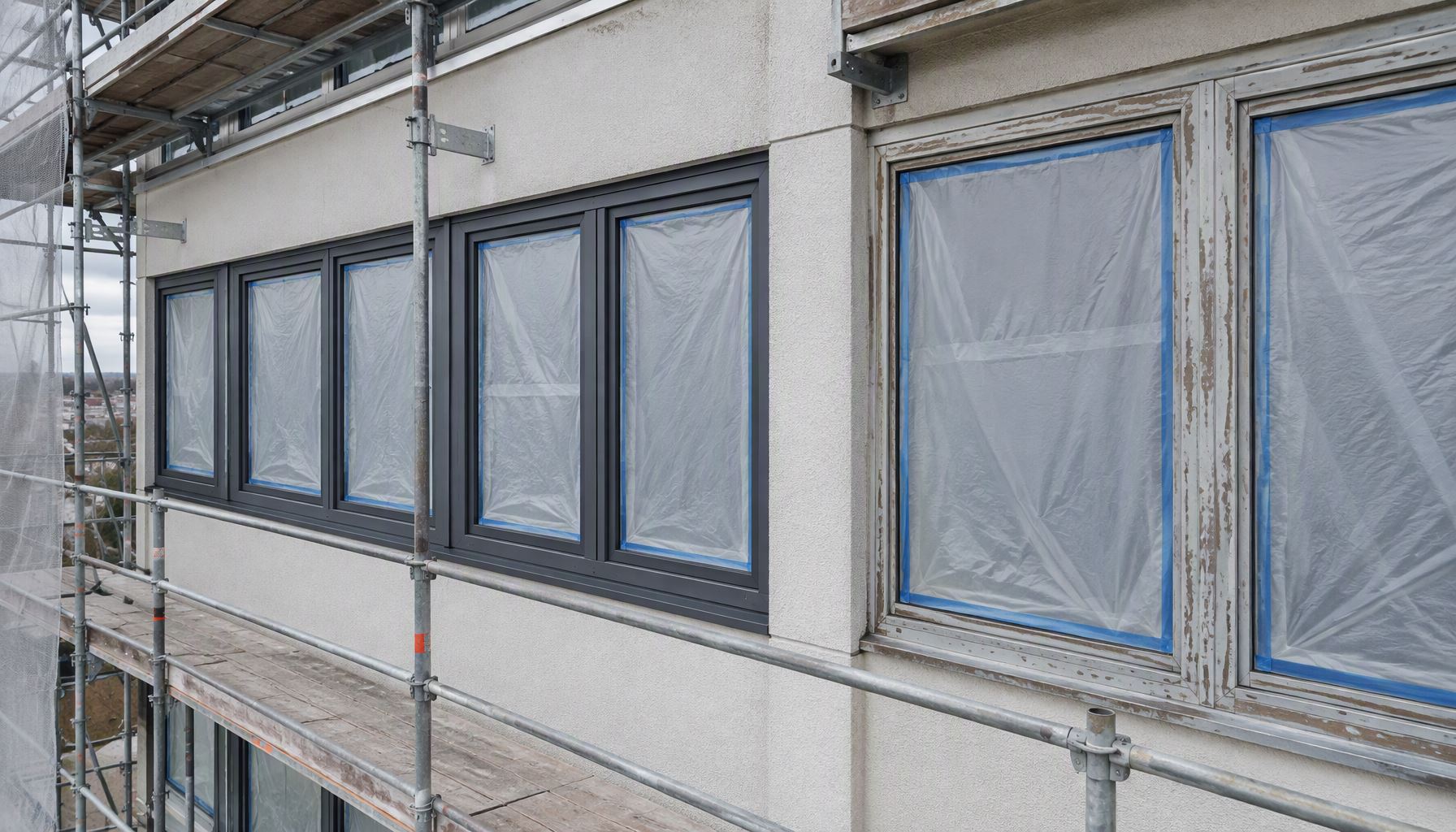
| Occupied building, elevations facing public space | Brush-applied system with full masking and containment per opening | Controls overspray; delivers an acceptable film on a serviced frame |
| Best possible film on a limited number of units | Remove the sashes and coat them in a controlled off-site setting | Temperature, dust and film thickness all become manageable |
| Bare or heavily pitted aluminum | Mechanical prep to sound metal, etching-type primer, then build color coats | Adhesion has to be created, not improved |
| Coastal or industrial exposure | Prep plus a coating selected for the exposure, with an inspection cycle written in | Contaminant load re-deposits; one coating is not a system |
| Frames under an active finish warranty | Confirm the warranty position before any field coating | Field coatings commonly affect the original finish warranty |
Frequently Asked Questions
Do I have to take the units off before painting aluminum window frames?
No, and that is normally the whole point of the method. The frame is coated in place with the hardware removed or masked, the glass protected, and the gaskets and drainage kept clear. Removal is only necessary when off-site coating is chosen for film quality or when the assembly must be dismantled for other work.
Do I need a special primer on aluminum?
Yes. Bare or abraded aluminum needs a primer formulated for the metal, because a general-purpose primer sits on the surface rather than bonding to it. Where an original factory coating is being abraded and overcoated, a bonding primer selected for that substrate is the usual route.
Why does new paint peel off aluminum frames?
The recurring causes are contamination left under the film — silicone, wax, chalk, salt or grit — insufficient abrasion, too heavy a film in one pass, or a damp or cold substrate. Peeling is almost always a shortened prep step.
Should I spray or brush an installed frame?
Spray gives a better film but oversprays onto glass, seals, walls and adjacent units, so it demands professional containment. Brush work is the standard field method on profiled frames with returns and rebate corners. Thin passes at the correct recoat interval beat one heavy attempt.
Will painting stop corrosion on my frames?
A coating is a barrier, and it helps — but coating over an active problem locks the problem in place. Drainage that is blocked, dissimilar-metal contact at fixings, and uncoated water-holding details need correcting first. The mechanism and the specification order are in the corrosion prevention guide linked above.
Does a field refinish match a factory powder coat?
No. A factory film is baked and cross-linked to a controlled thickness; a field coating cures at ambient conditions and is thinner and softer by comparison. That is a durability and appearance question rather than a color one, and the comparison is made properly in the powder coated durability guide linked above.
Can I paint over the gaskets or the glass edge?
No. Coating hardens an elastomeric seal and bridges the edge of an insulating glass unit, neither of which is a repair. Mask both, and keep weep openings unobstructed. Any change to the glazed assembly should be understood against the rated product configuration described by NFRC for rated fenestration.
What coating should I specify for a project?
Specify by condition and evidence: substrate state after washing and abrasion, primer type for that substrate, coating selected for the exposure, film built in documented passes, and an inspection cycle. Coating and quality-assurance guidance is published through FGIA standards resources, and the practical window-maintenance perspective is covered in the DOE energy and maintenance guidance for windows.
Get the Coating Package Reviewed
If you are preparing a scope for painting aluminum window frames on an installed package and want it reviewed against the original system documentation — substrate condition, primer and coating selection, drainage and seal protection, and the inspection cycle — send us your drawings, opening schedule, site exposure and the finish history you have. Our team can review the specification before the work is let — send the package through the contact page.