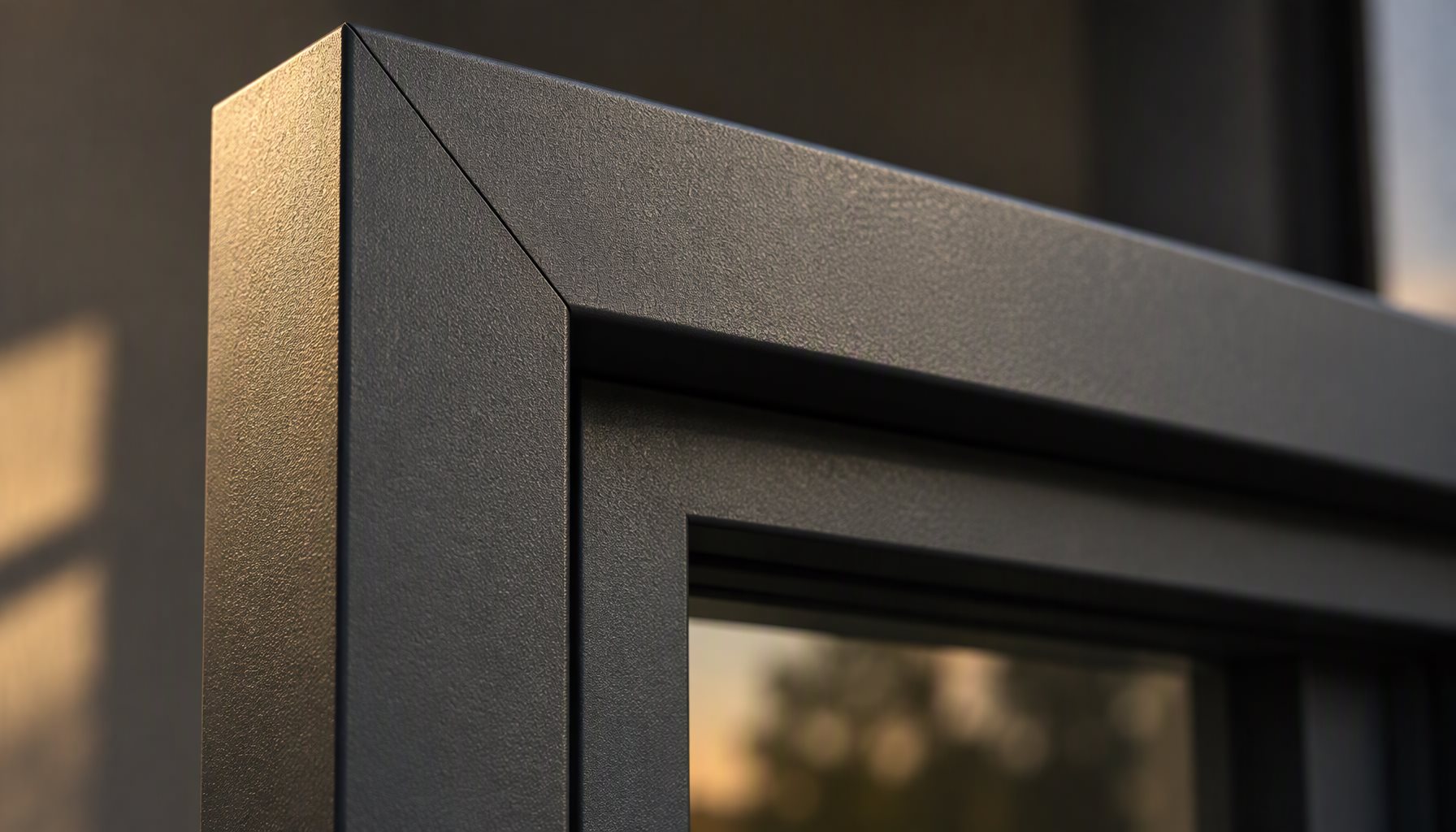
Powder coated aluminum windows commonly hold their appearance for 15-25 years in a mild inland exposure and 10-15 years in a coastal or high-UV exposure, and less in salt spray, heavy industrial fallout, or unbroken sun on a dark colour. Those are typical planning ranges, not guarantees. The spread inside each range is driven far more by how the coating was specified and applied than by the powder brand on the box.
The class number on a specification sheet tells you what a finish was designed to survive, not what a particular coater achieved. A quote can state AAMA 2605 and still ship windows that chalk within a few years if the pretreatment line drifted, the film went on thin, or the cure oven ran cold. That gap is where cheap quotes differ, and it is worth verifying before the container leaves rather than after the first warranty claim.
This article is about service life: what determines how long a powder coat lasts on an aluminum window profile, how it fails, and what to put in writing at order. Appearance and colour selection are covered separately in our notes on black aluminum window finishes.
Why Powder Coated Aluminum Windows Are Not One Product
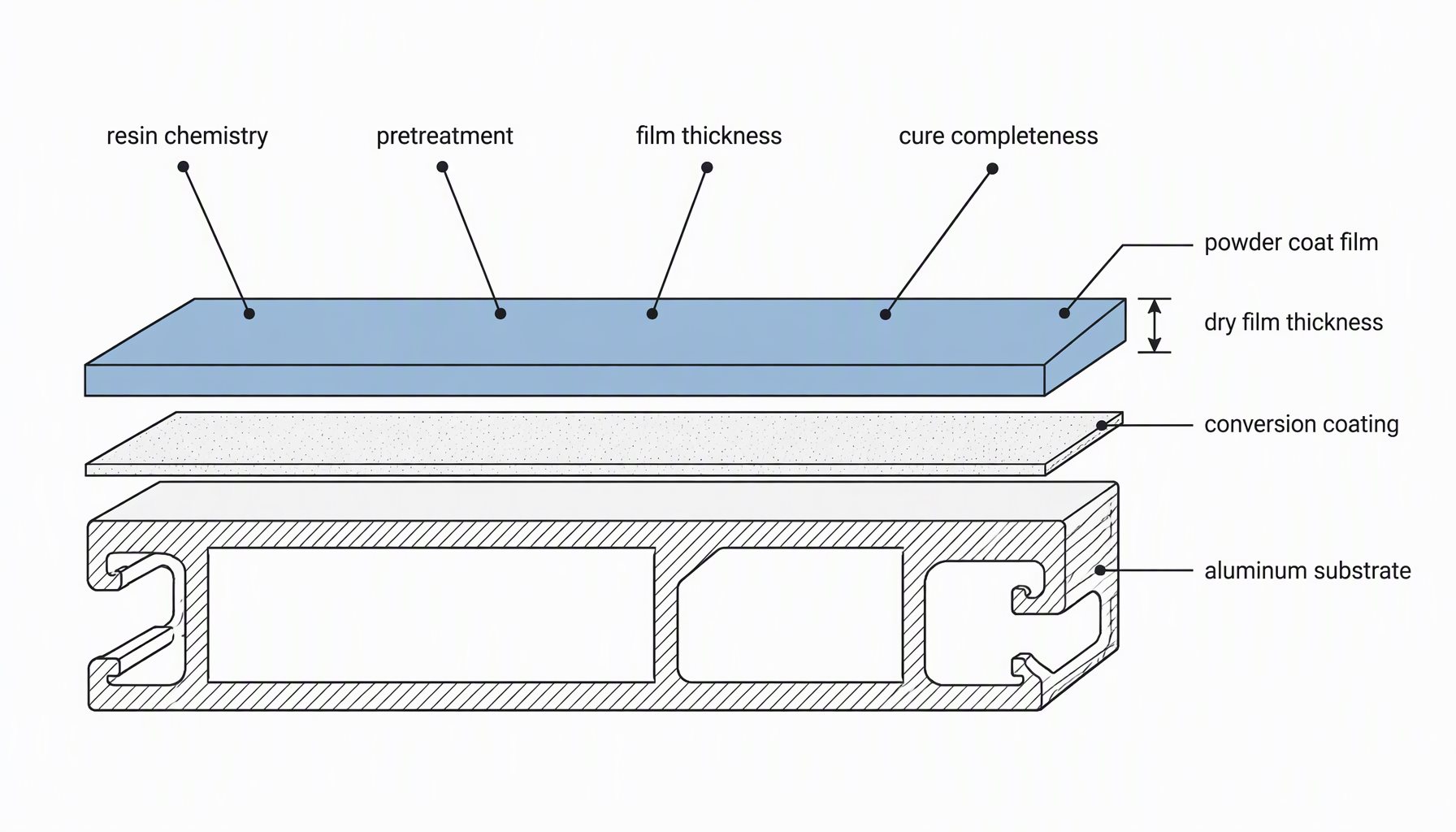
“Powder coated” describes a deposition method, not a performance level. Powder is sprayed electrostatically onto a grounded aluminum extrusion, then melted and crosslinked in an oven. Everything that determines service life sits in that sequence: resin, pretreatment, film thickness, and cure completeness.
Resin chemistry is the first variable, and it sets the ceiling on UV performance. Two coaters can both write “polyester powder coat” on a quote and ship finishes with materially different expected lives.
Qualicoat licenses and audits coaters against a controlled process, so it speaks to process discipline as much as to product; QUALANOD is its equivalent for anodizing. Neither substitutes for the AAMA class.
The substrate and window design matter too. The aluminum window systems we manufacture at Lansen use 6xxx-series extrusions, and frame drainage and weep paths determine how long the finish on those surfaces survives. A coating cannot outlast standing water. For substrate choice, see our aluminum vs vinyl window comparison.
The AAMA Coating Classes Compared
The AAMA organic coating classes are a ladder of exterior performance, defined by progressively longer exposure testing and tighter thresholds for colour retention, gloss retention, chalking, and corrosion at a scribe. The class documents are maintained through FGIA / AAMA, and where a jurisdiction adopts them by reference it is usually through the model codes and standards.
| Class | Test basis and typical service environment | Expected retention and cost tier |
|---|---|---|
| AAMA 2603 | Baseline organic coating; exterior exposure with modest thresholds. Interior, sheltered exterior, soffits and low-UV inland work. | Noticeable chalking and gloss loss sit inside the class basis; colour shift likely over a long exterior life. Lowest cost tier. |
| AAMA 2604 | High-performance organic coating; longer exposure and tighter thresholds. Residential and light commercial exteriors in moderate UV and inland climates. | Moderate gloss loss across the class basis; colour shift limited but visible over time. Mid cost tier. |
| AAMA 2605 | Superior-performing organic coating; longest exposure basis and tightest thresholds. Coastal, high-UV, high-visibility and high-specification commercial work. | Highest colour and gloss retention of the three under the same exposure. Highest cost tier. |
| Qualicoat / QUALANOD | Coater approval and process-control schemes (Qualicoat for organic coatings, QUALANOD for anodizing), used alongside AAMA classes rather than instead of them. | Not a retention specification; a signal of process discipline. Cost varies with the coater. |
Cost tier reflects powder price, pretreatment discipline, cure control, and testing burden. The finish is rarely the dominant line item on a window programme, so trading a class down to save a small percentage of unit cost is usually poor value. Figures behind each class depend on the exact product: confirm against the finish supplier’s test data for the class specified.
What Actually Determines How Long the Finish Lasts
Pretreatment quality
Pretreatment is the step nobody photographs and the one that ends most finish warranties early. The aluminum is etched, rinsed, desmutted, and given a conversion coating for the powder to bond to. Get cleaning or conversion wrong and adhesion fails long before the class suggests it should: a 2605 powder on a badly pretreated extrusion behaves worse than a 2603 powder on a good one.
The choice between chromate and chrome-free conversion coatings matters here. Trivalent chrome systems tolerate wider variation in bath concentration, pH, temperature, and contact time. Chrome-free systems, usually zirconium or titanium based, are where the industry has moved, but they run in a narrower window. A coater that switched to chrome-free without re-validating line parameters can pass a flat-panel salt spray test per ASTM B117 or ISO 9227 and still fail at a cut edge or fastener hole in the field, because a flat panel does not test the geometry where real windows corrode.
Film thickness and its measurement
Architectural powder films are commonly specified between roughly 60 and 100 µm (about 2.4 to 4.0 mils), with the exact minimum set by the system and the class. Thickness is measured with a magnetic or eddy-current dry film gauge, and how it is measured matters as much as the number: readings shift with substrate alloy, curvature, and calibration, so a single reading on a flat face proves little. Require a documented sampling plan with multiple readings per rack, including recesses and returns.
Recesses are where thickness quietly drops. Electrostatic deposition is weakest in inside corners and deep channels because of the Faraday cage effect, so a frame reading above minimum on the exterior face can be thin at the glazing pocket and interior corner, where water and fasteners sit. Over-thick films are also a defect: past a point the coating becomes brittle, loses impact resistance per ASTM D2794, and fails cohesively.
Cure schedule
Powder cures when the aluminum itself reaches the specified metal temperature for the specified time, not when oven air does. That is where under-cure hides: a heavy extrusion and a thin one on the same line at the same speed do not reach temperature together, so one profile family can be starved while another is over-baked.
Under-cured powder looks fine on the rack and fails in service: crosslinking is incomplete, so adhesion is weak, chalking starts early, and the film resists impact and chemicals poorly. Over-cure embrittles the film and can yellow light colours. The control is a documented metal temperature profile per profile family, recorded with profile tags or data loggers, not an oven setpoint.
Standard polyester versus fluoropolymer-rich systems
Standard polyester powder suits interior, sheltered, and mild-climate exterior work; superdurable grades are the usual architectural exterior choice, and fluoropolymer-rich powder raises gloss and colour retention further under intense UV, earning its cost on high-visibility facades, coastal work, and dark colours in strong sun. Metallics and micas deserve caution: flake orientation varies with application, so colour can differ between batches, touch-up rarely matches, and what reads as colour shift is often pigment- and orientation-related rather than a coating failure.
What the building actually sees
Exposure is not one number. UV dose varies enormously with latitude, altitude, and orientation, so a west-facing elevation in the desert Southwest receives a very different dose from a north-facing elevation in the Pacific Northwest; the orientation and solar-exposure logic behind that is set out in the Energy Saver guidance. Airborne chloride drives corrosion within a coastal band and on elevations exposed to prevailing onshore wind, and industrial fallout holds moisture against the film. Rain washing helps, while sheltered soffits and recesses stay wet longer. Washing frequency, alkaline run-off from stucco or concrete, and contact with dissimilar metals or treated timber leachate all shorten or lengthen life in ways the class number cannot capture.
How Powder Coated Aluminum Windows Fail, and What Gets Misdiagnosed
| Visible symptom | Root cause | What in the specification prevents it |
|---|---|---|
| White powdery film on the surface (chalking) | Binder degradation at the film surface under UV, accelerated by under-cure | State the AAMA class for the actual UV exposure and require documented cure verification |
| Uniform gloss loss, dulling | Surface micro-etching of the binder; expected to some degree, rate is resin-dependent | Specify a class with a defined gloss retention basis and state the resin family |
| Colour shift, especially on reds and organics | Pigment degradation; chalking can lighten the apparent colour | A class with colour retention thresholds; verify with measured colour difference per ASTM D2244 |
| Thread-like filaments creeping from a scribe, cut edge, or fastener hole | Filiform corrosion: moisture and chloride ingress along the coating-metal interface | Proper conversion coating, adequate edge coverage, a class with a scribe corrosion requirement, sealed cut ends |
| Blistering or lifting | Contamination, soluble salts, or moisture trapped under the film causing adhesion loss | Pretreatment control records, verified dry-off, adhesion tested per ASTM D3359 |
| Cracking, peeling, or cohesive film failure | Under-cure, over-cure, or excess film thickness | Documented metal temperature profiles per profile family, and a maximum as well as a minimum thickness |
| Chips and scuffs at corners after installation | Site handling, abrasion, and contact with other trades | Packaging spec, protective film with a defined removal window, and a touch-up provision |
Most of these have more than one possible cause, and the cause is usually the process rather than the product. Chalking is the most commonly misread, blamed on the powder supplier when the real driver is an under-cured film or a class never appropriate for the UV dose on that elevation. Gloss loss per ASTM D523 is measurable and gradual, and some loss is normal for any organic coating, so the question is rate, not presence. Filiform corrosion is the most commonly missed, because it starts at a scribe, cut end, or fixing hole and creeps under a film that still looks sound from a metre away, and it is chloride-driven. Where the driver is the metal rather than the film, see preventing aluminum window corrosion in salt air.
Mechanical damage is the failure mode buyers cause themselves. Windows are handled several times between the coating line and final fixing, and protective film left on through a summer of sun can bake on and leave residue harder to remove than the damage it prevented. Field touch-up is cosmetic only: it does not restore corrosion protection at a cut edge.
Inspection: What a Buyer Can Actually Verify
Verification is a paperwork exercise, and it belongs before shipment.
Ask for the pretreatment system type and its control records, cure records as metal temperature profiles per profile family rather than oven settings, and film thickness records with the sampling plan and readings from recesses, plus adhesion results per ASTM D3359 on production parts. Where salt spray is offered, read what was tested: a flat panel result per ASTM B117 or ISO 9227 is a floor, not evidence of edge performance. Vetting the supplier that produces those records, and telling a factory from a trader, is covered in how to evaluate aluminum window manufacturers.
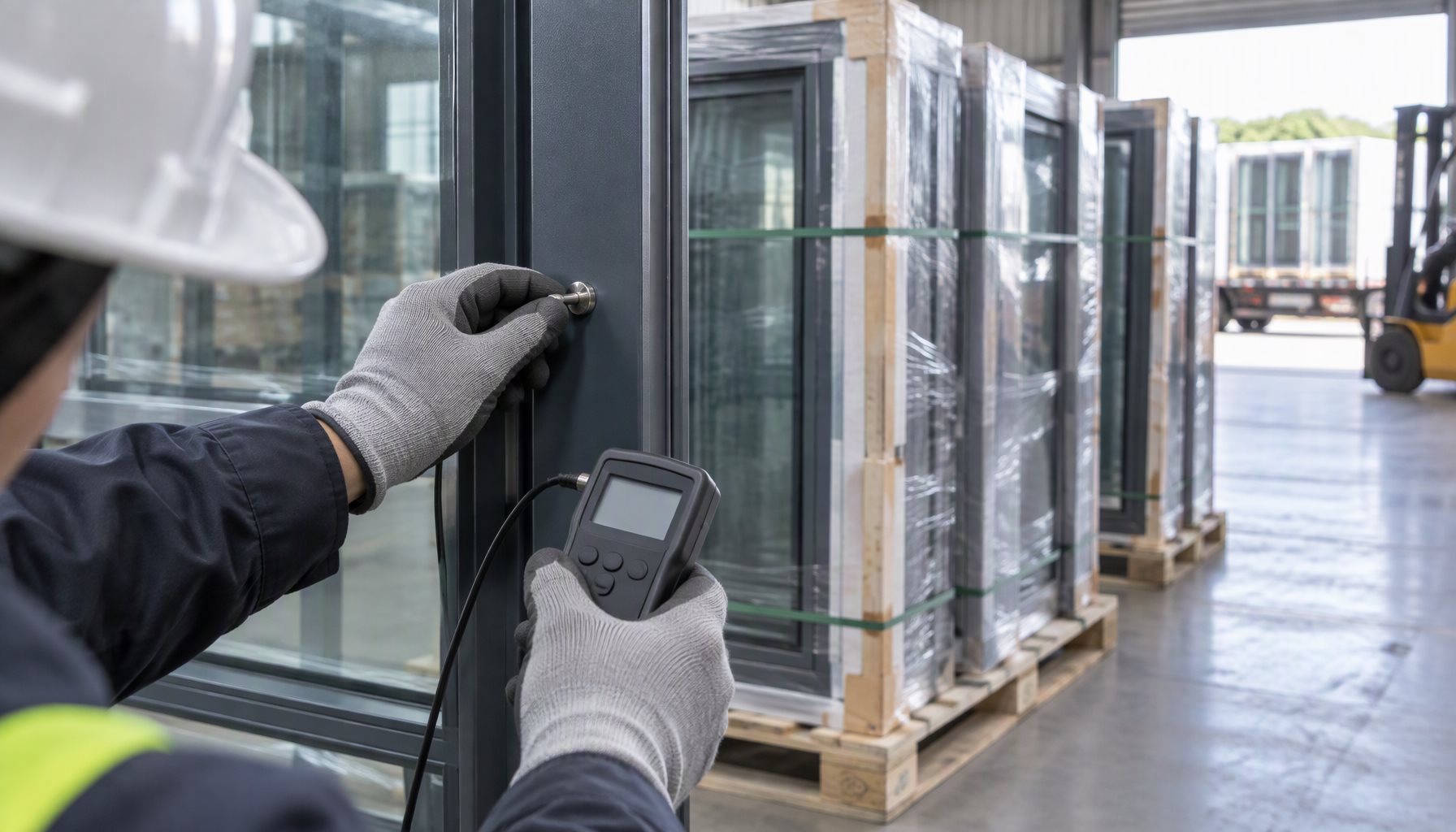
Then verify at your dock: check colour against an approved master under a defined light source, spot-check dry film thickness with your own gauge, run a tape adhesion test on a sacrificial part, and inspect cut ends, fastener holes, and glazing pockets for coverage. Confirm protective film is within its removal window. The same discipline applies on our lines; see quality control.
What to Require on the Purchase Order
Put the following in writing, on the order, not in a brochure:
- The AAMA class stated by name for exterior surfaces, and separately for interior or concealed surfaces.
- The film thickness range in writing, with minimum and maximum, the measurement method, and the sampling frequency.
- The cure verification method: metal temperature, documented, per profile family.
- The pretreatment type (chrome-free or trivalent chrome) and the control parameters that will be recorded.
- A finish certificate per batch, traceable to the powder lot and to the process records.
- The resin family, if the UV exposure on the project justifies naming it.
- A touch-up provision: quantity, batch matching, application instructions, and confirmation that touch-up is cosmetic, not a corrosion repair.
- Handling, packaging, and protective film requirements, including a removal window.
- Test data for the specific product, confirmed against the finish supplier’s test data for the class specified.
Drainage is part of finish durability: specify that frames drain and cut ends are treated or covered, because water standing at a sill will end the finish’s life whatever the class. Then define what the warranty covers. Chalking, colour, adhesion, and corrosion at a scribe are different failures with different thresholds, and a warranty that names none of them is not a durability commitment.
Frequently Asked Questions
How long do powder coated aluminum windows last?
Commonly 15-25 years in a mild inland exposure and 10-15 years in coastal or high-UV conditions, with shorter service in salt spray, industrial fallout, or continuous sun on dark colours. These are typical planning ranges rather than guarantees. Delivered life depends mainly on pretreatment, film thickness, cure, resin family, and the exposure the building actually sees.
Is AAMA 2605 worth the extra cost over AAMA 2604?
On coastal, high-UV, or high-visibility elevations, usually yes, because the class sets a longer exposure basis and tighter colour and gloss retention thresholds. On a sheltered inland project the return is smaller and AAMA 2604 may be adequate. The deciding factor is the UV and chloride dose at the actual elevation, not the building type. Confirm against the finish supplier’s test data for the class specified.
Does a thicker powder coat last longer?
Only up to a point. Adequate thickness protects the substrate, but excess film becomes brittle and fails cohesively, which is why specifications set a maximum as well as a minimum. Thickness also has to be verified in recesses and returns, where electrostatic deposition is weakest.
Can chalking or colour shift be repaired on site?
Not properly. Field touch-up and overcoating are cosmetic, adhesion to a degraded or contaminated film is unreliable, and a repaint will not match the factory finish or restore corrosion protection at cut edges. Where appearance has failed across a facade, recoating or replacing the affected units is the realistic remedy.
How do I know the coater actually achieved the class on my order?
Require process records with the shipment: pretreatment control data, metal temperature cure profiles, dry film thickness readings with the sampling plan, and adhesion results per ASTM D3359 from production. Ask for a finish certificate per batch, traceable to the powder lot. Then spot-check thickness and adhesion yourself on arrival, because a class statement on a quote is a claim, not evidence.
Talk to Us About Finish Specification
If you are specifying powder coated aluminum windows for a North American project, send us the elevations and exposure conditions. We will tell you which AAMA class the project justifies, what the film thickness and cure records will show on your order, and where a lower class is adequate. Contact our export team to start the conversation.