When a project sits near traffic, a rail line or a busy commercial strip, soundproof aluminum windows become a specification decision rather than a comfort extra. The goal is simple to state and easy to get wrong: reduce the sound energy that reaches the interior without giving up daylight, view or the slim sightlines aluminum frames are known for. This guide explains the acoustic mechanism, what a rating actually measures, and how to write a glazing and sealing specification that a fabricator can build and test.
What Soundproofing a Window Actually Means
Sound travels through a window assembly in two ways. Airborne noise passes directly through the glass and any gap around the sash, and structure-borne noise travels through the frame and the wall junction before re-radiating into the room. A quiet assembly has to address both paths at once. Improving only the glass while leaving weak seals, or upgrading seals while keeping a thin single cavity, produces a fraction of the expected benefit.
The performance is usually described with a Sound Transmission Class (STC) rating. STC is a single number derived from laboratory transmission-loss measurements on a specific specimen, and a higher number means less sound passes through that specimen. It is worth being precise here: a value quoted for one tested configuration does not automatically describe every size, glass build-up or installation detail you order. The same distinction between an aluminum frame and the whole window, glass and installation, matters more for acoustics than it does for most other specifications.
Mass, Damping and Decoupling: The Three Levers
Effective sound control on glass comes from three physical strategies, and a good specification uses more than one of them together.
- Mass — heavier glass resists being driven by sound waves. Thicker panes and laminated constructions add mass without adding the same weight as solid glass.
- Damping — the plastic interlayer in laminated glass converts some vibration energy into heat, which flattens the resonant dips that plain annealed glass shows.
- Decoupling — an air cavity and separate panes stop vibration from passing straight through the system, which is why insulated glazing outperforms a single pane of equal total thickness.
The interlayer is what makes laminated glass the acoustic workhorse. If your brief already calls for safety or overhead glazing, laminated glass is often the same product with an acoustic benefit added, and it pairs naturally with the insulated builds described in our Low-E argon glass guide.
Asymmetric Glass Build-Ups
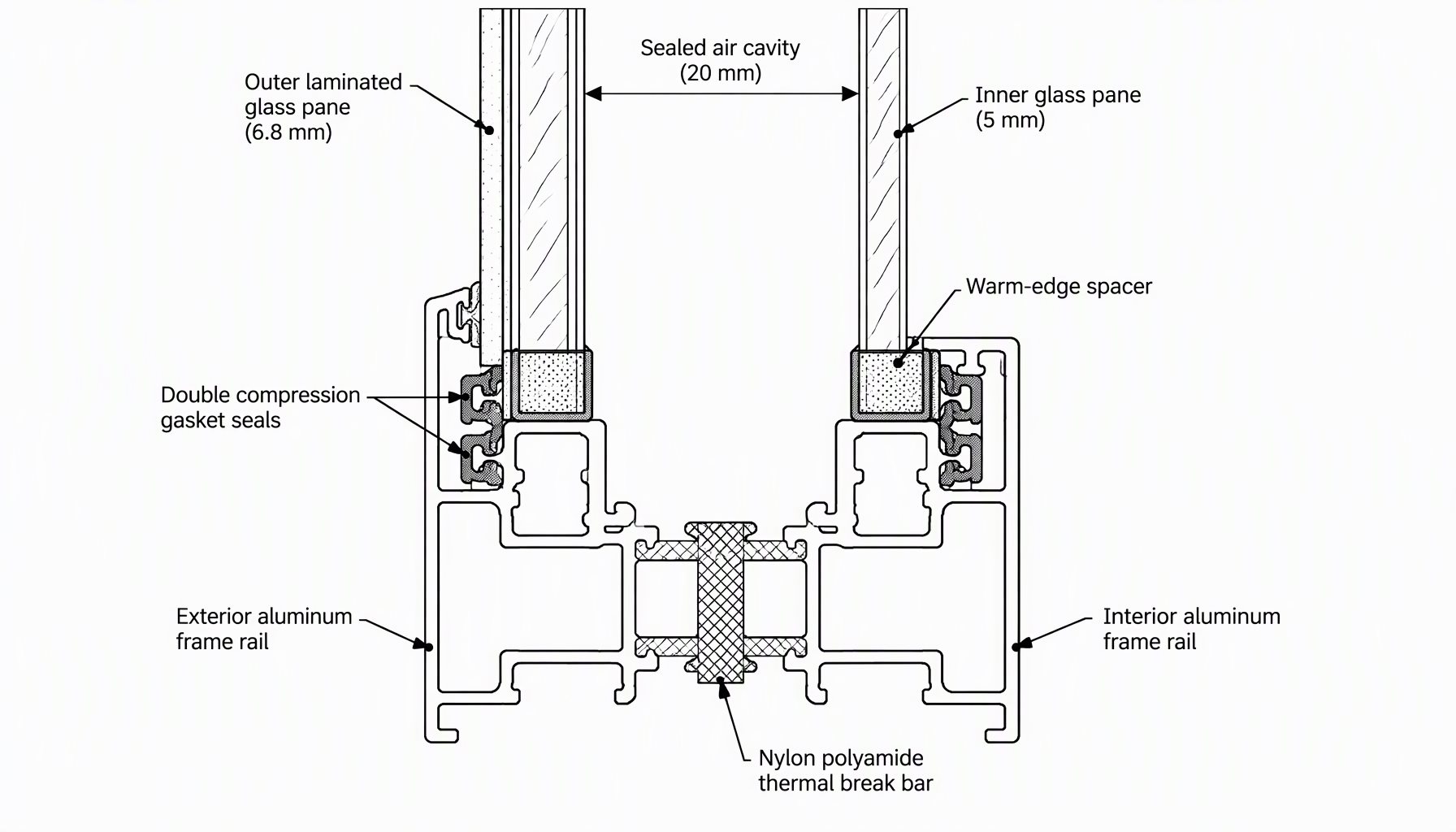
One of the most useful acoustic tricks costs nothing in frame size: make the two panes of an insulated unit different thicknesses. Two identical panes tend to resonate at the same frequencies, so their transmission loss dips line up and sound leaks through those bands together. Using, for example, a thicker laminated outer lite over a thinner inner lite staggers the resonances and smooths the curve. The wider the glass separation and the more the two lites differ, the better the mid-frequency behaviour tends to be — subject to the specific tested configuration.
Double glazing handles most road and general urban noise. When low-frequency sources dominate — plant equipment, bass from traffic, a nearby rail corridor — triple glazing or a wider cavity starts to earn its place. There is no universal answer; the right build-up is the one that a test report ties to your frequency profile.
Why Soundproof Aluminum Windows Fail at the Seals
Acoustic performance is frequently undone at the edges. A compression seal that is under-compressed, a sash that meets the frame with a hard gap, or a perimeter that was shimming-and-caulked on site rather than gasketed can leak more sound than the glass blocks. Aluminum frames suit tight tolerance work, but the seal design and the shop-to-site interface decide the result. Getting soundproof aluminum windows to perform means protecting the perimeter as carefully as the glass itself.
Operating style also matters. A window that compresses its gaskets when closed — such as a casement or tilt-turn — generally holds a better acoustic seal than a sliding sash that relies on brush or interlock seals. That trade-off is a common reason we steer noise-sensitive projects toward the operable styles covered in our aluminum window types guide rather than large sliders.
Acoustics, Thermal Performance and the Label
Buyers often conflate the two because the same laminated, argon-filled, low-E unit can be doing acoustic and energy work at once. They are, however, separate measurements run under separate procedures. An NFRC label reports thermal and optical performance — U-factor, SHGC, visible transmittance — not an STC number. Whole-window thermal behaviour is explained in our aluminum windows energy efficiency and thermal break windows pieces; a sound rating has to come from acoustic test documentation for the exact assembly.
The rating itself is set through standardized laboratory test methods that the wider fenestration industry documents, and body and field performance can differ once installation is included. This is the same caution that applies to the door counterpart — if you are specifying a soundproof sliding glass door, the meeting stile and track are the usual weak points in ways a fixed sash is not.

How to Specify: A Decision Matrix
The table below frames the common noise scenarios against a defensible starting specification. Each is a direction to test, not a guaranteed rating.
| Project Requirement | Recommended Choice | Why |
|---|---|---|
| General road and urban traffic | Laminated outer lite + asymmetric double glazing, warm-edge spacer | Mass plus damping plus a staggered resonance beats equal-thickness double glazing at the same frame size |
| Low-frequency plant, rail or heavy traffic | Wider cavity or triple glazing with two laminated lites | Low frequencies are the hardest band; cavity depth and a second laminated lite extend the useful range |
| Tight sightlines with moderate noise | Single slim laminated unit with high-performance seals | Keeps the aluminum profile narrow while adding damping; accepts a moderate acoustic target |
| Max quiet where space allows | Asymmetric insulated unit, compressing casement or tilt-turn sash | Combines glass strategy with a gasket that closes tight instead of a sliding interlock |
What a Test Report Has to Prove
When a supplier offers an STC figure, read it as a claim about a specimen, not about your order. The report should name the test method, state the specimen size and build-up, and show whether the number is a laboratory (field-measured) rating. The industry test standards behind these figures — the E90 measurement family and the E413 single-number rating, published by ASTM — define how the curve becomes a single STC. The fenestration technical resources from FGIA and the rating-program documentation at NFRC explain the wider performance-certification framework these numbers sit inside.
Energy and comfort programs such as ENERGY STAR certified windows are a useful parallel: they show how a rating always describes a specific tested configuration, not the category name. Bring the same discipline to acoustics and ask for the report that matches the exact glass and seal you are ordering.
Frequently Asked Questions
Do soundproof aluminum windows really reduce traffic noise?
Yes, when the glass, cavity and seals are designed together. A properly specified assembly with laminated, asymmetric insulated glazing and compression seals can measurably cut the airborne noise that reaches the room, provided installation does not introduce flanking paths.
Is a higher STC number always better for my project?
STC is a useful comparison, but it is weighted toward mid and high frequencies and can flatter performance against low-frequency sources. Judge the rating against the specific noise spectrum you are dealing with, not as a single scoreboard.
Does laminated glass make the biggest difference?
For most urban noise, yes — the damping interlayer flattens resonance dips that plain glass has. Pairing it with a different-thickness inner lite is usually the next most cost-effective change.
Are double or triple glazed units quieter?
Not automatically. A well-built asymmetric double unit with a wide cavity can beat a poorly spaced triple unit. Cavity width, pane asymmetry and lamination matter more than pane count alone.
Do sliding aluminum windows block sound as well as casements?
Usually not. Sliders rely on interlock and brush seals, while a compressing casement or tilt-turn closes its gasket against the frame. Where noise is severe, operable compression styles tend to outperform sliders of the same glass.
Will thicker glass alone solve a noise problem?
Thicker single glass helps only modestly because of the mass-air-mass effect. Damping and decoupling — lamination and a proper cavity — deliver far more per unit of weight and cost.
Does the NFRC energy label tell me the sound rating?
No. The NFRC label reports thermal and optical data. An acoustic STC value must come from a separate acoustic test report for the exact assembly you are specifying.
Specify the Quiet You Actually Need
Sound control rewards a specific, testable brief. Send your project location, the noise sources you are targeting, your preferred frame size and sightline, and any energy requirements, and the Lansen team can review a glass build-up, seal design and operable style that meets them before production.
Send your drawings to our engineering team for an acoustic and thermal glazing review.