Part of our door specification series — see the full sliding glass doors specs guide.
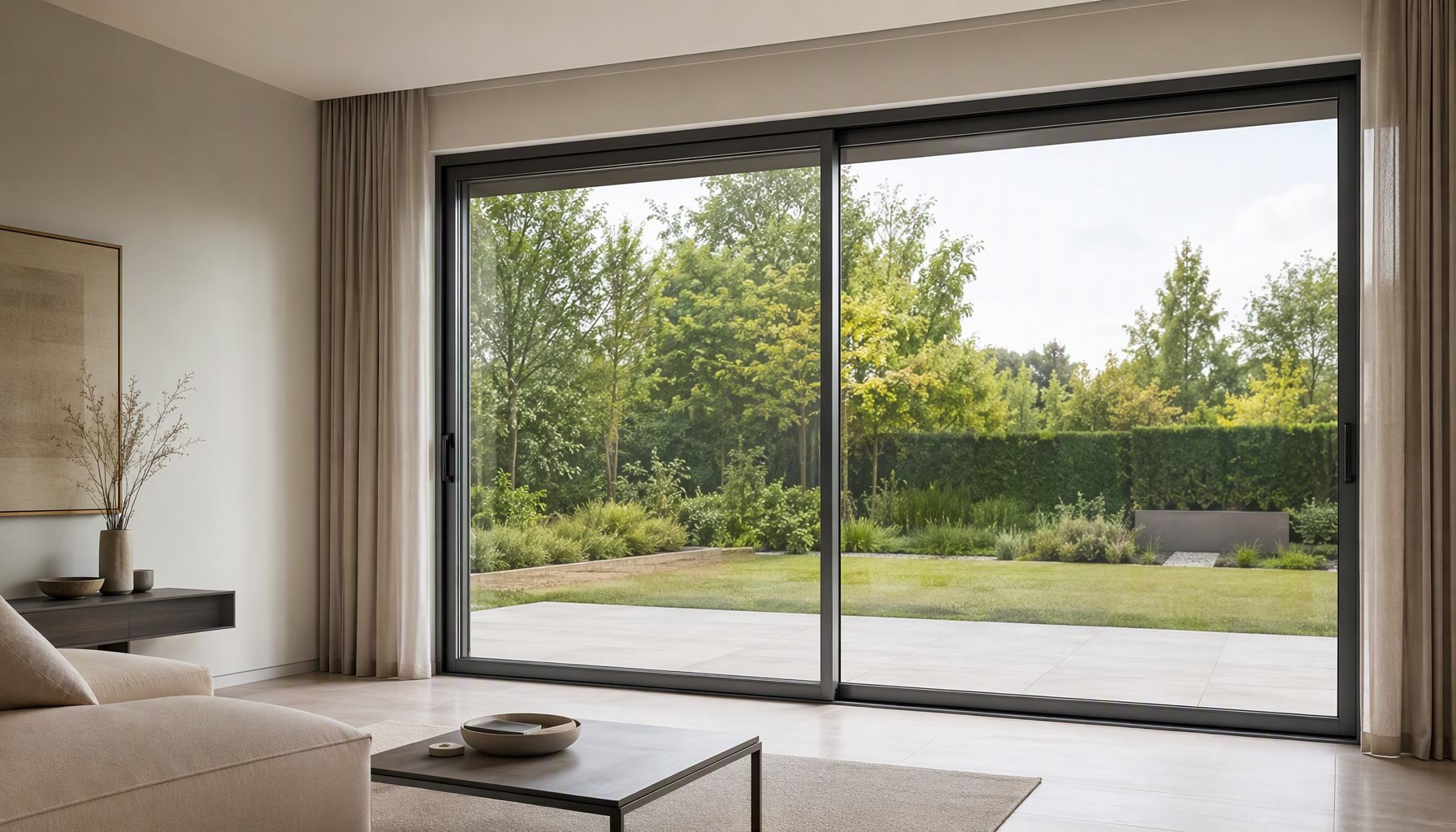
A soundproof sliding glass door is a genuine engineering challenge, not a product you can buy off a shelf by asking for a higher STC number. The sliding format is the least airtight of the common door types: one panel must move, so the meeting stile can never be fully compressed, and the panel rides in an open track. Reducing noise transfer means attacking each of those paths deliberately — glazing mass, cavity asymmetry, seals, and installation quality — in that order of leverage.

This guide explains why sliding doors leak sound, which measures actually change the result, and how to write a specification that a manufacturer can price and test against.
Quick Summary
| Question | Short answer |
|---|---|
| Why do sliders transmit more noise? | Moving panels need clearance; gaps and the track are flanking paths |
| What helps most? | Laminated glass, asymmetric IGU build-up, quality seals, tight installation |
| Does thicker glass alone fix it? | No — mass helps, but coincidence dips and gaps limit monolithic panes |
| How is performance expressed? | STC from lab tests (ASTM E90); field performance is measured per E413 |
| Biggest spec risk? | Assuming a lab rating survives a poor site installation |
Why sliding glass doors are the weak point in the wall
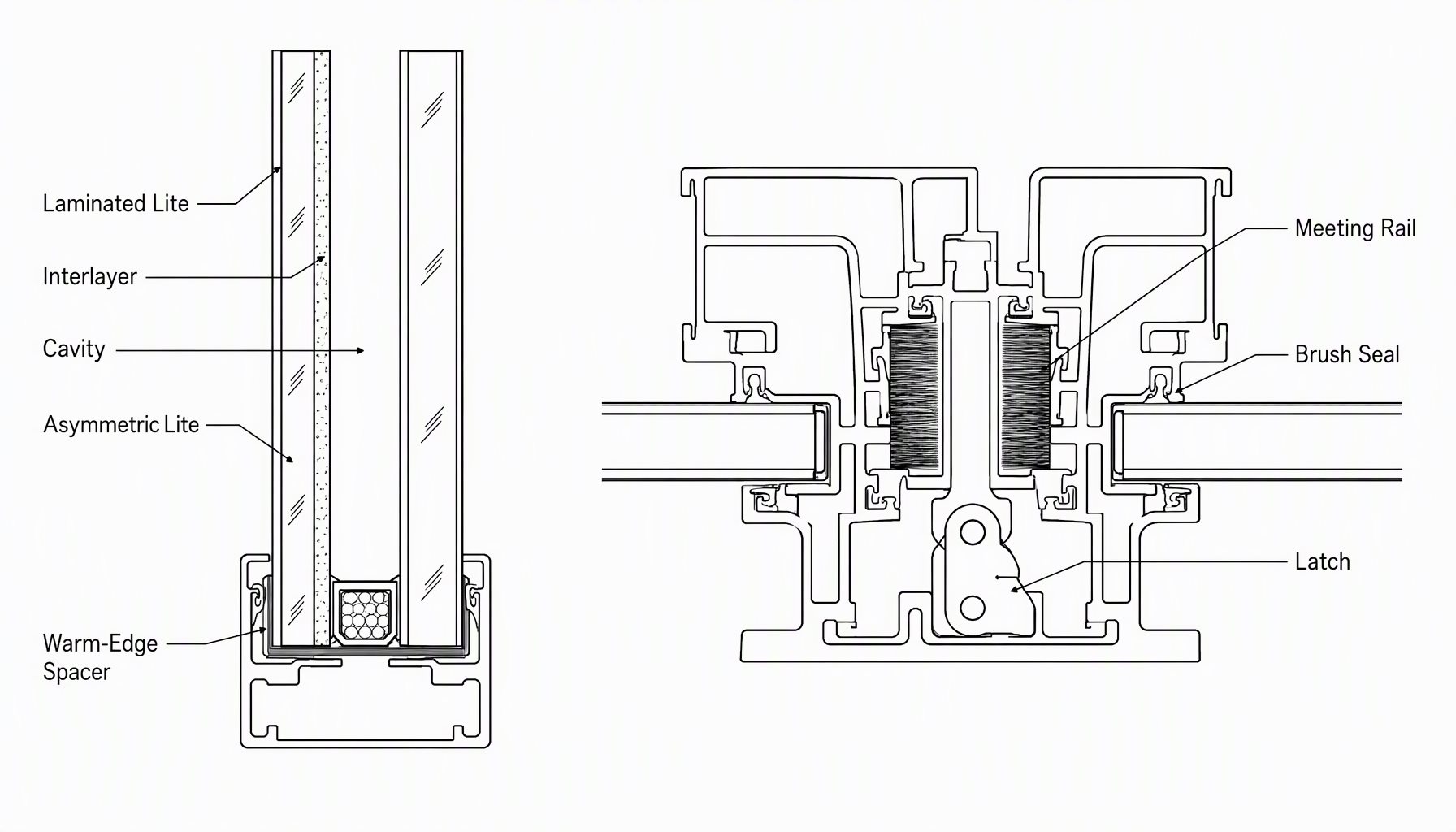
Sound travels through the path of least resistance, and a sliding door is built from such paths. The fixed panel can be gasketed like a window, but the operating panel has to glide, which means brush piles instead of compression gaskets, a meeting rail that closes with a latch rather than full perimeter compression, and a track at the bottom that is inherently an open channel. Even a well-made slider admits some air — and wherever air moves freely, sound follows.
Glazing makes the second half of the problem. Sliding doors use large, thin panes, and large light glass panels resonate more easily than smaller ones. A single monolithic lite transmits mid-frequency traffic noise efficiently around its coincidence range, which is why simply asking for “more glass” is not a strategy.
What actually reduces sound transfer
Four levers, roughly in order of impact:
- Laminated glass. The plastic interlayer in laminated glazing damps panel vibration and cuts the coincidence dip that plain annealed glass suffers in the frequencies where traffic and voices live. It is the single most effective glazing change for a door like this.
- Asymmetric cavity build-up. In an insulating glass unit, two lites of different thicknesses resonate at different frequencies, so the weaker panel’s transmission is not reinforced by the stronger one. A common acoustic arrangement pairs a laminated lite with a thicker annealed lite and a wide air or gas cavity.
- Seals and closure. Fresh, dense brush piles, a well-adjusted latch that pulls the sash into its stops, and correctly seated weep covers shrink the gap paths. On an older installation, seal replacement alone can be noticeable — the same logic behind fixing drafty aluminum frames, because draft paths are sound paths.
- Installation quality. A perfectly rated door installed with under-packed, gapped, or unsealed frame-to-wall joints will underperform its rating. The perimeter detail is part of the acoustic assembly, not a separate trade.
Rating language a buyer should insist on
Acoustic performance is quoted as STC (sound transmission class), derived from laboratory tests following ASTM E90, with field measurement of installed assemblies covered by ASTM E413. Three rules keep those numbers honest:
- A lab STC belongs to the tested specimen — its size, glass build-up, and hardware. It is evidence of the design’s behavior, not a guarantee for every configuration on your drawing.
- Field performance is typically lower than lab performance because of flanking paths through the surrounding wall. Two identical doors can give different results in different walls.
- Energy labels are not acoustic labels. The NFRC certification program rates thermal and optical properties; sound transmission is not on that label, so request acoustic test documentation separately.
Ask the supplier to state the build-up the rating was measured on. A quote that says “STC 32 door” without naming glass thickness, laminate, cavity, and seals is a marketing sentence, not a specification.
Where sliding doors sit against other formats
If the acoustic target is aggressive and the opening is on a busy road, it is worth asking whether the slide is the right format at all. Hinged and sliding alternatives trade views and motion differently:
| Door format | Acoustic character | Trade-off |
|---|---|---|
| Sliding (2 or 3 track) | Brush-sealed gaps limit peak performance | Best space economy and clear floor |
| Lift-slide doors | Panel compresses onto gaskets when closed | Hardware cost and heavier operation |
| Folding (bi-fold) | Multiple meeting stiles create multiple paths | Open-wall living, see our bi-fold guide |
| Fixed + one slider | Fixed lite is as good as the wall around it | Half the opening stops moving |
Our standard sliding door sizes reference covers which openings suit which format before acoustics even enter the discussion.
Decision guide: specifying for a quiet result
| Project Requirement | Recommended Choice | Why |
|---|---|---|
| Moderate street noise, residential slider | Laminated lite + asymmetric IGU, quality brush seals | Attacks the two dominant paths at once |
| High noise (arterial road, rail) | Lift-slide or fixed-plus-slider hybrid with laminated IGU | Compression closure beats brush piles |
| Existing door, budget-limited retrofit | Seal replacement, latch adjustment, perimeter re-caulk | Cheapest real gain; gaps are the weak link |
| Audited acoustic target for a project | Specify the tested build-up, require field testing per E413 | Lab data alone does not prove the installed wall |
| Warm climate with noise + heat | Laminated low-E IGU sized for both goals | See our Low-E argon glass guide for the thermal half |
For whole-building context, the aluminum window and door hub links glazing, style, and performance guides in one cluster.
Frequently asked questions
Can a soundproof sliding glass door work as well as a hinged one?
A lift-slide can approach hinged performance because its panel compresses onto gaskets when closed. A standard two-track slider, which relies on brush piles, will usually fall short of an equivalently glazed hinged door.
Is a wider air cavity always better for sound?
Up to a point — deeper cavities help low frequencies, but the gain depends on glass thicknesses and the laminate. Diminishing returns arrive quickly, and frame depth is finite.
Does laminated glass also help with heat and UV?
Yes, it blocks a share of solar heat gain and most UV, but it is not a substitute for a low-E coating. For combined thermal and acoustic goals, specify both in one build-up.
What STC should a soundproof sliding glass door target?
It depends on the source and the wall around it. Traffic noise demands attention to low frequencies, which no glazing fully eliminates. Set the target from a site measurement, then ask suppliers for tested evidence on that configuration.
Why does my quiet door still let in noise through the wall?
Flanking. Sound arrives through studs, shared cavities, ducts, and the gap between frame and masonry. Treating only the door leaves the rest of the path intact.
Are triple-glazed units worth it for noise?
Not automatically. Asymmetry and laminate usually do more than the third pane. A well-built double unit with a laminated lite can outperform a symmetric triple unit.
Can I improve an existing sliding door without replacing it?
Yes: replace worn brush piles, adjust the latch so the sash pulls into its stops, seal the frame-to-wall perimeter, and cover the track path. If the existing glass is a thin symmetric IGU, a glazed-unit swap is the next step.
Specify the quiet door your project needs
Send your opening dimensions, the noise conditions on site, and the performance target your consultant set. Our team can review the glass build-up, seal scheme, and format — lift-slide versus slider — before you commit to a quote. Start at contact and we will respond with a specification-level review.