Tag: low-e-glass

Posts about low e glass on Lansen aluminum windows and doors.

  • Privacy Glass Windows: Frosted, Reeded, Frit, Film

    Privacy Glass Windows: Frosted, Reeded, Frit, Film

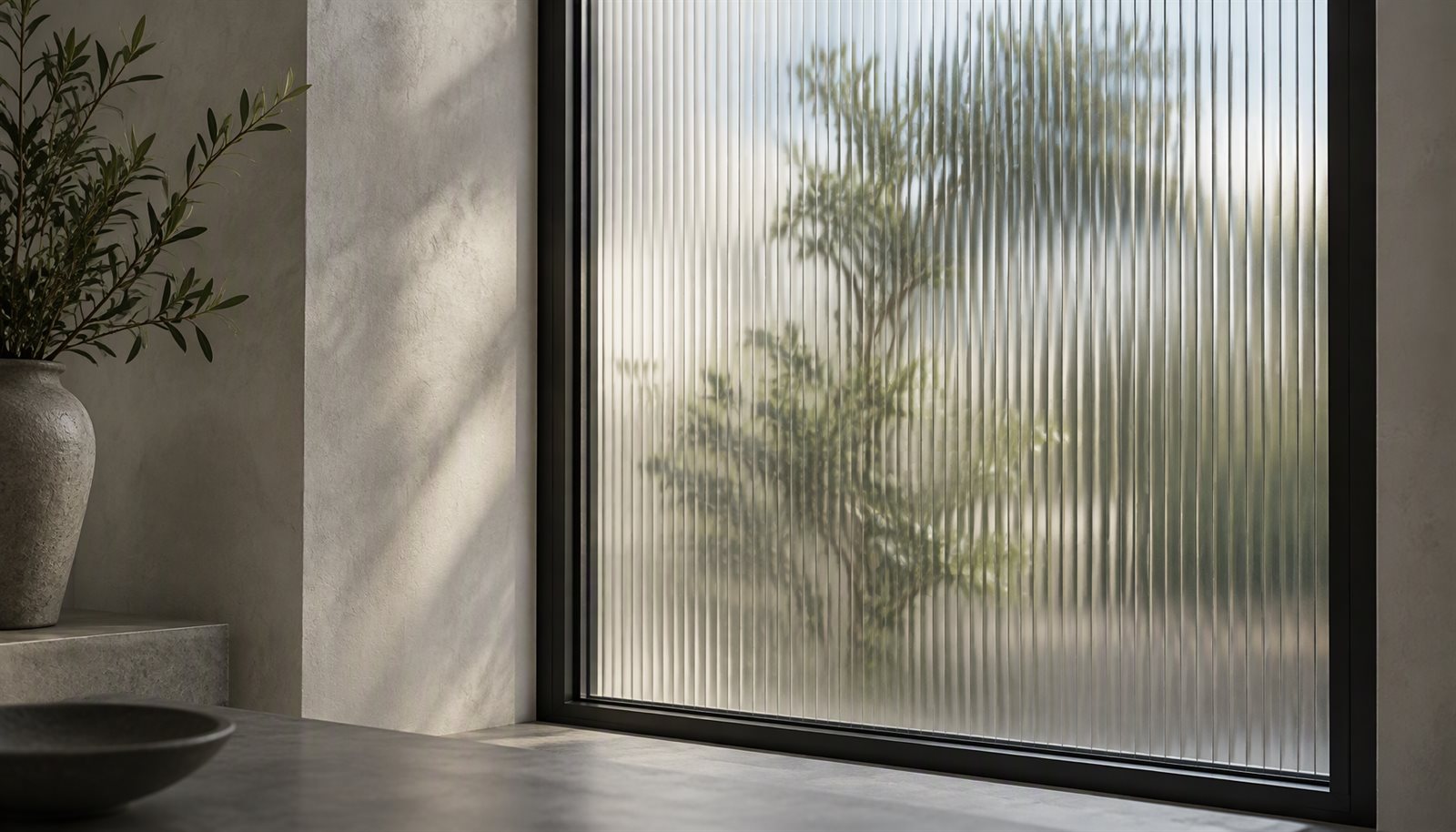
    Privacy glass windows with reeded patterned glazing set in a dark aluminum frame

    What Privacy Glass Windows Actually Block

    Privacy glass windows are glazed so that a viewer on the other side cannot resolve detail through them. That is the whole mechanism: not a barrier, but a loss of resolution. Obscured glazing stops the eye from forming an image, and everything else follows from that — how far away the observer stands, how much light falls on each side of the glass, and whether the surface scatters light uniformly or in a pattern.

    Because privacy glass windows work by an optical mechanism rather than a physical one, the specification has to be honest about what privacy glazing does not do. It does not make the unit safer, it does not change its thermal rating by itself, and it does not add acoustic mass. The glass-selection logic for a facade — vision glass versus opaque panels, build-up ladders by zone — is developed for curtain walls in curtain wall glazing selection; this article stays on the residential and light-commercial window case, where the question is usually one or two elevations rather than a whole skin.

    Four Ways to Make Glass Obscure, and What Each Costs
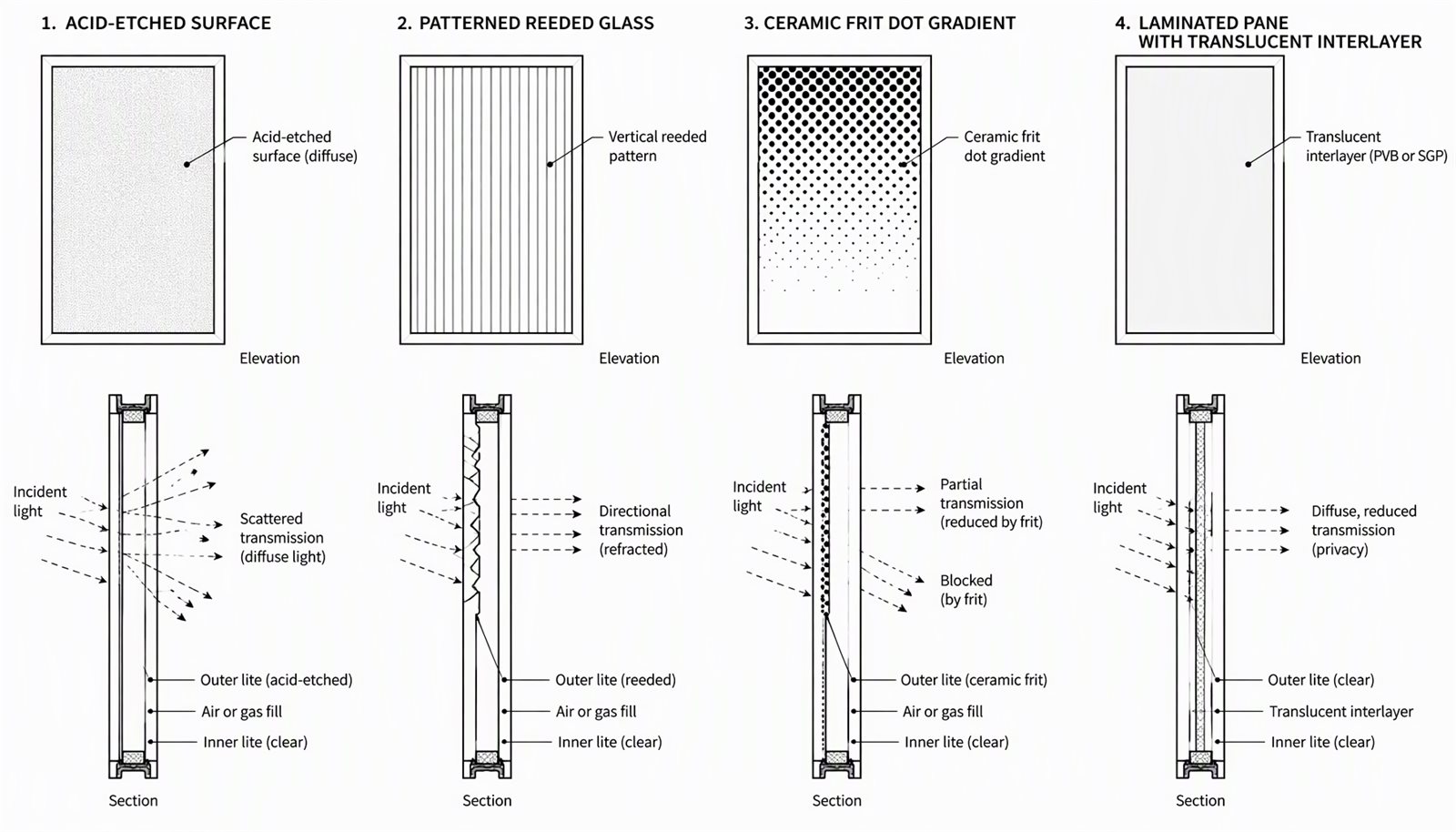
    Four privacy glass options compared in elevation and section: acid-etched, patterned reeded, ceramic frit gradient and translucent laminated interlayer

    Surface texture is the first family. Acid-etched or sandblasted glass scatters light across the whole pane, which gives even obscurity at every viewing distance and a soft, uniform daylight. Patterned rolled glass does the same job with a formed surface — reeded or fluted — and trades evenness for a directional blur that distorts shapes while still letting light through at an angle.

    Applied coatings are the second family. A frosted film is bonded or applied to the interior face of the pane; it is reversible, it can be replaced, and its life depends on the adhesive and the UV load it sees. Reflective and mirrored films are the same category with a different effect: they do not obscure by scattering, they work on a light differential, which means they behave well in daylight and poorly at night when the interior is lit and the exterior is dark.

    Ceramic frit is the third family. A fired-on enamel pattern, usually a dot or gradient, blocks detail where the frit is dense and leaves clear glass where it is not. It is durable because it is fired into the surface, and the same technology is what makes opaque spandrel glass read as a solid panel — the definition and build-up of that material is in spandrel glass detail.

    Laminated interlayers are the fourth. A white or translucent interlayer inside a laminated pane obscures the view while the glass surfaces stay smooth and cleanable, which solves the fingerprint problem that an exterior-etched bathroom window has. This family also carries the safety and hold-in-frame behavior of laminated glass, which the other three do not automatically provide.

    MethodWhat it is strong atWhat it gives up
    Etched or sandblasted surfaceEven obscurity, soft uniform daylightOil marks show, and the surface cannot be locally repaired
    Patterned reeded or fluted glassDirectional blur with high light transmissionDistorts the view rather than removing it; read the pattern at distance
    Frosted or reflective filmReversible, low cost to change, works on existing glassAdhesive and UV life; differential films reverse at night
    Ceramic frit patternFired durability, designed gradient and cut-offReduces transmitted light where the pattern is dense
    Translucent laminated interlayerSmooth cleanable surfaces, retains laminated behaviorCost and weight of a laminated build-up

    Daylight, View and the Trade You Are Making

    Every obscuring method changes how much light arrives and how much of the outside is still legible; the two move independently. Window properties are one part of the opaque-envelope trade-off, and a privacy glazing shifts that balance on the elevation where it is used. A reeded pane can pass nearly as much light as clear glass while resolving nothing. A dense frit gradient passes little light in the band where it is printed. A frosted surface scatters, which reduces how much light reaches the deep part of a room even when the total transmission looks acceptable.

    Where the project has a daylight requirement, the number to read is visible transmittance on the residential rating label, which is produced for the rated configuration of the whole product — so an obscure glass change is a configuration change, and the label that was submitted has to belong to the unit that ships. The solar side of that same label is discussed in low-E argon glass, because a privacy glazing that also has to earn its keep on a hot elevation is a different order than a frosted bathroom pane.

    Durability, Cleaning and the Surface That Gets Touched

    Obscured glass fails in the hand, not the weather. An etched or sandblasted exterior surface in a bathroom or a pool enclosure collects skin oil and cleaning residue in its microtexture, and once that staining sets it cannot be polished out without changing the appearance of the pane. Patterned glass puts the texture on one face, so specifying which face the pattern sits on — inside the insulated unit or out — decides whether the texture is protected behind a sealed cavity or exposed to the hose.

    Film-based privacy is the reverse case: the glass is untouched, and the film is the wear layer. Edge lift, adhesive yellowing and cleaning-agent damage are all film failures on a sound pane, which is why a film specification belongs with a stated replacement interval in the maintenance documentation rather than hidden in a finish note. Frame finishes at the same opening have their own field-care rules, covered in painting aluminum window frames.
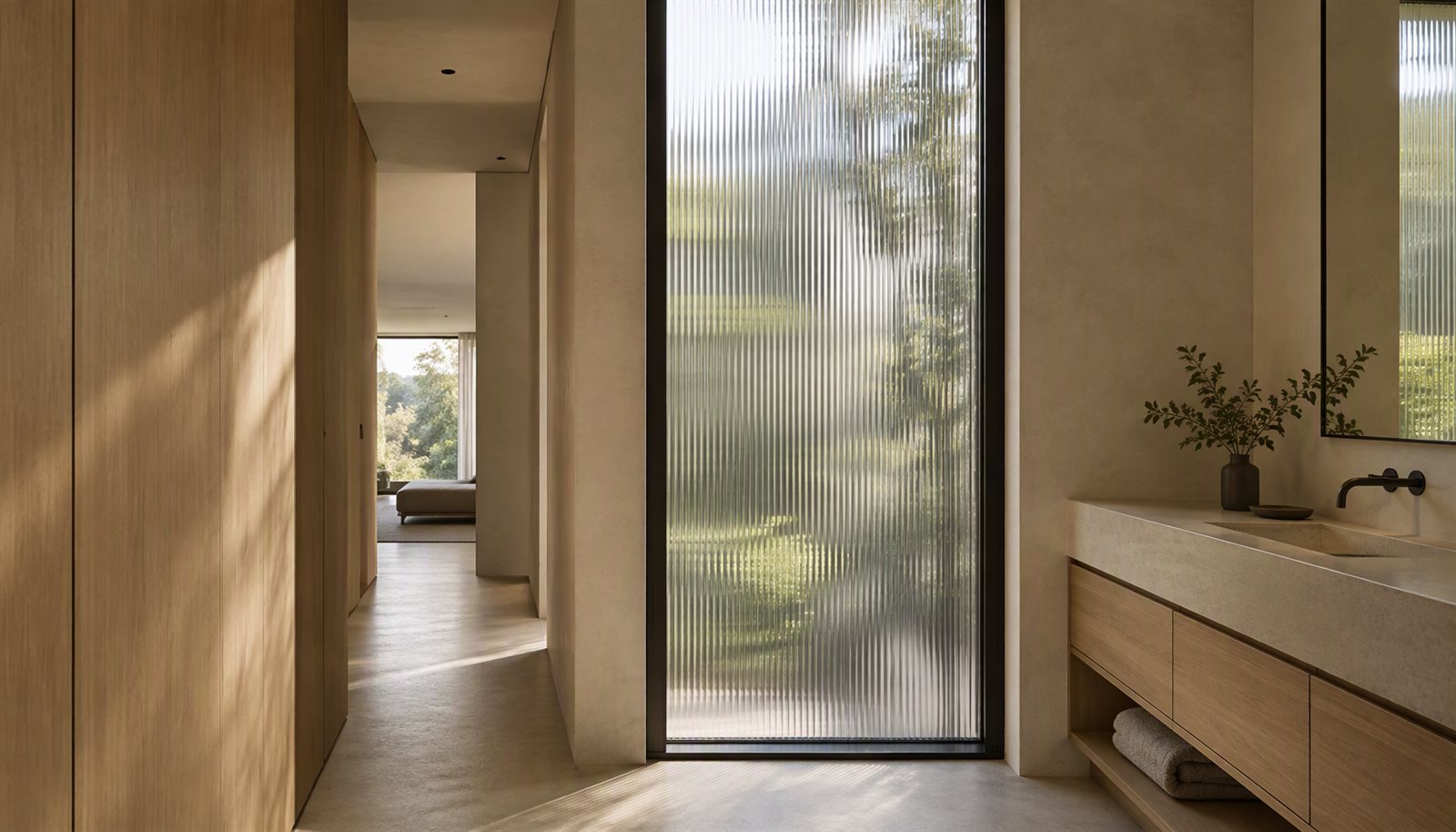
    Reeded privacy glass window lighting a bathroom corridor while screening the garden view

    What Obscured Glazing Does Not Change

    Privacy does not change the code status of the opening. A bedroom window that serves as an emergency escape and rescue opening still has to meet the residential code’s clear opening, height and operating requirements whatever is on the glass, and the glazing-location rules that decide where tempered or laminated glass is required are read from the same document — the building-planning chapter of the International Residential Code — not from the privacy finish. Similarly, a frosted pane in a door sidelight does not become a fire-rated or forced-entry assembly because it hides the view.

    Acoustics follow the same logic. Sound isolation comes from mass, damping and a sealed assembly, which is why the acoustic specification is treated in soundproof aluminum windows and not assumed here. A translucent laminated interlayer happens to add damping, so it can contribute — but a film on a clear pane does not make a quiet window.

    What to Specify: Decision Matrix

    Project RequirementRecommended ChoiceWhy
    Street-facing ground floor, view out still wantedReeded or fluted patterned glass, one elevation onlyPasses light and blurs detail instead of deleting the view
    Bathroom or pool enclosure with heavy contactTranslucent laminated interlayer with smooth facesTexture stays out of the room side and cleaning does not fight the surface
    Existing installation, reversible requirementFrosted film with a documented replacement intervalThe pane is untouched and the specification can be walked back
    Privacy band with daylight kept above itCeramic frit gradientFired durability and a designed cut-off height rather than a whole frosted pane
    Privacy that switches with occupancySwitchable laminated interlayerClear-to-opaque on demand; requires power and a stated default state
    Grid appearance as well as obscurationGrilles between the glass with a frosted pane behindDivided-light look without a surface that has to be cleaned between bars

    Privacy Glass Windows Questions

    Are privacy glass windows the same as frosted glass?

    Not exactly. Frosted is one method — a scattered surface. Privacy glazing also covers patterned glass, film, ceramic frit and a translucent interlayer inside a laminated pane, and each behaves differently at distance, at night and under cleaning.

    Does obscured glass still let in daylight?

    Usually yes, and in some patterns almost fully. What drops is resolution, not necessarily quantity; the number that tells you the difference is visible transmittance on the rating label for the configuration ordered.

    Why does my one-way mirror film stop working at night?

    Because it never obscured anything — it relied on the brighter side being the reflecting side. When the interior is lit and the exterior is dark, the differential reverses and the effect inverts. Scattering methods do not have that failure.

    Can frosted glass be cleaned without marking it?

    With the right products, yes, but an exterior-etched surface in a contact-heavy location will mark. Specifying which face carries the texture, or moving the texture into an interlayer or the cavity, is the durable answer.

    Does a privacy glazing change the window’s energy rating?

    It changes the configuration, so the rated value has to be re-issued for what ships. A frit or a translucent interlayer affects transmitted light and can shift the whole-product values; the thermal and solar behavior of the glass build-up itself is what the label documents.

    Is switchable privacy glass worth it?

    Where an opening genuinely needs both states and the power can be run to the frame, it works well and the specification question is the default failure state, not the concept. Where the need is one static elevation, a laminated interlayer or frit is simpler and cheaper over the life of the unit.

    Do divided lights give privacy?

    Only visually, and only a little. Grilles break up the image but do not scatter light; if the goal is obscuration, the pane behind the grid still has to be specified for it. The grid types themselves are covered in Tudor windows.

    Send the Elevation, Not Just the Glass Note

    Lansen specifies obscured glazing into thermally broken aluminum window systems: patterned and etched panes, fired frit gradients, translucent laminated interlayers and switchable build-ups, with the rating re-issued for the configuration that ships. Send the elevations where privacy is required, the room side and face the texture should sit on, and the daylight you are trying to keep, and we will review the glass build-up against the frame and hardware before production. See the range at our window hub or send drawings through the contact page.
  • Curtain Wall Glazing: How to Choose the Glass

    Curtain Wall Glazing: How to Choose the Glass

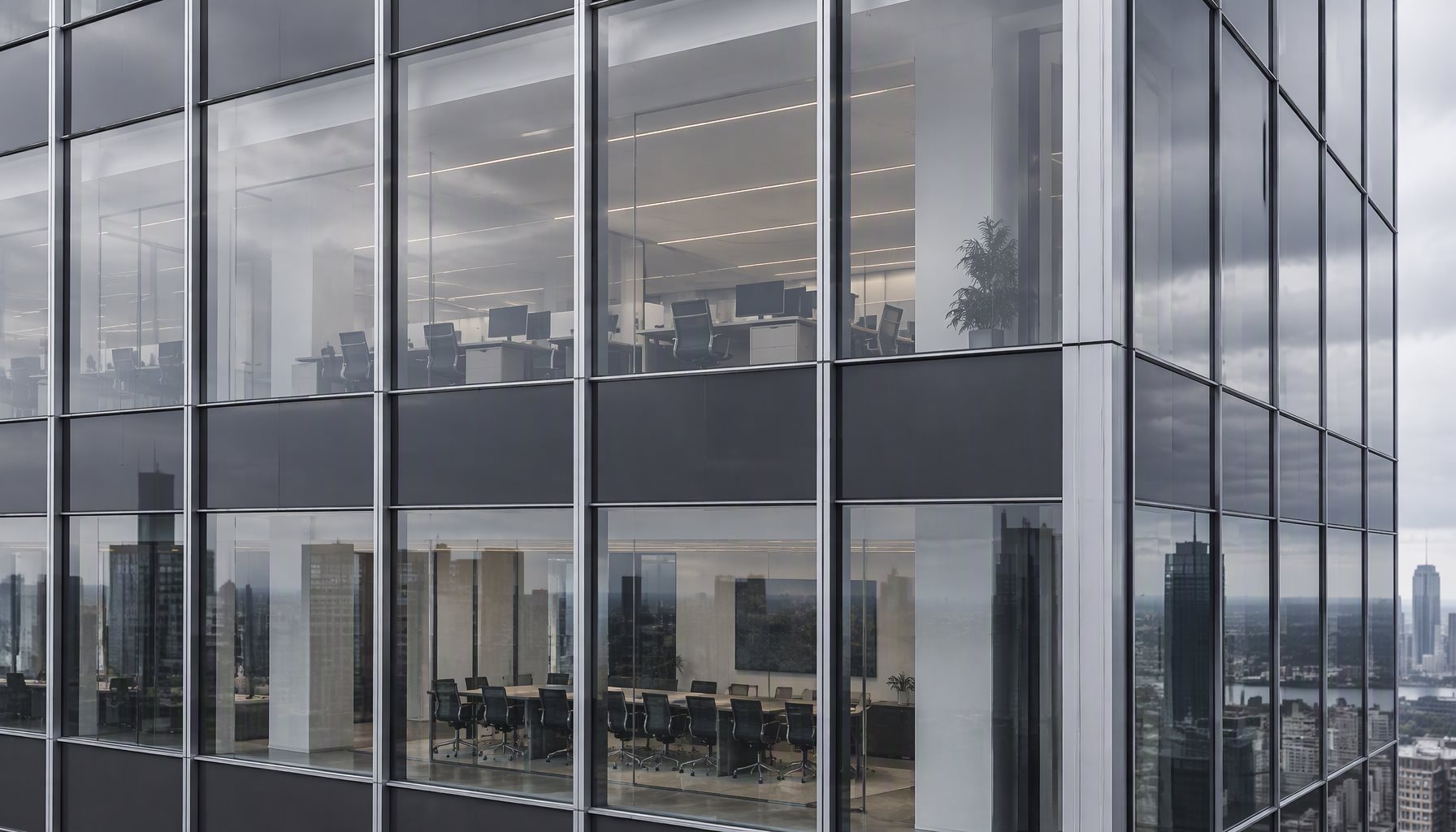
    Curtain wall glazing is rarely one decision. A single facade can carry insulated vision units at the occupied band, opaque glass behind the slab edge, and a different tint or build-up on the tower face than on the podium. Treating glazing as one building-wide choice is how projects end up with a glass package that is either over-specified on cost or under-performing on energy, solar gain, and appearance. This guide walks through the actual selection sequence: build-up first, then thermal and solar properties, then the opaque zones, then a plan by elevation.

    Curtain wall glazing with clear vision glass and opaque spandrel bands on a commercial facade

    Glazing Decisions Start Zone by Zone

    Before comparing coatings or tints, split the elevation into functional zones. The three that drive most of the specification are:

    • Vision zones: glass at occupied floor levels where people look out. Safety build-up, view clarity, and solar control all apply here.
    • Spandrel zones: glass (or metal panels) that hide slab edges, floor decks, and mechanical runs between the sill of one floor and the head of the next. The backing is opaque, so the decision is about appearance and alignment, not daylight.
    • Roof and soffit glazing: overhead or sloped units where safety-glazing requirements and water exposure differ from vertical walls.

    Each zone gets its own build-up, and the schedule should say so line by line. For the framing and system families that these units mount into, see our overview of aluminum curtain wall system types; this post stays on the glass itself. The distinction also matters for code: safety glazing requirements depend on location, orientation, and applicable code, so confirm against the current ICC code text rather than assuming monolithic glass is acceptable anywhere.

    Vision Glass Build-Ups and What Each One Controls

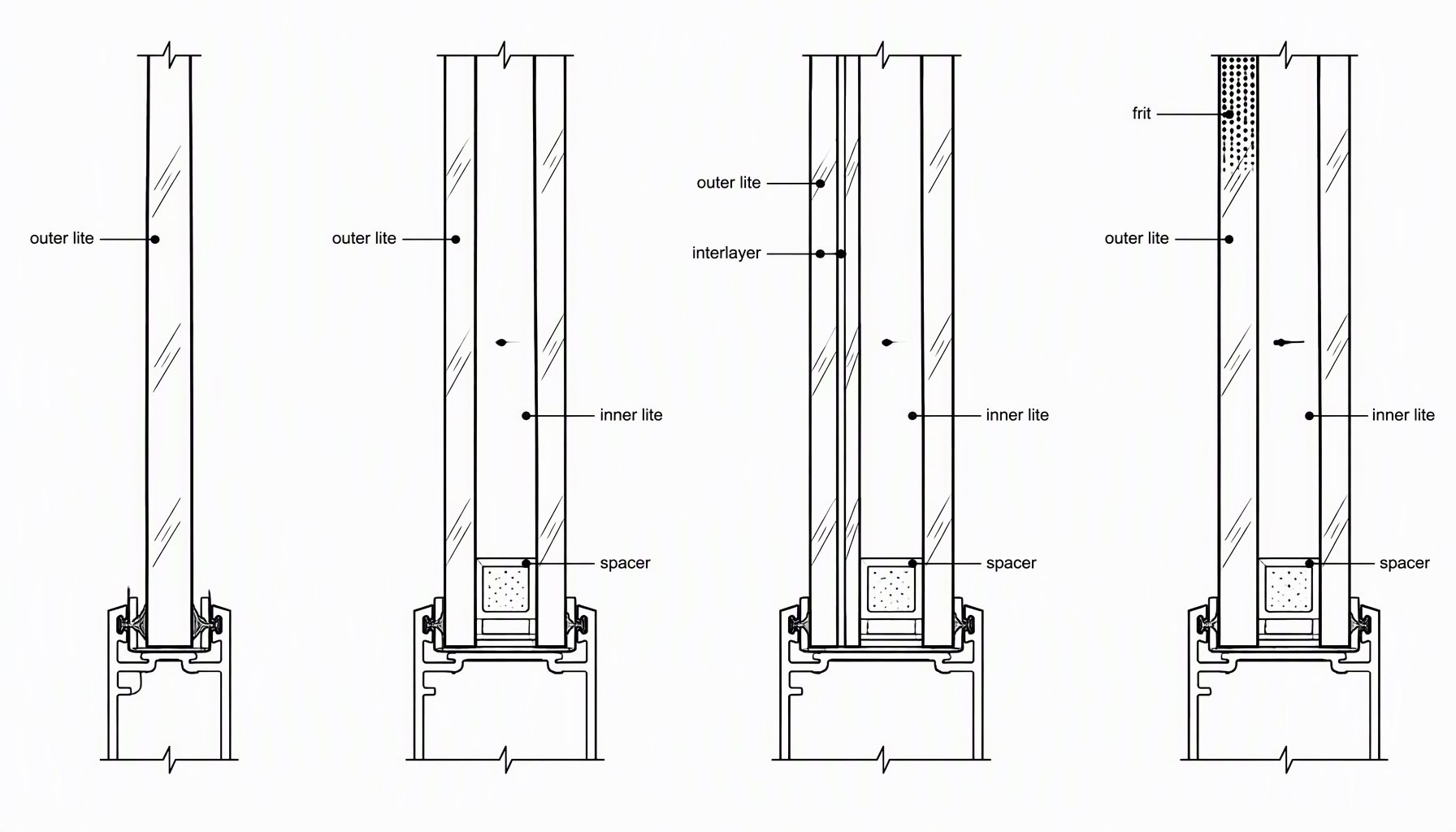
    A vision unit is assembled from a small set of building blocks: tempered glass, laminated glass, insulating glass units (IGUs), warm-edge spacers, and low-emissivity coatings. Most North American curtain wall jobs land on one of four common configurations.

    Build-upWhat it controlsWatch-outs
    Double IGU with one low-E coatingThe default vision spec: sets whole-assembly U-factor and SHGC togetherGet the full configuration (coating number, cavity gas, spacer) on the schedule; performance claims from a different build-up do not transfer
    Laminated IGU (laminated outboard lite + clear or coated inboard lite)Overhead positions, security and fallout protection, sound dampingEdge exposure and weep detail must match the thicker stack; check hardware and pocket depth early
    Monolithic tempered or heat-strengthened glassLowest-cost vision infill where codes and project risk allow itTempered glass can still break and fall; rarely appropriate for overhead glazing without a laminated construction
    Tinted or patterned IGU (bronze, gray, extra-clear, fritted)Exterior appearance, glare reduction, transmittance targetTints reduce daylight along with solar gain; interior brightness suffers in low-orientation elevations

    The thermal mechanics behind these numbers – why frame, glass, and whole-assembly values are different measures – are covered in our aluminum window U-factor guide, and coating and gas fill behavior in the Low-E argon glass explainer. For a curtain wall, read those two as prerequisites; this post is about which configuration to schedule where.

    The glazing label is not a single verdict: an assembly carries separate rated numbers for U-factor and SHGC, and the rating covers the whole assembly, not just the glass. NFRC publishes the rating and label program most North American projects rely on; a quoted value without a rated or calculated configuration behind it is a marketing number.

    Curtain wall glazing build-up comparison diagram: monolithic lite, IGU, laminated IGU, and fritted tinted IGU

    Thermal and Solar Control: Which Properties Matter by Climate

    Two properties carry most of the energy argument, and they pull against each other. U-factor governs conductive heat flow – you generally want it low in both heating and cooling climates. SHGC governs how much solar radiation passes through – low SHGC helps cooling-dominated buildings, while heating-dominated buildings may want more of it. The ENERGY STAR zone program is explicit that these thresholds shift by climate zone; our breakdown of ENERGY STAR compliance for aluminum systems covers how the zone map works, and the ENERGY STAR Product Finder lists the current zone thresholds.

    For curtain walls specifically, budget the analysis at assembly level. A facade is mostly glass but the frame, pressure plates, and brackets are continuous aluminum, so the whole-system number is what the model and the code path actually see. The DOE Energy Saver guide explains the same principle for windows: property selection should answer the building’s dominant load first – cooling glare and gain, or heating retention.

    A practical sequence that avoids rework:

    • Establish the dominant climate load and the code or rating pathway the project must satisfy.
    • Fix a visible transmittance target per elevation before choosing tints; daylight goals die quietly at the tint table.
    • Choose coatings and cavities to hit the U-factor and SHGC targets together, then verify the whole-assembly rating for that exact configuration.
    • Only after those numbers close, select color, reflectance, and frit for appearance.

    Opaque Zones: Spandrel Glass Versus Metal Panels

    Spandrel glass and back-panned metal panels both hide the construction line of the building, and both are part of the curtain wall glazing schedule – but they buy different things. Glass spandrels keep the reflective, continuous look across the whole facade and can match the vision units’ color closely, including a visible ceramic frit pattern at the edges. Metal panels are lighter, usually more forgiving on flatness, and make insulation and air-barrier detailing straightforward behind them.

    What actually decides the zone is visual: slab-edge alignment tolerance, whether the spandrel must mirror the vision glass’s reflection, and how much depth the panel zone can absorb out of plumb. The construction detail – opaquing methods, frit, color matching against vision glass – is covered in the spandrel glass detail guide, which this post deliberately does not repeat.

    Curtain Wall Glazing by Elevation: The Spec Sequence

    With zones and build-ups chosen, write the schedule elevation by elevation. North and south faces rarely justify the same tint package; a street-facing podium has different reflectance constraints than a tower face; atrium walls add overhead positions and larger maximum sizes. The schedule rows should each state: build-up, coating and position, gas fill, spacer type, color and exterior reflectance limits, and the rating or calculation basis for that configuration.

    Sequence mock-ups and evidence to match. Whether the wall is stick or unitized changes what you can prove on the job site versus in the lab, as covered in stick vs unitized curtain wall; a full-scale mock-up is where glass color matching under real sky, water penetration, and seismic cycling get verified together rather than assumed. If you are still deciding whether the elevation is a true curtain wall or a glazing system at ground floor, storefront vs curtain wall marks that boundary.

    Installed curtain wall glazing on a mixed-use tower elevation at dusk
    Project RequirementRecommended ChoiceWhy
    Cooling-dominated commercial tower with daylight requirementDouble silver-type low-E IGU with neutral tint on sun-loaded elevations onlyLow SHGC with high transmittance serves both loads; a building-wide dark tint over-pays on daylight
    Heating-dominated mid-rise, code path via envelope U-factorHigh-performance low-E IGU, warm-edge spacer, argon fill where the configuration is ratedThe whole assembly carries the calculation; unverified gas claims do not close a compliance path
    Slab-edge bands must read as continuous glassSpandrel glass with frit matched to vision colorMetal panels rarely match reflection; the detail requirements live in the spandrel guide above
    Overhead lobby glazingLaminated IGU, tempered lites, per applicable code for sloped and vertical glazing overheadBreakage retention is the governing property; safety glazing rules vary by configuration and code edition
    Budget-sensitive mid-rise with neutral appearance targetClear IGU with one low-E coating, single tint family across elevationsFewer SKUs simplifies fabrication and replacement; performance still closes most envelope paths in mild climates

    Frequently Asked Questions

    What glass is used in a curtain wall?

    Most commonly an insulating glass unit made of two lites with a sealed cavity and at least one low-E coating, with tempered and/or laminated glass depending on position and code. Monolithic glass appears in older and low-rise systems; laminated IGUs move safety-critical positions like overhead glazing.

    How do I choose SHGC versus U-factor for curtain wall glazing?

    Decide which load dominates: cooling or heating. Cooling-dominated buildings usually trade some daylight for lower SHGC; heating-dominated projects lean on low U-factor and may accept higher SHGC as free heat. Then verify the whole-assembly rating for the exact build-up you schedule, not a center-of-glass value.

    Does the glass choice affect the curtain wall frame?

    Yes. Thicker laminated IGUs change pocket depth, gasket size, hardware reach, and sometimes the extrusion chosen. This is one reason glass and framing should be scheduled together, not in two separate procurement steps.

    Can spandrel glass match vision glass color exactly?

    Closely, with a matched coating stack, substrate, and frit – but expect a deliberate small difference under some sky conditions, because an opaque-backed unit reflects differently than a see-through one. A visual mock-up under real sky is the only reliable sign-off.

    What documentation should I require with the glass order?

    The NFRC rating or calculation for each configuration, the build-up per schedule line (coatings, gas, spacer, interlayer), and test reports matched to the specimen configuration you ordered. A test report for one specimen size does not prove performance for every size.

    Is laminated glass required everywhere on a curtain wall?

    No. Requirements depend on location, orientation, height, and the applicable code edition, including hazards like fall risk and overhead occupancy. Treat safety glazing as a jurisdictional question and confirm against the adopted code.

    Send Your Glazing Package for a System Review

    Lansen fabricates custom aluminum curtain wall and window systems with glazing packages scheduled line by line. Send your elevation drawings, glazing schedule, project location, and the energy path your project must satisfy, and our engineering team can return a frame-and-glass compatibility review with a quotation before production. Start at the contact page or browse the windows and facade hub.

  • Soundproof Aluminum Windows: STC, Glass & Seals

    Soundproof Aluminum Windows: STC, Glass & Seals

    When a project sits near traffic, a rail line or a busy commercial strip, soundproof aluminum windows become a specification decision rather than a comfort extra. The goal is simple to state and easy to get wrong: reduce the sound energy that reaches the interior without giving up daylight, view or the slim sightlines aluminum frames are known for. This guide explains the acoustic mechanism, what a rating actually measures, and how to write a glazing and sealing specification that a fabricator can build and test.

    Soundproof aluminum windows with laminated glazing on a modern facade

    What Soundproofing a Window Actually Means

    Sound travels through a window assembly in two ways. Airborne noise passes directly through the glass and any gap around the sash, and structure-borne noise travels through the frame and the wall junction before re-radiating into the room. A quiet assembly has to address both paths at once. Improving only the glass while leaving weak seals, or upgrading seals while keeping a thin single cavity, produces a fraction of the expected benefit.

    The performance is usually described with a Sound Transmission Class (STC) rating. STC is a single number derived from laboratory transmission-loss measurements on a specific specimen, and a higher number means less sound passes through that specimen. It is worth being precise here: a value quoted for one tested configuration does not automatically describe every size, glass build-up or installation detail you order. The same distinction between an aluminum frame and the whole window, glass and installation, matters more for acoustics than it does for most other specifications.

    Mass, Damping and Decoupling: The Three Levers

    Effective sound control on glass comes from three physical strategies, and a good specification uses more than one of them together.

    • Mass — heavier glass resists being driven by sound waves. Thicker panes and laminated constructions add mass without adding the same weight as solid glass.
    • Damping — the plastic interlayer in laminated glass converts some vibration energy into heat, which flattens the resonant dips that plain annealed glass shows.
    • Decoupling — an air cavity and separate panes stop vibration from passing straight through the system, which is why insulated glazing outperforms a single pane of equal total thickness.

    The interlayer is what makes laminated glass the acoustic workhorse. If your brief already calls for safety or overhead glazing, laminated glass is often the same product with an acoustic benefit added, and it pairs naturally with the insulated builds described in our Low-E argon glass guide.

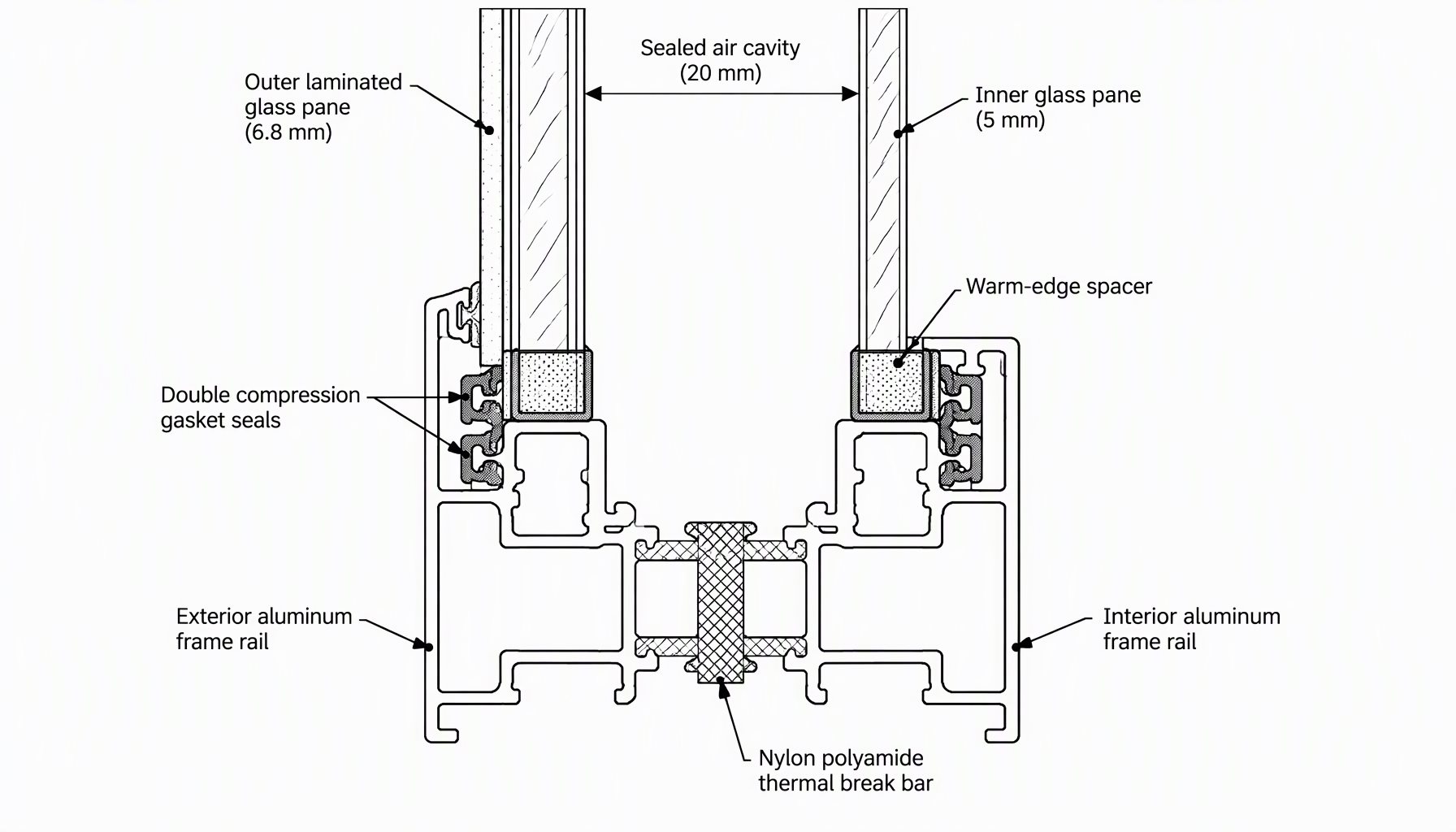
    Cross-section of a soundproof aluminum window showing laminated glass panes, air cavity and compression seals

    Asymmetric Glass Build-Ups

    One of the most useful acoustic tricks costs nothing in frame size: make the two panes of an insulated unit different thicknesses. Two identical panes tend to resonate at the same frequencies, so their transmission loss dips line up and sound leaks through those bands together. Using, for example, a thicker laminated outer lite over a thinner inner lite staggers the resonances and smooths the curve. The wider the glass separation and the more the two lites differ, the better the mid-frequency behaviour tends to be — subject to the specific tested configuration.

    Double glazing handles most road and general urban noise. When low-frequency sources dominate — plant equipment, bass from traffic, a nearby rail corridor — triple glazing or a wider cavity starts to earn its place. There is no universal answer; the right build-up is the one that a test report ties to your frequency profile.

    Why Soundproof Aluminum Windows Fail at the Seals

    Acoustic performance is frequently undone at the edges. A compression seal that is under-compressed, a sash that meets the frame with a hard gap, or a perimeter that was shimming-and-caulked on site rather than gasketed can leak more sound than the glass blocks. Aluminum frames suit tight tolerance work, but the seal design and the shop-to-site interface decide the result. Getting soundproof aluminum windows to perform means protecting the perimeter as carefully as the glass itself.

    Operating style also matters. A window that compresses its gaskets when closed — such as a casement or tilt-turn — generally holds a better acoustic seal than a sliding sash that relies on brush or interlock seals. That trade-off is a common reason we steer noise-sensitive projects toward the operable styles covered in our aluminum window types guide rather than large sliders.

    Acoustics, Thermal Performance and the Label

    Buyers often conflate the two because the same laminated, argon-filled, low-E unit can be doing acoustic and energy work at once. They are, however, separate measurements run under separate procedures. An NFRC label reports thermal and optical performance — U-factor, SHGC, visible transmittance — not an STC number. Whole-window thermal behaviour is explained in our aluminum windows energy efficiency and thermal break windows pieces; a sound rating has to come from acoustic test documentation for the exact assembly.

    The rating itself is set through standardized laboratory test methods that the wider fenestration industry documents, and body and field performance can differ once installation is included. This is the same caution that applies to the door counterpart — if you are specifying a soundproof sliding glass door, the meeting stile and track are the usual weak points in ways a fixed sash is not.

    Quiet interior behind soundproof aluminum windows facing a busy street

    How to Specify: A Decision Matrix

    The table below frames the common noise scenarios against a defensible starting specification. Each is a direction to test, not a guaranteed rating.

    Project RequirementRecommended ChoiceWhy
    General road and urban trafficLaminated outer lite + asymmetric double glazing, warm-edge spacerMass plus damping plus a staggered resonance beats equal-thickness double glazing at the same frame size
    Low-frequency plant, rail or heavy trafficWider cavity or triple glazing with two laminated litesLow frequencies are the hardest band; cavity depth and a second laminated lite extend the useful range
    Tight sightlines with moderate noiseSingle slim laminated unit with high-performance sealsKeeps the aluminum profile narrow while adding damping; accepts a moderate acoustic target
    Max quiet where space allowsAsymmetric insulated unit, compressing casement or tilt-turn sashCombines glass strategy with a gasket that closes tight instead of a sliding interlock

    What a Test Report Has to Prove

    When a supplier offers an STC figure, read it as a claim about a specimen, not about your order. The report should name the test method, state the specimen size and build-up, and show whether the number is a laboratory (field-measured) rating. The industry test standards behind these figures — the E90 measurement family and the E413 single-number rating, published by ASTM — define how the curve becomes a single STC. The fenestration technical resources from FGIA and the rating-program documentation at NFRC explain the wider performance-certification framework these numbers sit inside.

    Energy and comfort programs such as ENERGY STAR certified windows are a useful parallel: they show how a rating always describes a specific tested configuration, not the category name. Bring the same discipline to acoustics and ask for the report that matches the exact glass and seal you are ordering.

    Frequently Asked Questions

    Do soundproof aluminum windows really reduce traffic noise?

    Yes, when the glass, cavity and seals are designed together. A properly specified assembly with laminated, asymmetric insulated glazing and compression seals can measurably cut the airborne noise that reaches the room, provided installation does not introduce flanking paths.

    Is a higher STC number always better for my project?

    STC is a useful comparison, but it is weighted toward mid and high frequencies and can flatter performance against low-frequency sources. Judge the rating against the specific noise spectrum you are dealing with, not as a single scoreboard.

    Does laminated glass make the biggest difference?

    For most urban noise, yes — the damping interlayer flattens resonance dips that plain glass has. Pairing it with a different-thickness inner lite is usually the next most cost-effective change.

    Are double or triple glazed units quieter?

    Not automatically. A well-built asymmetric double unit with a wide cavity can beat a poorly spaced triple unit. Cavity width, pane asymmetry and lamination matter more than pane count alone.

    Do sliding aluminum windows block sound as well as casements?

    Usually not. Sliders rely on interlock and brush seals, while a compressing casement or tilt-turn closes its gasket against the frame. Where noise is severe, operable compression styles tend to outperform sliders of the same glass.

    Will thicker glass alone solve a noise problem?

    Thicker single glass helps only modestly because of the mass-air-mass effect. Damping and decoupling — lamination and a proper cavity — deliver far more per unit of weight and cost.

    Does the NFRC energy label tell me the sound rating?

    No. The NFRC label reports thermal and optical data. An acoustic STC value must come from a separate acoustic test report for the exact assembly you are specifying.

    Specify the Quiet You Actually Need

    Sound control rewards a specific, testable brief. Send your project location, the noise sources you are targeting, your preferred frame size and sightline, and any energy requirements, and the Lansen team can review a glass build-up, seal design and operable style that meets them before production.

    Send your drawings to our engineering team for an acoustic and thermal glazing review.

  • Argon Filled Windows: Low-E Argon Glass Explained

    Argon Filled Windows: Low-E Argon Glass Explained

    Most of a window’s energy performance lives in the glass package, and most glass-package performance comes from two technologies: a microscopically thin metallic coating called Low-E, and an inert gas fill — usually argon — between the panes. Neither is exotic; both are standard in quality windows. What varies enormously is how well they’re specified for your climate, and how honestly they’re presented on a quote.

    This guide covers what Low-E coatings physically do, what argon actually contributes (and what it doesn’t), whether triple glazing earns its premium, how to decode U-factor / SHGC / VT, and how to pick a glass package by climate zone.

    What Are Low-E Coated Argon Gas Windows? A Plain Definition

    Every object radiates heat as infrared energy. Emissivity measures how readily a surface radiates and absorbs that energy: plain glass runs an emissivity of roughly 0.84, meaning it happily absorbs and re-radiates heat. A Low-E (low-emissivity) coating is a layer of metallic oxides a few hundred atoms thick that drops that figure to roughly 0.02–0.10 — the surface now reflects infrared heat while passing visible light.

    The practical consequences:

    • Winter: interior heat (long-wave infrared) bounces back into the room instead of escaping through the glass. Rooms stop feeling cold near the windows.
    • Summer: the sun’s radiated heat is reflected before it enters, cutting solar gain dramatically without visibly darkening the glass.
    • UV: Low-E coatings block a large share of ultraviolet transmission, slowing fading of floors and furniture (laminated glass with a PVB interlayer blocks even more).

    There are two manufacturing routes, and the difference matters:

    Soft coat (sputtered, MSVD) — the metallic layers are applied off-line in a vacuum process to finished glass. Emissivity reaches the low end (~0.02–0.04), performance is the best available, and optical clarity is excellent. The coating is delicate, so it must face into the insulated unit’s sealed cavity — which is why soft-coat glass always arrives as part of a double- or triple-glazed unit, never as exposed single glass.

    Hard coat (pyrolytic) — the coating is fused into the glass surface during float-glass production. It’s durable enough for exposed single glazing (storm windows), but emissivity is higher (~0.15–0.25) and solar control is weaker. It’s the budget option; virtually all modern residential insulated glass uses soft coat.

    One nuance worth knowing: Low-E coatings are tuned, not generic. By adjusting the coating stack, glassmakers trade solar heat rejection against visible light and passive winter gain. The same “Low-E” label can describe a glass optimized to keep Arizona sun out or to welcome Minnesota winter sun — which is why the performance numbers on the label matter more than the marketing name.

    What Is Argon Gas in Windows? Myth vs Measurable Benefit

    Argon is a denser, lower-conductivity gas than air — thermal conductivity around 0.016–0.017 W/m·K versus air’s 0.026. Filling the gap between panes with 90%+ argon slows both conduction and convection inside the cavity, which typically improves the whole-window U-factor by roughly 0.01–0.03 compared to an air-filled unit.

    So the honest verdict: argon’s benefit is real, measurable, and modest — and because it costs only a few dollars per unit at the factory, it is among the cheapest performance upgrades in the window industry. That’s why quality double glazing ships argon-filled by default rather than as an upsell.

    Two follow-up facts buyers should know:

    • Argon doesn’t last forever. The gas slowly permeates through seals over decades (roughly on the order of 1% per year in well-made units), but even heavily depleted units retain most of their performance — the Low-E coating does the heavy lifting.
    • Krypton is the niche alternative. Krypton conducts even less heat (~0.009 W/m·K) and performs best in the narrow gaps used in triple glazing, but it costs several times more than argon. It earns its price in high-performance northern builds, not in standard double glazing.

    The myth to skip: argon as a dramatic transformation. It’s a refinement on top of Low-E glazing geometry, not a technology that rescues a bad window.

    Low E Argon Glass Meaning: What the Term Actually Covers

    Low E argon glass meaning comes down to two components that are often sold as one product. The low-E part is a microscopically thin metallic coating on an interior glass surface; the argon part is the gas filling the cavity between the panes. Neither does the other’s job. The coating controls radiant heat transfer across the cavity, and the gas slows conduction and convection inside it.

    That is why a quote that says only “low E argon glass” tells you almost nothing. You still need the coating type (soft coat or hard coat), its emissivity, the gas and its concentration, the cavity width, and the spacer. Those five values decide the number; the phrase does not.

    Argon Filled Units: What the Fill Actually Changes

    Argon filled units improve performance in a specific and limited way. Argon is denser and less conductive than air, so it reduces heat movement through the cavity — typically a modest improvement in whole-window U-factor rather than a transformation. The gain is real but it is a fraction of what the coating contributes.

    Argon-filled units also make one thing worse if the unit is badly built: an insulated unit that loses its fill loses part of its rated performance, and you cannot see that from outside. Ask how the unit is sealed and what the manufacturer’s gas-retention position is, rather than assuming the fill is permanent because it is invisible.

    Argon Requirement for Insulating Glass: When It Gets Specified

    There is no universal argon requirement for insulating glass. Argon gets specified when a project needs a lower U-factor than air fill can reach in the cavity depth available, or when a climate zone’s energy provisions push the assembly into a performance band that air fill cannot meet. In mild climates with generous cavity depth, the same coating on air can be close enough that the argon premium is hard to justify.

    So the specification question is not “argon or not” but “what U-factor does this opening need, and does air fill reach it in this profile”. Confirm against the certified test data for the exact glass make-up you are buying rather than against a family-level claim.

    Low-E Argon Gas-Filled Insulated Windows: the Build-Up, Line by Line

    A low-E argon gas-filled insulated window is a stack, and each layer has a job. Outer pane, sealed cavity filled with argon, low-E coating on the cavity surface, spacer at the edge, inner pane. The spacer matters more than its name suggests: it is the thermal bridge at the perimeter, and a cheap spacer gives back much of what the coating and gas earn in the middle.

    Read the build-up as a whole when comparing quotes — 6 mm + 12 mm argon + 6 mm with a soft-coat low-E and a warm-edge spacer is a different product from the same glass dimensions with a hard coat and an aluminium box spacer, even though both get described as low-E argon glass.

    Argon Filled Triple Glazing: Do You Really Need Triple?

    Triple glazing adds a third pane and a second gas cavity, pushing whole-window U-factors from the typical double-glazed 0.25–0.32 down to roughly 0.20–0.28. The costs: roughly 15–30% more for the glass package, meaningfully heavier panels (which affects hardware sizing on large doors), and slightly lower visible transmittance.

    Where triples win:

    • Cold climates — the Northern zone and high elevations, where heating dominates and windows are the coldest surface in the wall. The added insulation pays in both energy and comfort (the interior glass surface stays warmer, killing condensation).
    • Large glass areas in cold regions — glass walls, sunrooms, big sliders — where the window fraction of the envelope is high.
    • Noise — the extra pane and cavity measurably dampen exterior sound, a bonus in airport and road corridors.

    Where triples waste money:

    • Hot climates. In the South, the enemy is solar gain, and a third pane does almost nothing against it. The budget belongs in low-SHGC soft-coat Low-E and good frames — a double-glazed unit with SHGC around 0.25 beats a mediocre triple on every metric that matters in Texas or Florida.
    • Standard-size replacement windows in mixed climates, where the energy payback of the third pane stretches past the window’s service life.

    The rule of thumb from the factory side: triple glazing is a heating-climate tool, not a status upgrade.

    The Upgrade Ladder: What Each Glass Option Adds

    Glass options are usually presented as a menu; it’s more useful as a ladder, where each rung solves a specific problem:

    Rung What it adds Typical effect Worth it when
    Air-filled double glazing baseline insulated unit whole-window U ≈ 0.30–0.45 almost never the final spec — but common in builder-grade stock
    + Argon fill slower conduction in cavity ΔU ≈ 0.01–0.03 always — it costs almost nothing at the factory
    + Warm-edge spacer warmer glass edge less edge loss, less edge condensation cold climates and any condensation-prone room
    + Tuned soft-coat Low-E solar control and low emissivity SHGC from ~0.60 down to ~0.25; U down toward 0.28–0.32 always — this is the main event
    → Triple glazing second cavity U ≈ 0.20–0.28 heating-dominated climates, big glass areas, noise corridors

    Reading the ladder by region: in the South, the journey usually ends at rung four with a very low SHGC; in the North it climbs to five. The two most common specification mistakes are stopping at rung two (argon with a generic hard-coat glass) and jumping to rung five where rung four was the actual requirement — both pay real money for the wrong problem.

    One factory-floor footnote on gas fill: quality units are filled to 90%+ argon at the assembly line, and reputable manufacturers verify fill rates periodically on production samples. Units built with capillary tubes or pump holes for pressure equalization (common at extreme altitudes) may need their gas topped up — an edge case worth mentioning only because high-elevation projects are exactly the ones that spec triples.

    Decoding U-Factor, SHGC, and VT

    Three numbers on the NFRC label describe the glass package — and each one answers a different question:

    • U-factor answers “how fast does heat pass through?” — the insulating quality. Lower is better; it drives winter heat loss and, secondarily, summer heat gain by conduction. Compare whole-window numbers, not center-of-glass.
    • SHGC (Solar Heat Gain Coefficient) answers “how much of the sun’s energy comes through?” — a value from 0 to 1. Lower is better in cooling climates and on west/east glass; higher can be a feature on south glass in heating climates.
    • VT (Visible Transmittance) answers “how much daylight?” — also 0 to 1, higher is better. Good coatings balance SHGC and VT rather than sacrificing daylight entirely.

    The pairing logic that catches buyers out: a window can have a superb U-factor and still roast a west-facing room, because U-factor says nothing about solar gain. Conversely, a very low SHGC glass in a cold-climate south elevation throws away free winter heat. Glass selection is orientation-by-orientation, not house-by-house.

    Bright interior lit through energy-efficient Low-E argon glass windows that balance daylight and solar heat control.

    Climate-Zone Picking Guide

    North American energy programs (ENERGY STAR and IECC climate zones) sort the continent into roughly four bands. The glass-package logic for each:

    • Northern (cold-heating dominated): prioritize low U-factor — 0.27 or lower; triple glazing earns consideration. SHGC can stay moderate or high (roughly ≥0.30) on south-facing glass for passive winter gain.
    • North-Central / mixed: U around 0.30 or lower with a good soft-coat double glazing; SHGC moderate (roughly ≤0.40) and tuned by orientation.
    • South-Central (hot summers, mild winters): U around 0.30, and SHGC tightly capped (roughly ≤0.25) — solar control is where comfort lives.
    • Southern (cooling dominated: FL, TX coast, AZ): U around 0.40 is generally acceptable, but SHGC ≤0.25 with strong visible transmittance is the real spec; triple glazing is wasted money here.

    Two add-ons that move real-world numbers more than most options: warm-edge spacers (they raise the glass-edge temperature, cutting condensation and edge heat loss) and quality installation with air sealing (infiltration can exceed the glass’s own leakage several times over if installation is sloppy).

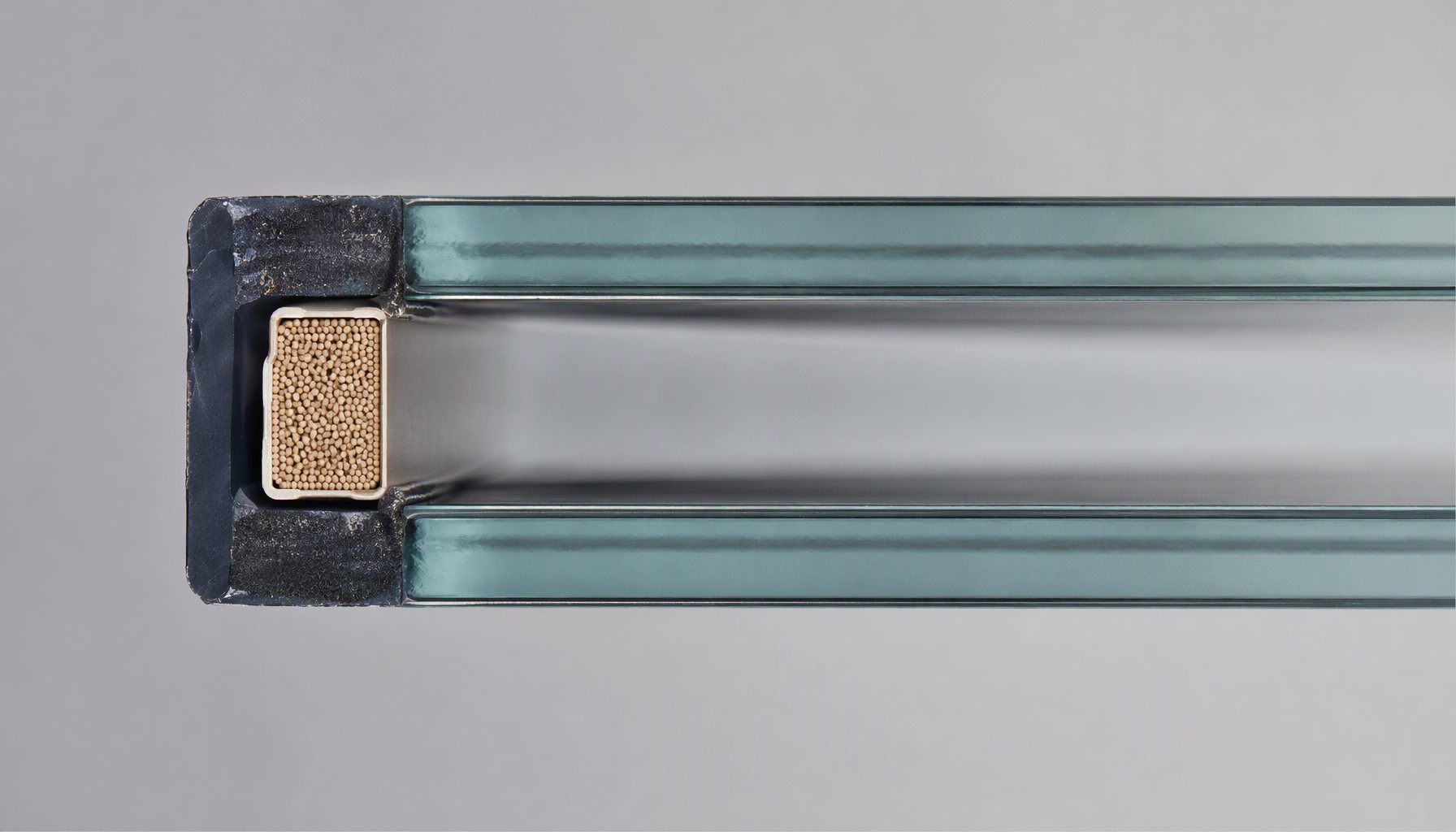
    Warm-edge spacer detail in a Low-E argon insulated glass unit, keeping the glass edge warmer to reduce condensation.

    FAQ

    Is argon fill actually worth it?

    Yes — as a bundle with good Low-E glazing. The measured benefit is modest (roughly 0.01–0.03 U-factor improvement) but the cost at the factory is only a few dollars per unit, making it the cheapest meaningful efficiency upgrade in the spec. It is not, by itself, a technology that rescues a poor window.

    What’s the difference between soft-coat and hard-coat Low-E?

    Soft coat (sputtered) delivers the best performance — emissivity around 0.02–0.04 — but is delicate and always lives inside a sealed insulated unit. Hard coat (pyrolytic) is fused to the glass, survives exposed single glazing, but has higher emissivity (~0.15–0.25) and weaker solar control. Modern insulated glass is soft-coat territory.

    Is triple glazing worth it in a hot climate?

    Generally no. A third pane barely affects solar gain, which is the dominant heat source in cooling climates. The budget belongs in low-SHGC soft-coat Low-E glass and a thermally broken frame; a well-specified double unit outperforms a mediocre triple in Texas or Florida.

    Does Low-E glass stop furniture fading?

    It slows it substantially. Low-E coatings block a large share of UV; laminated glass with a PVB interlayer blocks more (99%+). Fading is also driven by visible light and heat, so no glass stops it entirely — but Low-E glazing extends the life of floors and fabrics noticeably.

    How long does argon gas last in a window?

    Decades. Gas permeates slowly through seals — roughly on the order of 1% per year in well-made units — and even partially depleted units retain most performance, because the Low-E coating provides the majority of the benefit. Quality manufacturing and warm-edge seals matter more than the gas itself.

    —

    Explore Lansen’s Low-E and argon glazing packages — tuned by climate zone and orientation for North American projects.

    What is low e argon glass?

    It is an insulating glass unit combining a low-emissivity coating on an interior surface with an argon fill in the cavity between the panes. The coating suppresses radiant heat transfer and the argon slows conduction and convection, so the pair outperforms either alone. What the phrase does not tell you is the coating type, emissivity, cavity width and spacer — ask for all four.

    What are low e argon windows, and are they worth it?

    Low e argon windows are simply windows built with that kind of unit. Whether they are worth it depends on where the building is and what the opening needs to achieve: in heating-dominated climates the combination usually earns its cost, while in a cooling-dominated climate the solar heat gain coefficient matters more than the extra cavity performance. Compare whole-window U-factor and SHGC, not the descriptor.

    What are windows with argon gas and low e actually buying?

    They are buying two separate improvements that are sold together: a coating that lowers radiant heat transfer, and a denser gas that reduces conduction across the cavity. Windows with argon gas and low e perform better than either feature alone, but the size of the gain depends on the cavity depth and the spacer. Confirm against the certified test data for the configuration.

    Is low e argon gas the same as argon-filled units?

    Low e argon gas describes the combination of a coating and a gas fill; argon-filled units describes only the fill. A unit can be argon filled without a low-E coating, and a unit can carry a low-E coating with air rather than argon. The terms are not interchangeable, and a quote should state both parts explicitly.

    Need a Quote for Your Project?

    Lansen manufactures thermally-broken aluminum windows, doors and sunrooms for North American importers, contractors and brands. Get factory-direct pricing, NFRC-rated performance data, and OEM/ODM support.

    Request a Project Estimate  OEM/ODM Program