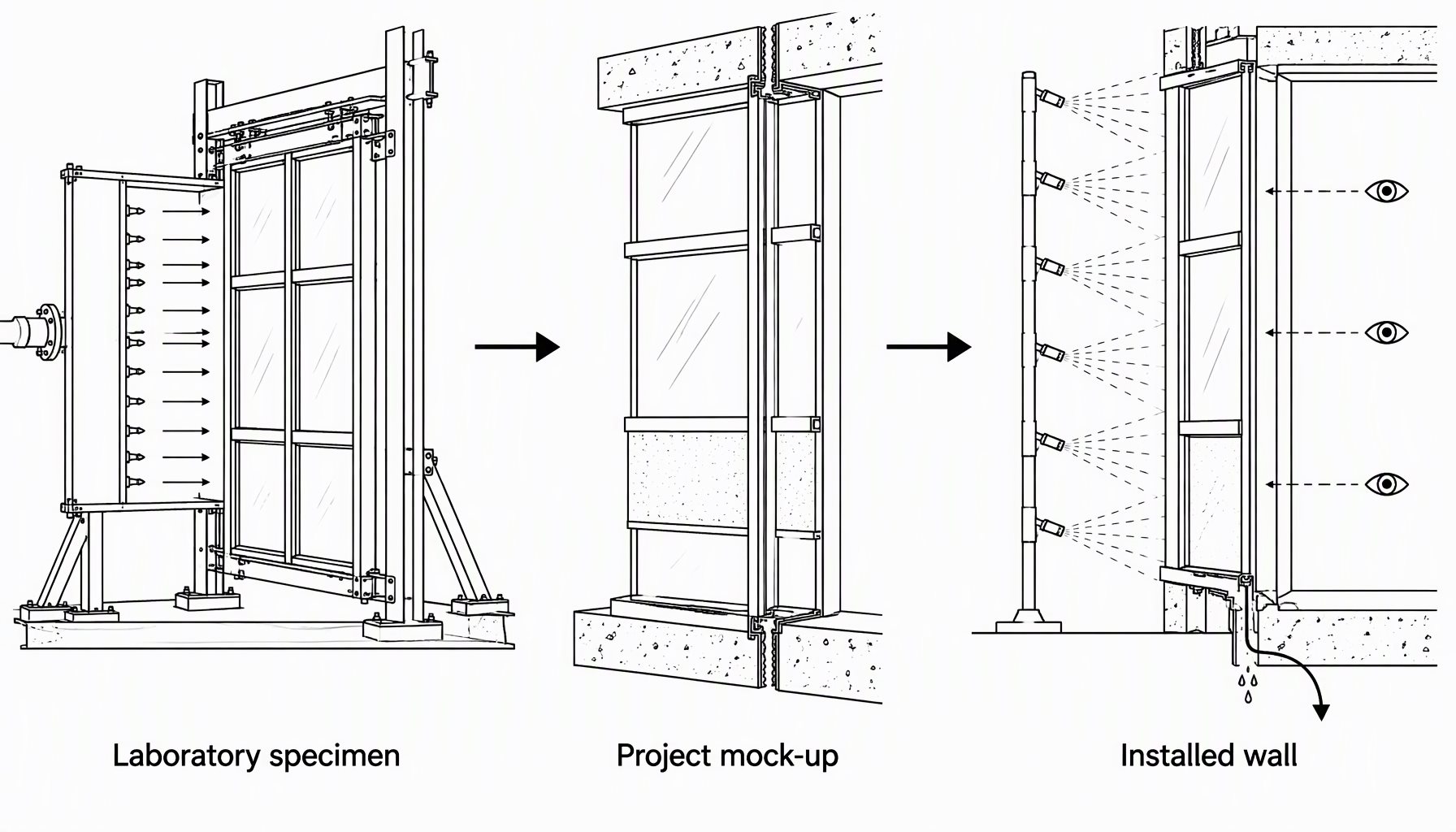
“Curtain wall water testing” covers three different activities that are routinely confused with one another: a laboratory test of a specimen, a mock-up test of the job-specific assembly, and a field test of the wall that was actually installed. They are ordered, witnessed and interpreted differently, and each proves something the other two cannot. A specification that asks for water testing without naming which one usually buys the cheapest of the three and misses the risk that matters.
Three Water Tests That Are Constantly Mixed Up
The first distinction is between a test method and a performance requirement. ASTM E331 is a static water penetration test method; ASTM E1105-style procedures expose an assembly to water while the test pressure is cycled, which is closer to what wind-driven rain actually does. Both measure behavior on a specimen under defined conditions; neither is a rating a supplier can attach to every size and detail on your building.
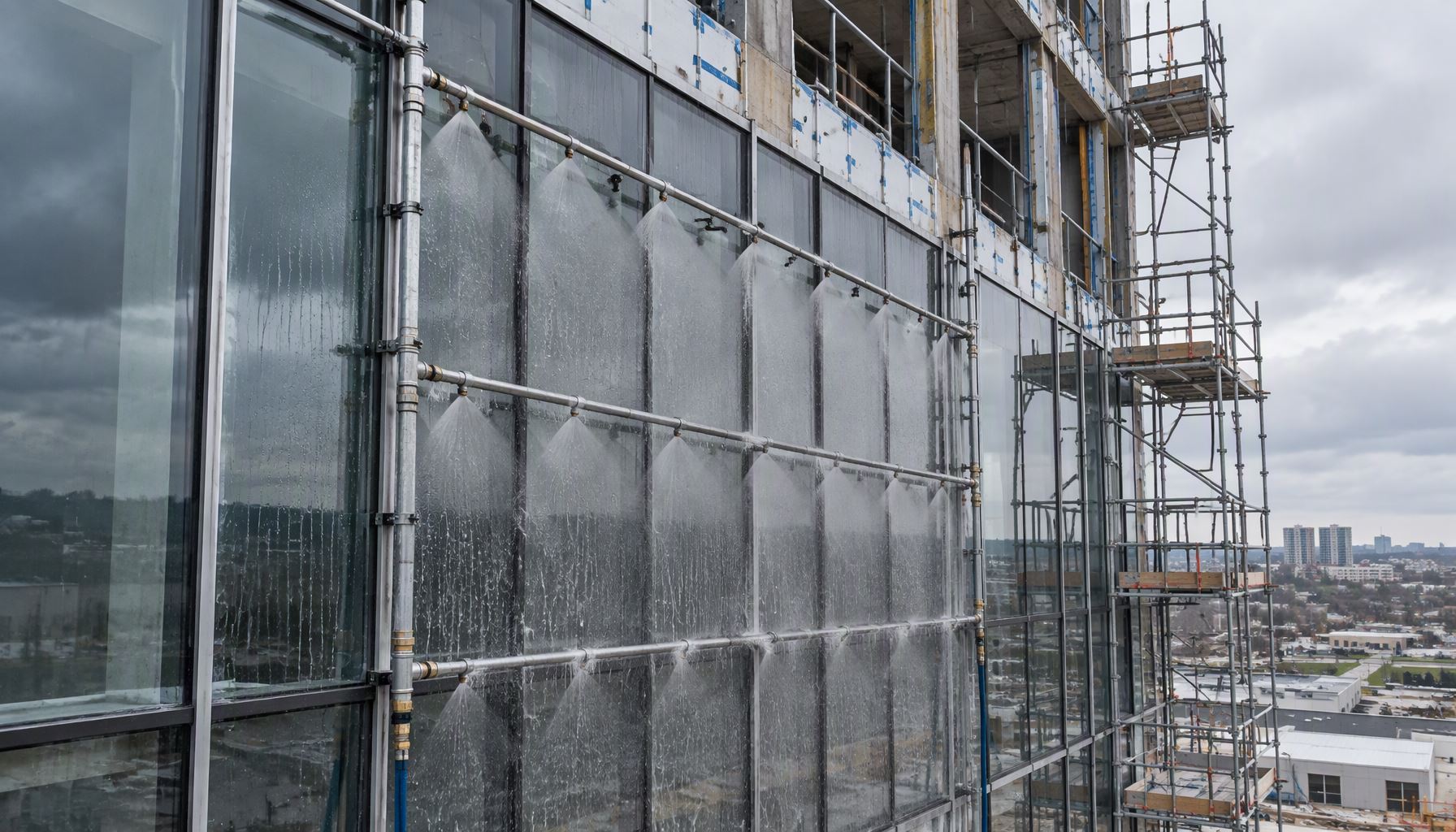
Field procedures are a third thing again. AAMA 501.2 is a voluntary industry procedure for checking installed window wall, curtain wall and storefront assemblies for water leakage using a hose or a mounted spray rack, and AAMA 503 supplements that approach with a defined field sequence — visual inspection followed by hose or spray-rack exposure, with guidance on what to do about water that is observed. These are checks on the finished installation, not a laboratory determination of a system’s capacity.
| Test Stage | What It Is | What It Can Prove |
|---|---|---|
| Laboratory test of a specimen | A defined assembly tested to a stated method under controlled pressure | How that tested configuration behaves; the basis of a performance claim |
| Mock-up or prototype test | The project’s own design, fabricators, sealants and interface details built and tested | Whether this project’s specific assembly and detailing holds water |
| Field test of the installed wall | Hose or spray-rack exposure on the completed installation with interior observation | Whether the wall as built and as installed leaks, including workmanship |
The FGIA standards resources are where to confirm which document a specification is actually invoking, rather than quoting a designation from memory.
Mock-Up Testing: The One That Catches Detailing Errors
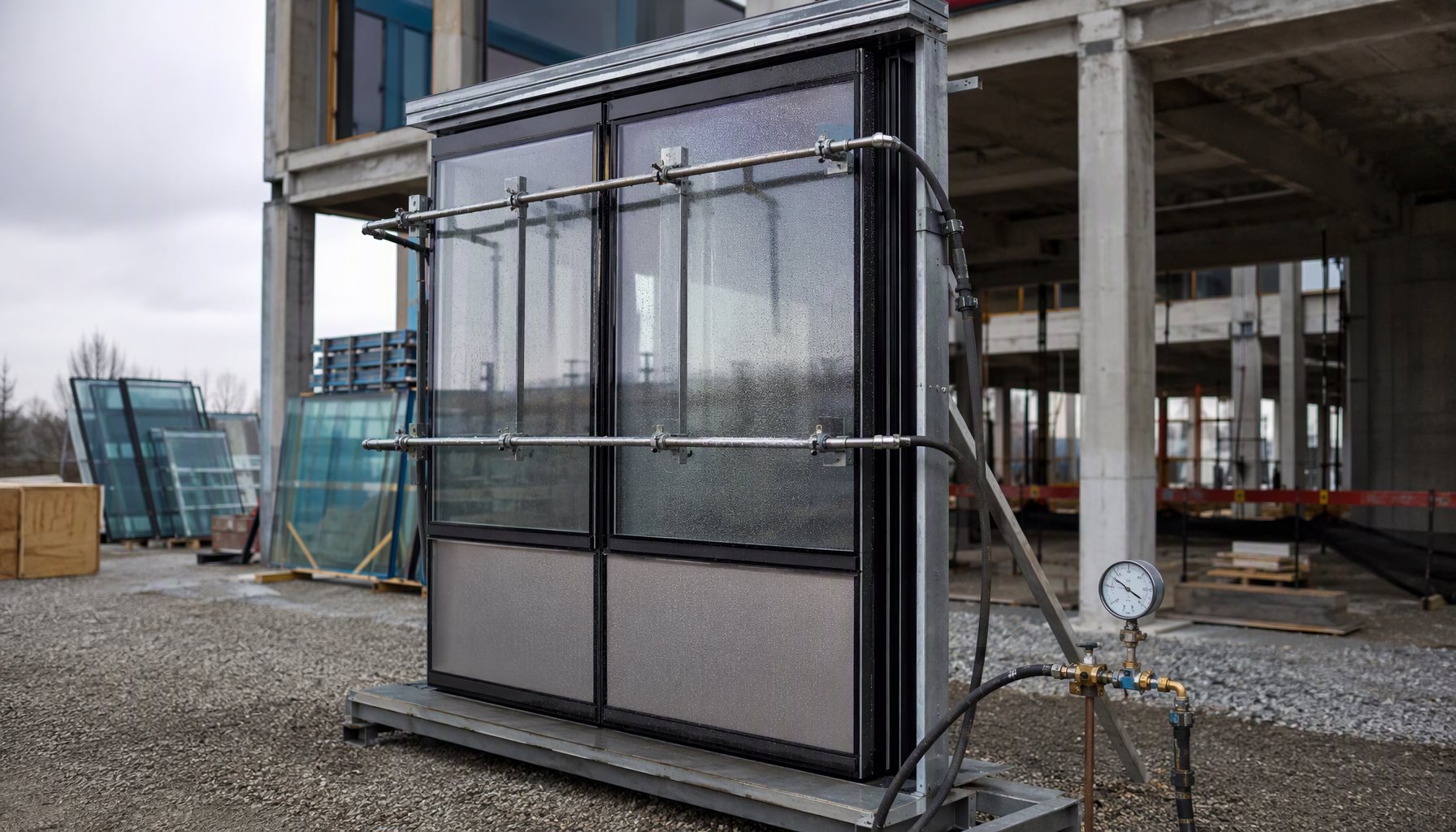
A mock-up is the project’s assembly, not the brochure assembly. It should contain the conditions that cause field problems: a sill or threshold detail, a head condition, a movement joint, an opaque spandrel panel zone, a mullion cap run, and at least one interface with the building structure. If it omits the interface conditions, it tests the part that almost never leaks.
On a curtain wall package, the two questions that decide the program are which system family is being built and who is fabricating it; the system families are defined in curtain wall system types, and the vendor-side evaluation in choosing curtain wall fabricators. Two sequencing points are worth enforcing. First, the mock-up should be built by the same crew, with the same sealant, substrates and primer sequence that will be used in production, or its result says nothing about production. Second, the mock-up should be inspected and tested before the permanent wall is fabricated, so that a correction costs a detail drawing rather than a demolition.
Shop testing controls the environment and catches fabrication problems; an on-site mock-up additionally exposes erection and interface conditions. Where tolerances are tight the assembly route matters too — the difference between site-built and factory-built systems is dealt with in stick vs unitized curtain wall.
Field Testing the Installed Wall
Field testing is a workmanship audit performed with water. It examines what no laboratory specimen contains: field-tooled sealant joints, cap pieces that did not seat, fasteners that over-compressed a gasket, blocked or omitted drainage, and damage from other trades.
What has to be agreed before the first nozzle goes on the wall:
- Scope and sampling. Which elevations, what proportion of the wall, and which high-risk locations go first — corners, sills, movement joints and interfaces with rooflines and balconies.
- Test pressure and duration. Stated in the procedure and applied consistently; ad-hoc hose work at unspecified pressure produces a result nobody can interpret.
- Observation and documentation. Who watches the interior face, how a wetted area is recorded, and how pre-existing wetness is told apart from water admitted during the test.
- Remediation and re-test. What happens after a failure: correction, sealant re-application with adequate cure time, then a re-test of the corrected area — not a punch-list note.
Run it while the interior is accessible and clean enough to observe. Late testing over a finished interior, with protective film still undisturbed, is the most common reason a genuine leak gets written off as condensation.
What a Water Test Cannot Tell You
A test report is a statement about a specimen. Performance is configuration-dependent: mullion spacing, glass size and weight, panel build-up, anchor layout and interface details all change the load path and the movement a joint must absorb. A result for one specimen does not automatically prove performance for every size or configuration on the project.
The same caution applies to the paperwork. A test report, a certificate, a declaration of conformity and a code approval mean different things, and buyers routinely accept the wrong one. The distinction is laid out in our explanation of NFRC, AAMA, ENERGY STAR and impact ratings; for water performance specifically, the useful question is which method was used, on what specimen, in what configuration, and with what observed result.
A dry test also does not mean a dry wall in perpetuity. Water management in a drained rainscreen assembly is a design property — the cavity, the drainage path and pressure equalization govern how much water passes the outer line and how fast it leaves. Field testing checks whether that design survived production; it does not replace it. The construction side of that is covered in curtain wall insulation, where the cavity and drainage layers are described.
Where Curtain Wall Water Testing Finds the Real Failures
Failures found in field testing cluster at a small number of locations, and they are almost never in the middle of a glazed bay.
| Location Found Wet | Usual Root Cause | Evidence Worth Demanding |
|---|---|---|
| Sill and threshold line | Drainage omitted, blocked or crossed by a sealant application; end caps unseated | Drainage detail as drawn and as built, with a cleared path |
| Head and slab-edge interface | Movement joint sized for the wrong total movement; incompatible substrate | Movement calculation and sealant compatibility record |
| Vertical mullion caps | Cap bridging, missing or under-compressed gasket at the cap line | Gasket compression specification and inspection photo |
| Opaque panel perimeter | Back-pan sealing discontinuity at the panel edge | Panel-edge detail and the mock-up result for that zone |
An interior wet surface is not always admitted water: condensation on a cold bridge is routinely misread as a leak, and the two have different remedies. The window-side versions are explained in condensation inside double glazing, and in why aluminum windows leak.
What the Model Code Adds
The model code treats an exterior wall as an assembly — weather resistance, the water-resistive barrier behind cladding, and performance as tested and evaluated — so water performance is not purely a voluntary industry matter. The provisions sit in IBC Chapter 14 on exterior walls, and the broader code library at ICC codes and standards is the wider reference library. Which edition binds your project is a local question for the authority having jurisdiction, not something to assume from a datasheet.
Which Water Test Program Fits Your Project
| Project Requirement | Recommended Choice | Why |
|---|---|---|
| Standard mid-rise, repetitive assembly | System documentation review plus a project mock-up and a sampled field test | Mock-up catches the detailing, field test catches the workmanship |
| Complex geometry, tight tolerances or heavy wind exposure | Full mock-up with the real interface conditions, tested before fabrication release | Corrections are cheapest while they are still drawings |
| Buyer needing to compare two bidders | Identical language in the specification for stage, method, pressure, sampling and re-test | Otherwise the bids are not for the same wall |
Frequently Asked Questions
What is curtain wall water testing?
Controlled exposure of an assembly to water, usually sprayed and often with pressure cycling, to see whether water reaches the interior side. The term covers laboratory testing of a specimen, mock-up testing of a project assembly and field testing of the installed wall — three activities with three purposes.
Is a laboratory water test the same as a field test?
No. A laboratory test characterizes a defined specimen under controlled conditions; a field test audits what was actually fabricated and installed — sealant joints, anchorage, drainage clearance, damage from other trades. A project normally needs the field test even with excellent laboratory data.
Does ASTM E331 give a curtain wall a rating?
It is a static water penetration test method, not a rating. A method tells you how the measurement was made; it does not by itself establish a performance level for your configuration, and a report should not be summarized as a product rating.
What is AAMA 503 used for?
It is an industry field procedure that supplements hose and spray-rack style testing of installed assemblies with a defined sequence and remediation logic — inspect, test, correct, re-test. It is used to establish whether the installed wall performs, not to characterize a system’s laboratory capacity.
How much of the installed wall should be field tested?
A project decision that belongs in the specification, weighted toward high-risk locations — sills, head conditions, movement joints, corners and building interfaces — rather than spread evenly across the flattest, safest bays.
Does curtain wall water testing prove energy performance?
No. Water penetration and thermal performance are separate properties measured by separate programs, and an energy rating label from NFRC is not evidence about leakage. Each needs its own documentation.
Can a wall pass a field test and still leak later?
Yes. A test audits a point in time. Blocked drainage after handover, joints beyond their design range, later trades penetrating the assembly and gasket compression set all change the result, which is why drainage access and inspection belong in the maintenance plan.
Who should witness the test?
Someone with authority to stop work on a failure — the specifier, the consultant or the client’s representative — with observations recorded as they are made. A test witnessed only by the installer’s own team produces a record nobody outside can rely on.
Get the Test Program Right Before Production
If your project needs a curtain wall package reviewed for water test scope — mock-up content, field test procedure, sampling, acceptance criteria and the remediation path — send us your drawings, the elevation schedule, the site conditions and the performance requirements. We can review the test program against the assembly design before fabrication is committed — reach us through the contact page.