Why aluminum windows leak is a question that usually has nothing to do with the aluminum. The material does not absorb water, warp under moisture or rot, so water appearing on an interior sill has almost always travelled along a path the assembly was supposed to manage — a blocked drainage route, a failed sealant joint, a compressed gasket or an installation detail that broke the weather barrier.
This article explains how water is meant to leave an aluminum window, the failure modes that let it enter instead, and how to diagnose the actual path before ordering repairs or replacement units.
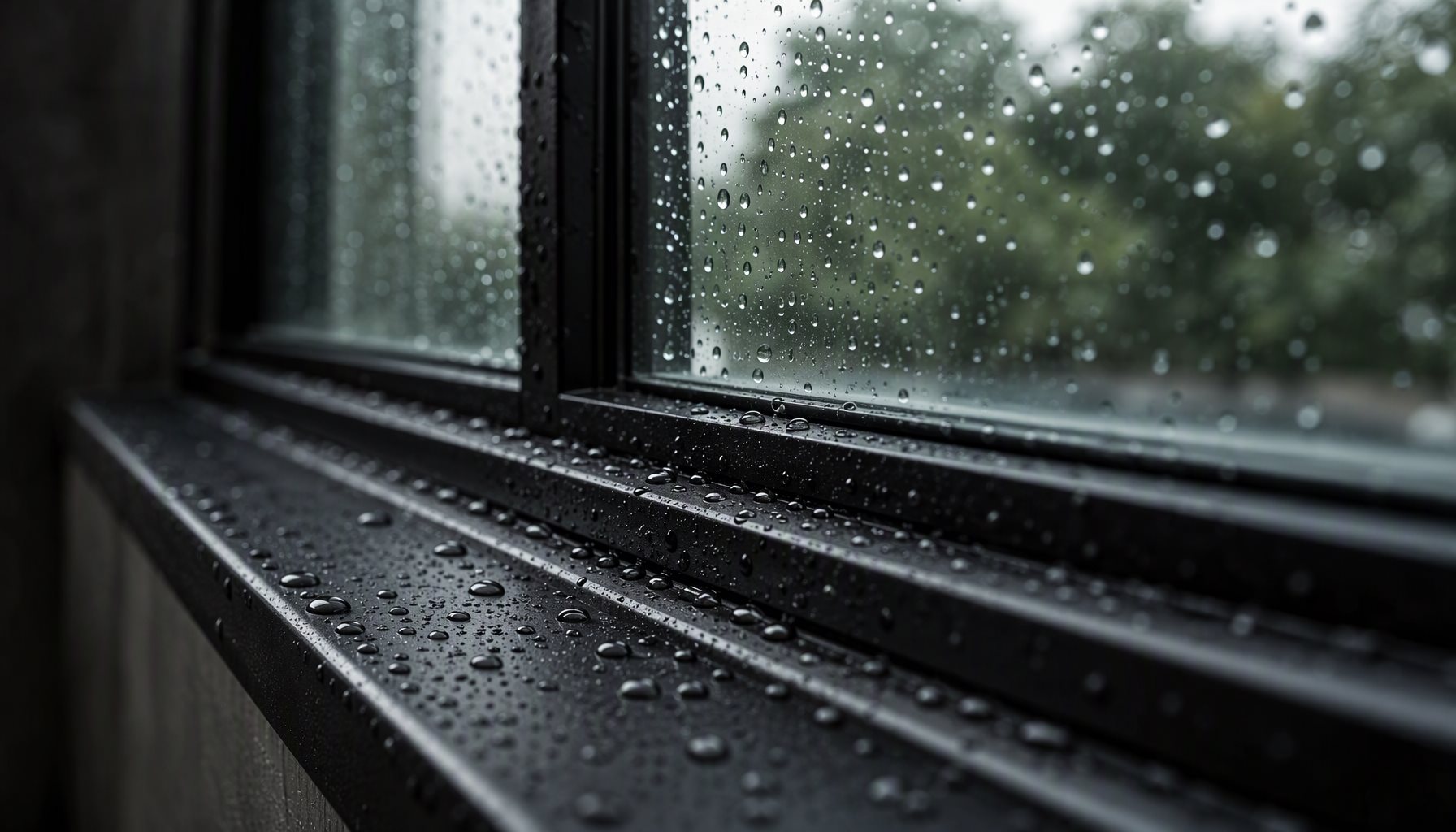
Why Aluminum Windows Leak: It Is Rarely the Frame Material
Aluminum framing is dimensionally stable and impervious to water absorption. When a leak appears, the cause sits in one of four places: the water management design of the system, the interfaces between the window and the wall, the seals and gaskets that close the moving joints, or the workmanship on site.
That distinction matters commercially. A leak attributed to “the windows” is often a leak in the flashing, the sealant or the rough opening, and replacing units will not fix it. Knowing why aluminum windows leak at an interface rather than in the profile is what makes diagnosis fast.
It is also worth separating water penetration from condensation. Moisture that forms on the interior glass surface in cold weather is a humidity and thermal performance issue, not a leak, and it requires a completely different response.
| Where Water Appears | Most Likely Path | First Check |
|---|---|---|
| Interior sill, near the corners | Blocked or missing weep drainage | Whether weep openings are clear and the sill drains outward |
| Along the head of the frame | Head flashing or sealant failure above the unit | Continuity of flashing and condition of the perimeter sealant |
| At the jamb, mid-height | Perimeter seal or shim gap left open | Sealant adhesion and whether the shim space was closed out |
| Around the operating sash | Compressed, aged or misaligned gasket | Gasket compression and sash alignment against the frame |
| Only during wind-driven rain | Pressure differential across the assembly | Drainage path and whether the system suits the exposure |
How Water Is Supposed to Leave an Aluminum Window
A properly designed fenestration system does not assume water will be excluded entirely. It assumes some water will get past the outer line of defense and provides a controlled route for it to leave.
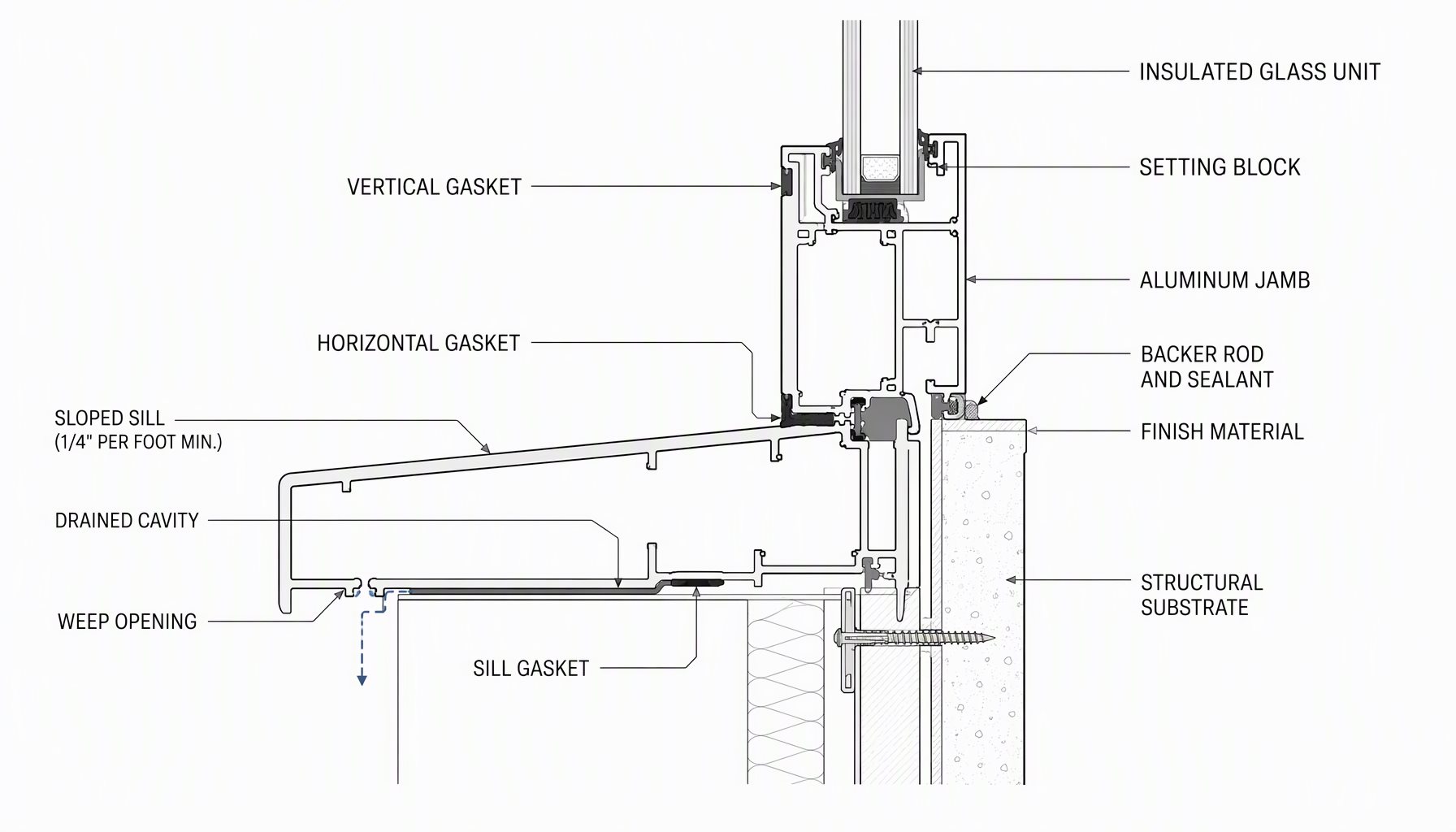
The key elements are a sloped sill that sheds water outward, weep openings at the low points, a drained cavity where the system uses one, and sealed inner lines that stop air and water moving inward. When weeps are blocked by sealant, debris, screening or paint, water that would have drained accumulates and finds another route. Standing water in the sill is also the starting point for most finish and pitting complaints, so preventing aluminum window corrosion treats drainage maintenance as a corrosion control, not a cleaning task.
These behaviors are measured rather than assumed. ASTM E283 / E283M determines air leakage rate through a specimen under a stated pressure differential, and ASTM E331 addresses water penetration under static pressure differential. Both are test methods, not ratings: a rating is the result a specific specimen achieved under defined conditions. FGIA publishes the AAMA standards and field test methods commonly used to evaluate installed assemblies.
Installation, Flashing and Tolerance Failures
Most reported leaks originate at the interface between the window and the wall rather than in the window. Common installation-related causes include:
- Flashing not integrated with the weather barrier. Head flashing, sill pan and jamb details must shingle in the correct order so water is directed outward.
- Sealant used as the primary water barrier. Sealant is a secondary line of defense; where it is the only one, any loss of adhesion becomes a leak.
- Open shim gaps. Shim space left unclosed creates a direct path from exterior to interior.
- Out-of-square or undersized rough openings. Forced fitting distorts the frame and stops gaskets compressing evenly.
- Unsupported sills. A sill that flexes under load breaks its own sealant bond.
Rough opening accuracy underpins all of these. Our window rough opening guide explains how openings are measured and verified across wood, masonry and concrete substrates.
Fastener choice matters too. Aluminum does not rust like steel, but it can corrode in aggressive environments, particularly where dissimilar metals contact without isolation. Galvanic separation, compatible fasteners and correct coating specification belong in the assembly design.
Gaskets, Sealants and Hardware Degradation
Moving joints are sealed by compression gaskets or brush seals, and those components age. Ultraviolet exposure, temperature cycling and repeated operation reduce elasticity over time, so a gasket that no longer returns to shape stops compressing — and an uncompressed gasket does not seal.
Sealant fails in recognizable ways: loss of adhesion at one substrate, cohesive tearing, hardening and cracking, or three-sided adhesion that prevents the joint moving with the building. Joint width and depth relative to expected movement must be specified deliberately, because sealant in an undersized joint fails regardless of product quality.
Hardware contributes indirectly. A dropped sash, a worn roller or an out-of-adjustment operator changes the geometry of the closing line so the gasket no longer meets its intended compression. Operational problems frequently present as water problems.
Thermal movement adds another variable: aluminum expands and contracts more than glass or masonry, so a wide frame in strong sun moves relative to its surrounds. Joint design has to accommodate that movement rather than resist it.
Diagnosing a Leak Before Ordering Repairs
Work outward from the evidence. Confirm whether water is entering under calm rain or only under wind, note exactly where it appears inside, and check the drainage path before touching any seal.
| Test Method | What It Measures | What It Does Not Prove |
|---|---|---|
| ASTM E283 / E283M (laboratory) | Air leakage rate through a specimen at stated pressure | Performance of a different size, glazing or configuration |
| ASTM E331 (laboratory) | Water penetration under static pressure differential | Behavior under dynamic wind and rain in the field |
| ASTM E330 (laboratory) | Structural response to uniform static air pressure | Watertightness of the installed wall interface |
| Field water spray testing (AAMA/FGIA methods) | Whether the installed assembly leaks in place | Which component is at fault — it locates, not explains |
| Visual and borescope inspection | Drainage condition, sealant state, gasket compression | Rate of leakage or design pressure capability |
A test report for one specimen does not automatically prove performance for every size or configuration in the same family, and no laboratory result predicts what happens once a unit is installed in a specific wall. Field investigation and laboratory evidence answer different questions.
Model code requirements for the surrounding wall assembly are maintained through the International Code Council. The edition adopted by the jurisdiction governs, and local amendments frequently add wind-driven rain provisions.
| Project Requirement | Recommended Choice | Why |
|---|---|---|
| Isolated leak at one opening | Inspect drainage and perimeter sealant first | Localized symptoms usually indicate a localized path, not a system defect |
| Leaks across many openings on one elevation | Treat it as a design or workmanship pattern | Repetition points to a detail, an exposure mismatch or a shared installation error |
| Leak only in wind-driven rain | Review system suitability and pressure management | Static-condition performance does not represent dynamic exposure |
| Moisture on interior glass in cold weather | Assess as condensation, not infiltration | Different cause, different remedy — see thermal break windows |
| Aged gaskets, sash misalignment | Re-gasket and re-adjust before replacing units | Restoring compression often resolves infiltration at a fraction of replacement cost |
| New build in exposed coastal location | Specify tested evidence matched to design pressure | Exposure sets the requirement; the product must be shown to meet it |
Uncontrolled air movement also affects energy performance, which is why U.S. Department of Energy guidance treats air leakage and thermal performance as linked issues.

Frequently Asked Questions About Why Aluminum Windows Leak
Why aluminum windows leak when the frame itself does not absorb water?
Because the leak is almost never in the aluminum. Water enters through drainage paths that are blocked, seals that have aged, interfaces between window and wall that were not detailed correctly, or gaskets that no longer compress. The frame material is the most durable part of the assembly.
Are blocked weep holes a common cause?
Yes, and they are frequently the first thing to check. Weep openings let water that has entered the drained cavity exit to the exterior. When they are obstructed by sealant, debris, paint or screening, water accumulates and migrates inward instead of draining outward.
Is the leak the window’s fault or the installer’s?
That has to be established by investigation, not assumption. Water at the head of the frame usually implicates flashing above the unit; water at the jamb implicates perimeter sealing and shim gaps; water around the sash implicates gaskets and alignment. Field water spray testing locates the leak but does not by itself assign cause.
Can a leak only happen in wind-driven rain?
Yes. Wind creates a pressure differential across the assembly, and that differential drives water through openings that calm rain would not penetrate. Laboratory water penetration testing under static pressure and field spray testing under dynamic conditions measure different things, so passing one does not guarantee the other.
Will resealing the outside perimeter fix it?
Sometimes, but not reliably. If the drainage path is blocked, adding sealant traps water inside the assembly and can make the problem worse. Clear the drainage route and identify the entry path first; sealing is a secondary measure, never the primary water barrier.
Do leaks mean the window is not energy efficient?
Not necessarily, though the two are related. Uncontrolled air movement through an assembly affects both infiltration and heat loss, and a distorted frame from installation stress can degrade both. Thermal performance ratings and watertightness are established separately, so one is not evidence of the other.
How does condensation differ from a leak?
Condensation forms on the interior surface when warm humid air meets a cold surface, typically on glass in winter. A leak is liquid water entering from outside, usually at a frame or wall interface. Condensation is a humidity and thermal issue; a leak is a water management issue. Confirming which one is present determines everything that follows.
Request a Leak Diagnosis and Specification Review
If you are dealing with water ingress on a project, send photographs of the affected openings, the elevation and exposure, the system type and any existing test documentation. Our engineering team can review the drainage design, gasket and sealant specification and installation interface details, and advise whether the issue sits in the product, the wall assembly or the workmanship. Our quality and testing page explains the documentation we provide, and the window hub and contact page are the fastest routes to a technical review.