Hard to open windows rarely begin with the handle. They begin with debris in a track, a gear head that lost grease years ago, a sash that left its rollers, or a frame that was racked during installation and now squeezes the sash along its whole travel. This guide separates those four mechanisms, shows how to diagnose each from the exterior side without forcing anything, and gives specifiers the language to keep replacement projects from repeating the failure.
Part of our window operation and comfort series for contractors, facility teams, and project specifiers evaluating hardware and frame performance.
Quick Comparison: Operating Style and Its Typical Failure
| Operating Style | What Usually Binds First | First Check |
|---|---|---|
| Casement and awning with crank operator | Gearbox wear and linkage arms out of geometry | Operate with sash open by hand; feel crank resistance with sash supported |
| Sliding and horizontal gliding | Track debris and worn or derailed rollers | Lift sash slightly and test whether it moves freely off the track surface |
| Tilt-turn | Mis-engagement of tilt mechanism and hardware strikes | Check turn position action before forcing tilt |
Hard to Open Windows: Where the Problem Usually Starts
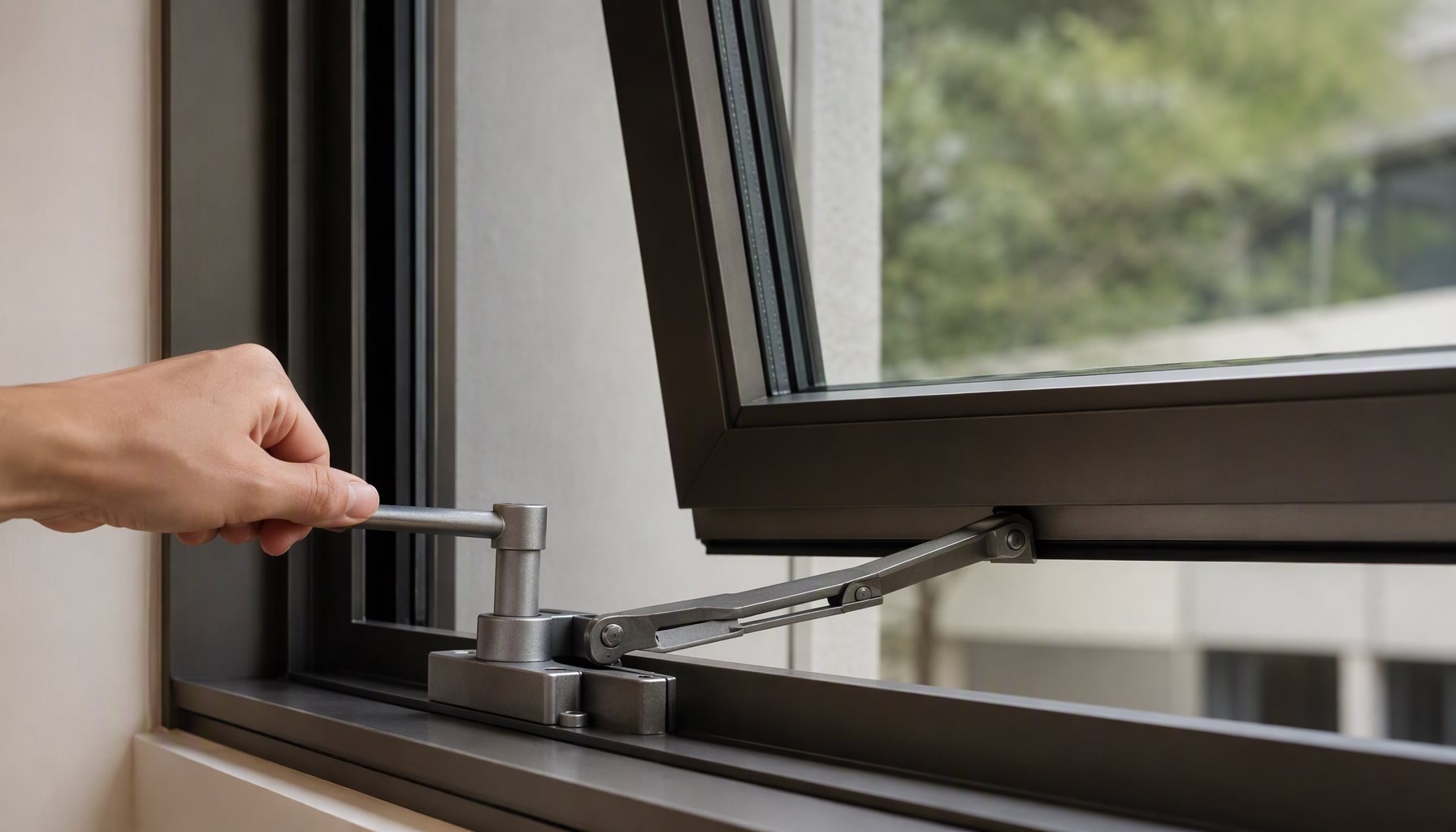
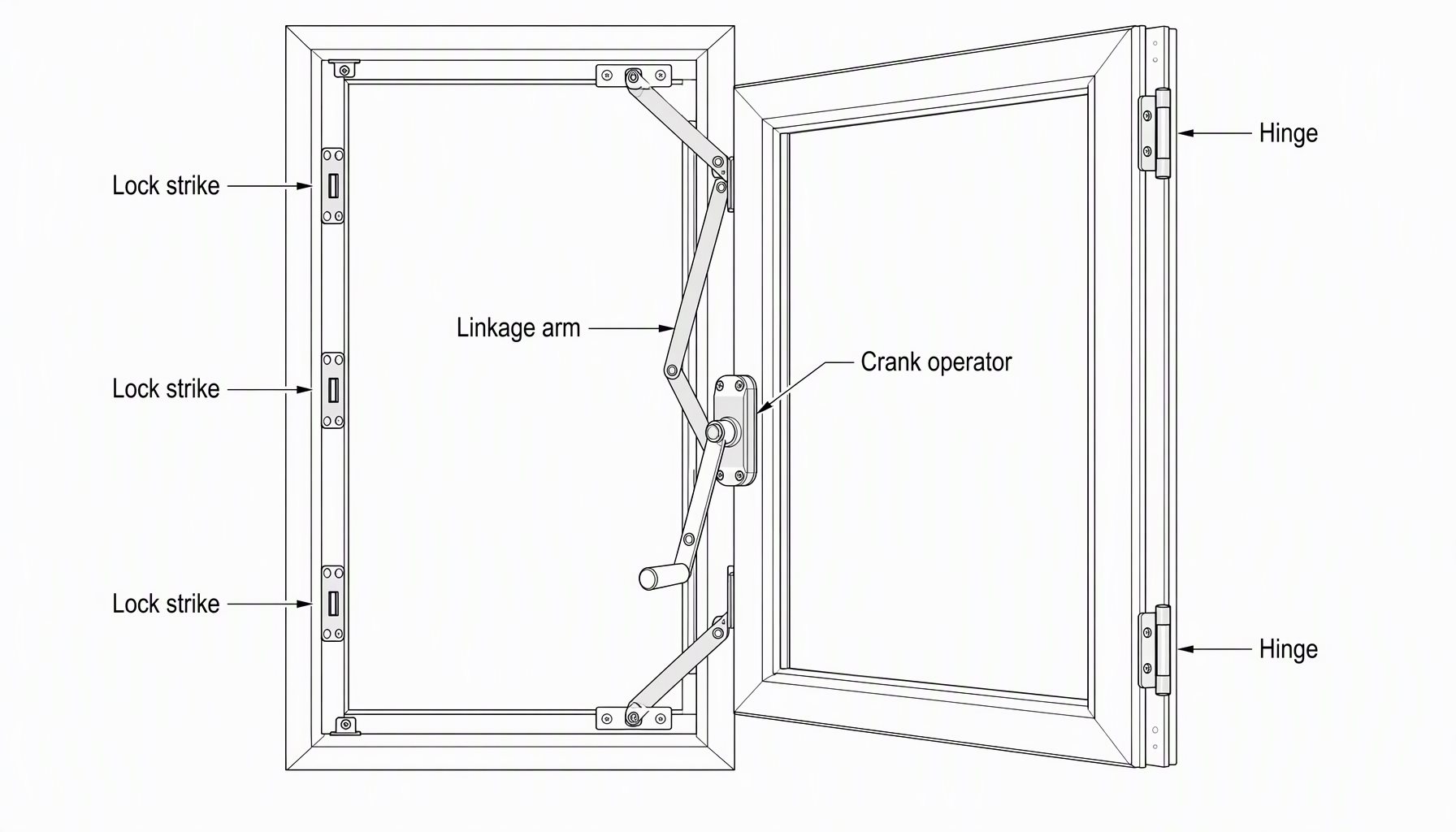
On casement and awning units, the crank operator converts hand torque into sash movement through a gearbox and a set of linkage arms. Over many cycles, grease degrades and gear teeth wear; the first symptom is a stiff, gritty crank near the start of the sweep. A related failure is geometry: if hinges sag or the frame shifts, the operator arms must pull the sash against its seals at the wrong angle, and the user experiences that as sudden resistance in the last few degrees of closing.
Sliding windows fail at a simpler interface. Debris packs into the track, roller treads flatten or shed, and the sash starts dragging along the rail instead of rolling. Aluminum frames do not swell with humidity the way wood does, so a sliding sash that has gone tight over time almost always points to rollers, track condition, or frame alignment rather than material movement.
Installation is the third and least-credited cause. Frames fastened out of plane, over-driven screws bending a sub-frame, or shim packs left under compression can leave a window that was fine on the bench and tight on the wall. This shows up as binding along the entire travel with an even gap pattern that is nonetheless wrong for the opening, and no hardware fault to find. In project terms, hard to open windows are often an installation record problem wearing a hardware costume.
Repairs That Hold, and the Point of No Return
Work the diagnosis from the outside in. For a sliding unit, lift the sash a few millimeters off its track with a proper block-and-tackle or suction handle and try again: if it moves freely suspended, the rollers and track are the problem, and cleaning the channel plus roller replacement is a durable repair. If it still binds, the sash or frame geometry is involved.
For crank-operated casements, open the sash, disconnect nothing, and swing it by hand. A sash that moves smoothly by hand but fights the crank is an operator or linkage fault; a sash that is stiff by hand too points at hinge alignment or frame distortion. Lubricate hardware only with what the hardware manufacturer lists; penetrating oils that film over seals create the next generation of complaints.
| Symptom | Likely Cause | Effective Action |
|---|---|---|
| Gritty stiffness through the whole crank sweep | Operator gearbox wear or dried grease | Replace the operator; matching by series, not by appearance |
| Hard to close the last few degrees | Hinge sag or linkage geometry out of position | Re-set hinges and arm positions, then re-check seal compression |
| Sliding sash drags along the sill track | Packed debris, flattened or derailed rollers | Clean channel, replace rollers to the system specification |
| Binding everywhere, hardware tests fine | Frame racked or over-fastened during installation | Correct the mounting condition; if the frame is deformed, replace |
| Handle turns but nothing moves | Stripped operator or disconnected transmission | Hardware replacement on the correct series |
The point of no return is a distorted frame. Heat a bent aluminum frame with a torch or force a racked sash with a longer handle and you convert a service problem into a replacement problem: yield geometry changes, seal lines stop matching, and the unit will never sit right again. If a shop test on the bench is free and the in-wall test is tight, fix the wall before condemning the window.
Two of our related guides cover the styles most often involved here: casement vs awning operation and aluminum sliding window details. If your hard-to-open complaint is actually a sash that will not stay put once open, that is a different mechanism and a different article.
What Operation Performance Means in a Specification
North American product specification treats operating force as a testable property, because hard to open windows are a measurable risk rather than a matter of opinion. Under the AAMA/WDMA/CSA 101/I.S.2/A440 standard system developed by the Fenestration Industries Standards associations, performance grades are verified through a test sequence that includes the operate force (O) designation alongside structural (PW), air (LC), water (CW), and condensation (RES) performance. The number in the O line is a classification from specimen testing, not a materials promise, and it applies to the tested configuration family.
Code adoption runs through the International Code Council system. The residential code, available full-text on ICC Codes Online, sets requirements for operable clear openings and egress that assume a window can actually be operated by an occupant, so hardware selection is not cosmetic: an operator sized for the sash weight and a sill-height plan that respects the code keep the assembly usable.
The practical specification language is short: require operators matched to sash weight per the manufacturer’s published hardware range, cap sash dimensions and glass package to the tested configuration, and ask the supplier to show that the exact assembly has passed the classification sequence. That is where a factory like ours locks the hardware set with the profile series: our OEM program records profile, glass, and hardware in one order-confirmation sheet, and the QC process tests operation on the line.
Decision Guide: Adjust, Replace Hardware, or Replace the Unit
| Project Requirement | Recommended Choice | Why |
|---|---|---|
| Units in square frames, stiff crank only | Operator and linkage replacement to series | The load path is sound; the mechanical element is consumable |
| Sliding sash drag in a clean, sound track | Roller replacement plus channel reset | Rollers are designed service items; track damage is not |
| Binding traceable to racked or over-fastened frame | Correct the installation interface before any product work | No hardware fix survives a distorted mounting condition |
| New project in a high-use or accessible unit | Specify sash sizes and glass weights inside the tested O-class range | Operate-force classification was earned by that configuration, not by the series in general |
Frequently Asked Questions
Why are hard to open windows worse in cold weather?
Seals stiffen as temperature drops, grease in operators thickens, and small clearances shrink as metals contract at different rates across the assembly. The result is more operating force needed across all three elements at once. Design clearances account for this, but worn hardware leaves no margin.
Should I lubricate a sticky crank operator myself?
Only with the product the hardware maker lists. The wrong lubricant films the seals, attracts grit, and converts a mechanical wear problem into a contamination problem. If the gearbox is gritty, it is worn, and grease does not rebuild teeth.
Is a misaligned frame the same as a racked frame?
They sit on a spectrum of the same defect family. Misalignment means the unit sits out of its intended plane or position in the opening; racking means the corners have lost square and the sash travels on a geometry the hardware was never set for. Both show up as binding that no hardware part explains.
Can a sliding window sash jump its rollers?
Yes, if stops or anti-jump blocks are missing, worn, or the wrong height for the glass package. That is a small force away from a falling sash, so inspect stops whenever roller service is done.
How big a window can still be comfortably operable?
There is no universal maximum. Comfortable operation is a relationship between sash weight, the operator or balance hardware range chosen for that weight, and the leverage geometry. This is exactly what a tested configuration and a hardware-range sheet express, and why oversized bespoke sashes are a spec conversation, not a catalog choice.
Do tilt-turn windows have their own binding issues?
Yes. The turn mechanism must engage and disengage at the right point in travel; worn strikes or a mis-set tilt function make the handle feel locked-up. See how tilt-turn hardware works before forcing the handle through resistance.
What should I send a manufacturer when operation complaints appear across a whole job?
A job-wide pattern points to installation condition or hardware range selection, not individual units. Send the opening schedule, installation photos at the frame perimeter, and which units are affected; that is the input for a system-level review rather than a serial-number exchange.
Send Your Schedule for an Operation and Hardware Review
If operating force is a risk on your project, send your drawings, opening schedule, location, and the operation you expect from each unit type. We can review hardware range against sash weight and glass package, and flag any sash that leaves the tested configuration, before production. Reach us through the windows hub or the contact page.