Part of our procurement series — see the full OEM and ODM program.
Search for aluminum window manufacturers and you will get hundreds of results, almost all of them calling themselves factories. The hard part is not finding a supplier — it is verifying which of them can actually build your product to specification, on time, and with documentation that survives a building code review and a customs broker’s questions.
This guide turns the work of comparing aluminum window manufacturers into a repeatable checklist: supplier type, engineering and production capability, quality system, testing evidence, and the red flags that should end a conversation. It is written for architects, contractors, developers, and importers who are comparing manufacturers rather than buying a stock window. For the full import journey from RFQ to loaded container, see our China sourcing guide.
Quick Summary
| Check | What it verifies |
|---|---|
| Supplier type | Factory, trading company, or integrated manufacturer |
| Engineering & production | Whether they can build your profiles, sizes, and hardware |
| Quality system | ISO 9001 and in-house QC records, not just marketing claims |
| Testing evidence | Test reports (not only certificates) for your exact configuration |
| Commercial & references | Payment terms, lead time, and verifiable past projects |
Start with the supplier type
Not every company listed among “aluminum window manufacturers” manufactures the same thing. Three supplier types dominate the market, and each changes where accountability sits:
| Supplier type | What they do | What to verify |
|---|---|---|
| Extruder | Produces aluminum profiles; may not fabricate finished windows | Profile alloy, temper, tolerances |
| Fabricator | Buys profiles and hardware, cuts and assembles into windows | In-house engineering, assembly QC, testing |
| Integrated manufacturer | Extrusion + fabrication + finishing + assembly in-house | Full-chain traceability, fewer handoffs |
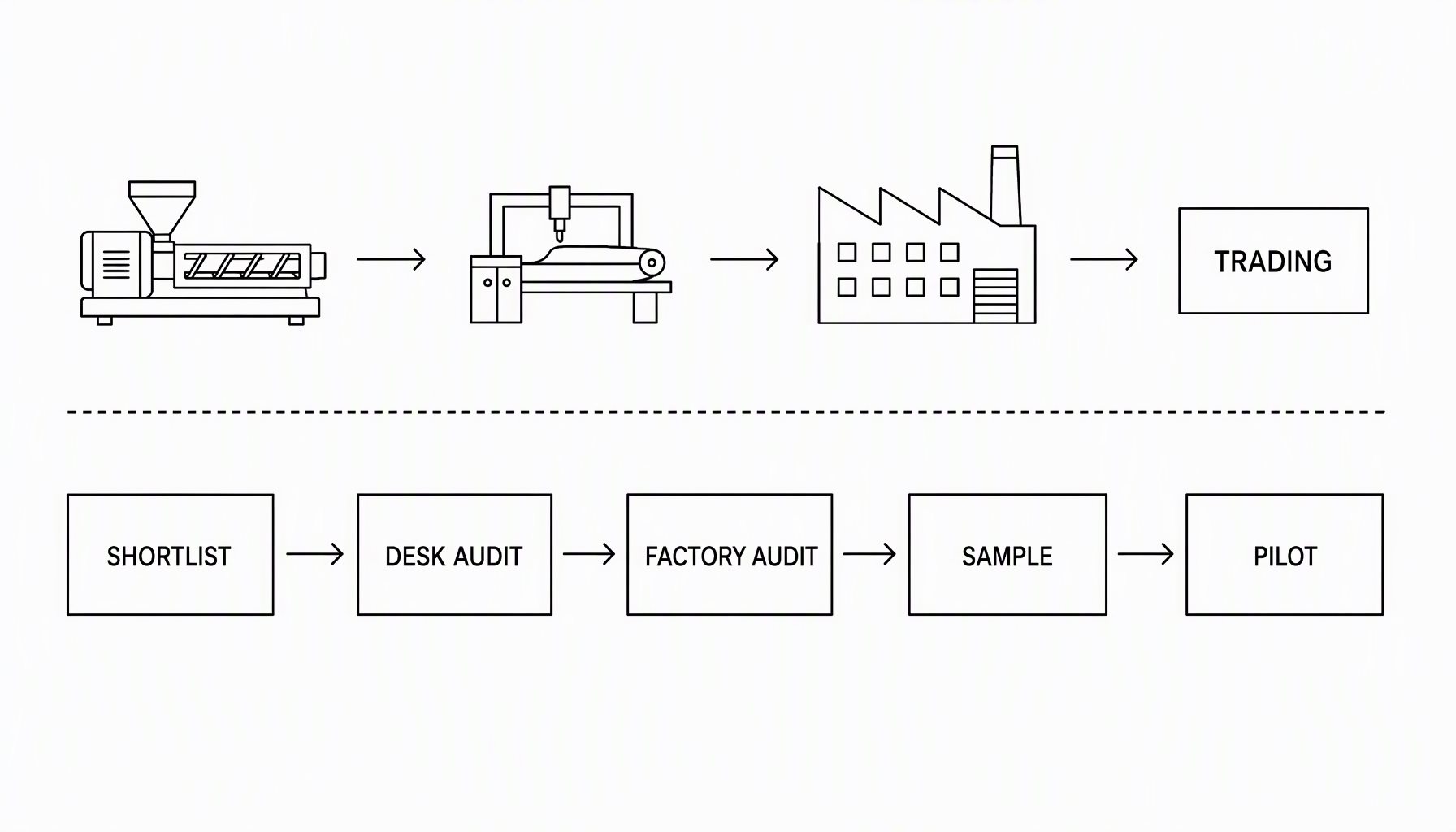
A trading company sits on top of any of these, buys from a factory, adds a margin, and sells under its own name. Trading companies are not automatically bad — many manage QC and export documentation well — but the further a supplier is from the physical production line, the harder it is to hold a single party accountable for a tolerance or a test result. For custom or code-critical work, the question to ask is: who owns the production, and can I trace a unit back to the line it came from?
The qualification checklist
Before you exchange drawings, run the supplier through these six questions. A credible manufacturer answers them with documents, not assurances.
- Engineering. Can they produce in-house structural calculations, section drawings, and a thermal assessment rather than copying a catalog? Do they understand the difference between NAFS performance classes and a project’s ASCE 7 wind load?
- Production. Confirm the profile system, wall thickness, corner joinery, and surface finishing (anodizing, powder coat, or PVDF). Ask where the glass unit is made and which hardware brands are used. Surface finishing is the specification most often written loosely and priced loosely with it; powder coated aluminum windows durability lists the coating questions worth putting in the RFQ.
- Quality system. Ask for the ISO 9001 certificate and — more useful — for a sample of in-process and final inspection records. A quality control system is a set of records, not a wall of logos.
- Testing. Request test reports that name the exact profile, glass make-up, hardware, and size you are quoting. Performance does not scale by arithmetic, so a report for a different configuration does not cover yours.
- Traceability. Confirm that production lots can be traced from raw material certificate to finished unit — useful when a warranty claim or a code review lands two years later.
- Commercial. Get terms in writing: payment milestones, lead time, packaging, freight responsibility, and the warranty’s scope and duration.
Window Quality Assurance: the Records That Prove It
Window quality assurance is not a certificate on a wall; it is a set of records that lets you trace a specific unit back through its production steps. The records that matter are incoming material verification (alloy and wall thickness on the extrusions, the barrier material, the glass and interlayer), in-process checks at the points where errors become invisible, and a final inspection with measured values rather than a visual pass.
Ask what is measured, at which step, and who signs it. A supplier with real window quality assurance can answer all three in a sentence and produce a sample record. Confirm the specific performance claims against the certified test data for the system you are buying.
Certificates vs. test reports: what to actually ask for
This is where most buyer-seller confusion happens. A certificate and a test report are not the same thing, and a wall of certificates does not make aluminum window manufacturers’ products code-compliant.
- A certificate (for example an ISO 9001 quality certificate, or a CE Declaration of Performance for the European market) tells you something about the company’s system or a declared product family.
- A test report tells you what a named specimen did in a named standard: air leakage under ASTM E283, water penetration under ASTM E331, structural performance under ASTM E330.
For the North American market, the documents that matter most are:
- NFRC ratings — U-factor, SHGC, and visible transmittance for a specific product, which is what ENERGY STAR and most US/Canadian energy codes cite.
- FGIA (formerly AAMA) certification and finish grades — including the AAMA 2603 / 2604 / 2605 coating ladder and the NAFS performance framework.
- Miami-Dade Notice of Acceptance (NOA) — for impact-rated products in the High Velocity Hurricane Zone and, by convention, anywhere impact products are sold on the Gulf and Atlantic coasts.
For the EU, the relevant product standard is EN 14351-1 with CE marking. A manufacturer that holds European and Australian marks in addition to North American ratings is often running a more mature testing program — but those marks do not certify a product for the US market. Match the certificate to the market you are actually selling into.
Verify before you order
Documentation is the first filter. Physical verification is the second.
- Order a sample unit. A sample reveals more in fifteen minutes than a PDF does in a week: operation, finish quality, sightline, gasket fit, hardware feel.
- Use third-party inspection. For first orders, a pre-shipment inspection by a firm such as SGS, Bureau Veritas, TÜV, or Intertek checks quantity, workmanship, and spec conformance against your PO before the container is sealed.
- Check references carefully. Ask for projects the supplier can actually name and, where possible, contact. A manufacturer that will not share references is telling you something.
- Run a pilot order. Test the full chain — quoting, engineering, production, packing, freight, documentation — with a small order before committing to container volume.
Red flags that should end a conversation
- No named test reports — only marketing brochures with generic performance claims.
- Vague answers on profile alloy, temper, or wall thickness.
- A refusal to put specifications, tolerances, and lead time in writing.
- An insistence on a large upfront payment with no milestone tied to verifiable production progress.
- No traceability, no QC records, and no one who can answer a technical question in writing.
None of these alone proves a supplier is bad, but several together is the pattern of a company that trades on margin rather than engineering.
Decision guide: how to run the evaluation
| Your situation | What to prioritize | Why |
|---|---|---|
| First container order | Pilot order + third-party pre-shipment inspection | De-risk before committing volume |
| Custom or profile-specific product | Factory with in-house engineering | Single party owns tolerances and drawings |
| Impact / hurricane market | Miami-Dade NOA + named test reports | Code requires an approved product |
| Commercial or high-liability project | Integrated manufacturer with traceability | Fewer handoffs, clearer accountability |
A practical sequence is: shortlist → desk audit (documents) → factory audit → sample → pilot order → scale. Most bad outcomes are avoided in the first three steps, before any container is booked.
Frequently asked questions
How do I verify an aluminum window manufacturer?
Work down the checklist in this guide: confirm supplier type, request engineering drawings and test reports for your exact configuration, check the quality system records, order a sample, and run a third-party pre-shipment inspection on the first order.
What is the difference between a factory and a trading company?
A factory physically produces the windows — an extruder makes profiles, a fabricator assembles them, and an integrated manufacturer does both. A trading company buys from a factory and resells. Trading companies can be competent, but accountability is harder to trace the further the seller is from the production line.
What certifications should an aluminum window manufacturer have?
It depends on your market. For North America, look for NFRC ratings, ENERGY STAR compliance, and FGIA finish and performance certification; for impact products, a Miami-Dade NOA. For Europe, EN 14351-1 with CE marking. There is no single “global certification” that covers every market.
Is a certificate the same as a test report?
No. A certificate describes a company system or a declared product family; a test report names a specific specimen, standard, and result. For code compliance, always ask for the test report that matches your exact profile, glass, hardware, and size.
What is a typical MOQ for custom aluminum windows?
There is no single number — minimum order quantity varies by product, customization, and finish. Confirm the MOQ in writing for the specific configuration you are quoting, and treat an unusually low MOQ as a prompt to verify the supplier type.
Should I hire a third-party inspection?
For a first order or a new supplier, yes. A pre-shipment inspection by a firm such as SGS, Bureau Veritas, TÜV, or Intertek verifies quantity, workmanship, and spec conformance before the container is sealed.
What are the red flags for a bad window supplier?
No named test reports, vague answers on alloy or wall thickness, an unwillingness to put specifications in writing, a large upfront payment without production milestones, and no quality or traceability records. Several of these together is the pattern to walk away from.
How do I evaluate custom aluminum outward-opening windows manufacturers?
Custom aluminum outward-opening windows manufacturers should be evaluated on the same three things as any supplier, plus one: whether they engineer the sash and hardware for the opening direction rather than adapting an inward-opening kit. Ask for a sample unit you can operate, the hardware brand and grade specified for outward opening, and the structural rating at your design pressure. Confirm the assembly against the certified test data before ordering.
Need aluminum windows for your project? Send your window schedule, performance requirements, and target market. Our team can review the system, glazing, and fabrication requirements before production — contact Lansen or review our OEM and ODM program.