A retrofit works on the window already in the wall. The profile, the thermal break and the glass make-up are fixed once the unit is installed; what remains changeable is the sealing system around and inside that frame: gaskets, weatherstrip, the glazing bead joint, the perimeter joint, and any secondary layer added to either face.
That boundary sets the ceiling on window frame insulation. Air infiltration and perimeter leakage can be cut enough that a window stops reading as drafty in ordinary weather. Conduction through a frame with no thermal break, or a break that is bridged, cannot be corrected by any gasket, film or blind.
The window frame insulation measures below are ordered by payback: gaskets, brush seals, glazing bead sealing, the rough opening, then the add-on layers — film, storm panels, secondary glazing, blinds — that change radiant behavior without touching the frame. The article closes with the cases where replacement is cheaper. If the leak path is unknown, trace it first with how to trace a draft to its source.
What Window Frame Insulation Can and Cannot Change
Three mechanisms matter, and they respond differently to retrofit work.
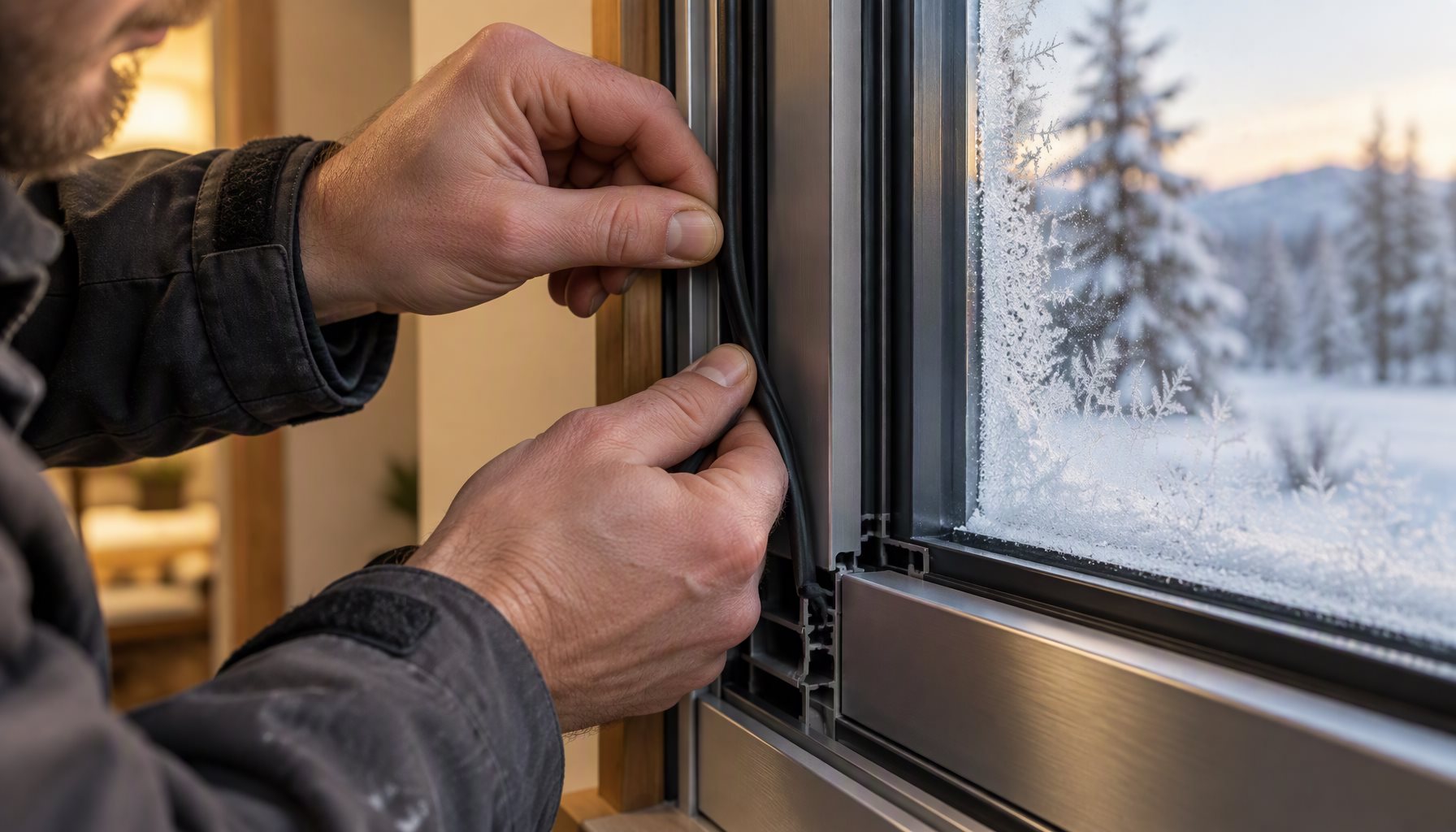
Infiltration is bulk air movement through gaps: sash to frame, bead to glass, frame to wall. It is what a retrofit targets, and where the return is largest, because the gaps are accessible and the fix is mechanical.
Conduction is heat traveling through aluminum, the thermal break and the glass. A frame without a break is one of the most conductive paths in the envelope, and no seal changes that. Radiation is solar gain and long-wave exchange at the glass, which surface treatments can modify. The U.S. Department of Energy’s Energy Saver program describes the same three mechanisms for existing buildings.
After a good retrofit the window leaks less, but its rated performance does not change: a laboratory air-infiltration value (ASTM E283) describes the product as manufactured, while a field check (AAMA 501) describes what is in the wall. Field work improves the second; it does not produce a new NFRC 100 rating.
The table below compares the measures.
| Retrofit measure | What it fixes and typical service life | When to skip it |
|---|---|---|
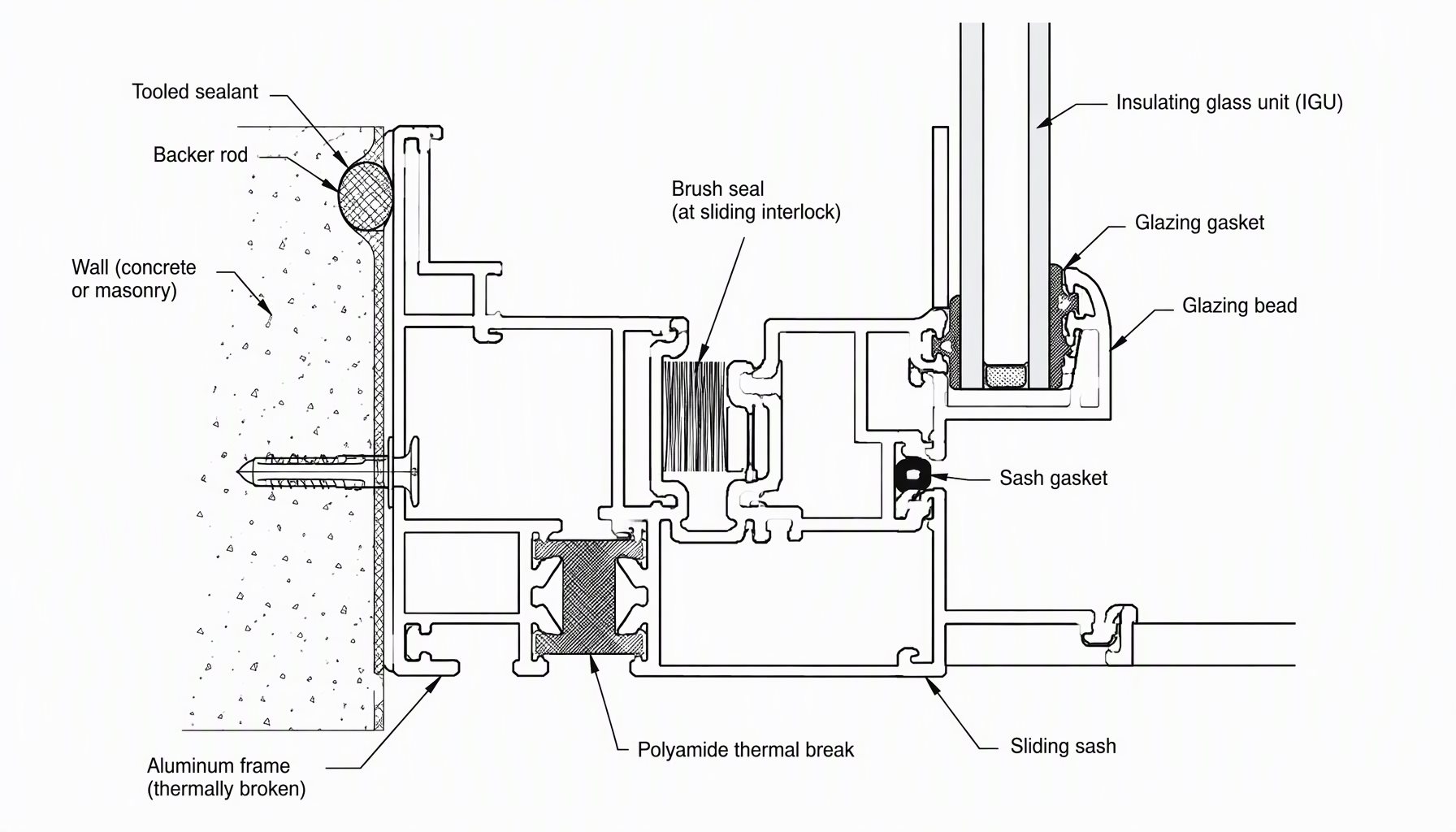
| Perimeter joint: backer rod, sealant, air-barrier tie-in | Bulk air leakage between frame and wall — the largest single path on many buildings. A tooled sealant joint typically lasts 10-20 years, less on high-movement joints. | Skip only where the joint is already sound; never skip the air-barrier tie-in |
| Sash gasket and weatherstrip replacement | Infiltration at sash-to-frame from compression loss and hardened seals. EPDM typically 10-15 years, longer for silicone. | Skip on a frame with no thermal break if condensation, not draft, is the complaint |
| Brush and pile seal renewal at sliders | Meeting-stile, track and sash-perimeter leakage on sliding units. Typically 5-10 years depending on traffic and abrasion. | Skip if the track is worn through, out of level, or the sash is out of square |
| Glazing bead re-seal or re-glaze | Leakage at glass-to-bead and bead-to-frame joints. Typically 10-20 years. | Skip if the IGU has already failed; the glass unit is the repair |
| Low-e or solar-control film | Radiant exchange and solar gain at the glass. Architectural film typically 10-15 years. | Skip on annealed glass at thermal-stress risk, or where the glass warranty excludes film |
| Exterior storm panel | Wind-driven rain, air washing over the facade, some radiant loss. The panel typically 15-25 years, less for fixings. | Skip where the cavity cannot drain and vent, or where egress and daylight are compromised |
| Interior secondary glazing | Conductive and radiant loss at the glass — the largest thermal gain of the add-on options. Typically 15-25 years. | Skip where it obstructs egress, sash operation or cleaning access |
| Thermal blind or cellular shade with side tracks | Convective loop and radiant loss at the glass, at night. Fabric and mechanism typically 5-12 years. | Skip as an insulation measure if the edges are not sealed |
| Frame replacement (reference case) | Conduction through the frame, glass performance and rated assembly values. Typically 25-40 years. | Not a retrofit measure; compare against the sum of the rows above |
Service lives are typical ranges, not quotations. Where a number decides an approval, confirm against the certified test data for your configuration.
Two measurements decide whether window frame insulation work is worth doing: an air-leakage test of the installed assembly, which quantifies removable leakage, and a thermal scan on a cold day, which shows whether the frame itself is the cold surface.
Gaskets and Weatherstrip: Replace, Do Not Top Up
A worn gasket leaks because it has lost compression set — the ability to spring back after years of being squeezed. Foam laid over a hardened gasket does not restore that; it takes a set within a season and leaves the original gap. Replacement is the only reliable route.
EPDM and silicone are the exterior-grade options. EPDM is the workhorse: good compression recovery, moderate UV resistance, lower cost. Silicone holds its properties across a wider temperature range and resists UV better, at higher cost, and suits high-exposure elevations and hard-to-reach joints. Avoid PVC and low-grade foam: plasticizer migration hardens the surface, and foam crushes permanently.
Profile follows the joint. Bulb gaskets tolerate movement; fin and leaf seals suit narrow gaps and sliding interfaces. For kerf-mounted systems, match kerf width and bulb compression. For surface-mounted, the adhesive is the weak point: clean and prime the substrate, never apply over chalked powder coat, and add mechanical retention where the joint faces sun.
Compression is where retrofits go wrong. A bulb should be compressed by roughly a fifth to a third of its free height when the sash closes — enough to seal, not enough to preload the sash or stop the lock latching. Keep every weep path clear: a gasket run crossing a sill weep slot seals water into the frame.
Corners matter more than straight runs. Butt joints at miters open with age, so use corner-molded or vulcanized frames, or a continuous run with the joint at a low-stress location. A perimeter seal is only as good as its worst joint.
Brush Seals and the Sliding Interlock
Horizontal sliders and sliding doors leak at three places a hung window does not: the meeting stile, the track, and the sash perimeter. The seals there are pile or brush, and they wear by abrasion rather than compression.
Pile height must match the gap. Too short and it does not reach the opposing surface; too long and the sash drags and skews. Dense polypropylene pile outperforms wool in wet service. Where the gap varies, a tandem brush or a brush plus a flexible fin is more forgiving than a single pile.
At the meeting stile the interlock carries its own gasket or pile, and a worn interlock seal is often the largest leak on a slider and one of the cheapest to replace. Check the rollers at the same time. Lowering the sash a turn on the adjustment screw increases compression at head and sill, within a small range before it drags. If the track is worn through or the sash is out of square, new seals will not hold.
Glazing Bead and the Glass-to-Frame Joint
Two joints around every lite can leak: glass to bead, and bead to frame. In a dry-glazed system a gasket does the work, relying on compression from the bead; in a wet-glazed system a sealant does it. When either has failed, the bead has to come off.
Remove the bead without distorting it, inspect the gasket or sealant bed, and replace rather than over-seal. A new EPDM glazing gasket, or glazing tape plus a back-bedding bead, gives a controlled joint. Butyl tape is a vapor barrier, not a structural or drainage solution, and sealant over a wet or dirty joint fails at the bond line.
The rule that matters most: never seal the drainage path. Weep slots and the sill drainage chamber let water that passes the outer seal escape. A bead sealed all round with the weep slots filled holds water against the glass edge and spacer, and the IGU edge seal fails first.
If the IGU has already failed — persistent haze, desiccant saturation, condensation between the panes — bead work will not restore it.
The Rough Opening and the Perimeter Joint
On a large share of buildings the biggest air path is not the window: it is the joint between frame and rough opening. That joint is also the one most often sealed from one side only, or filled with foam and left.
A perimeter joint is both the air seal and the rain seal, and they are not always in the same plane. In cold climates the interior side is normally the air barrier and the exterior side the rain screen; sealing both faces vapor-tight can trap moisture. Backer rod and a tooled sealant joint remain the default for a moving joint; low-expansion foam is a filler behind the sealant, not the seal. Exposed foam degrades under UV, and high-expansion foam can bow a jamb.
Air-barrier continuity is the part that gets missed. The wall’s weather-resistive barrier must connect to the frame, not stop at the opening. A gasket between frame and wall, a sealed sill pan and head flashing that drains belong to the same assembly. For sequencing and shim details, see rough opening preparation for aluminum windows.
Confirm the frame is plumb, square and not twisted first: sealant bridging a twisted frame is under permanent strain and will crack.
Window Film, Storm Panels and Secondary Glazing
These three add a layer at the glass, and they differ in what they change.
Solar-control film reduces solar heat gain and glare; a low-e film reduces long-wave radiant exchange at the glass. Neither stops conducted heat through an aluminum frame, so neither corrects a cold frame. Film raises glass temperature, and on annealed glass in a large lite with partial shading the thermal stress can crack the pane; some glass warranties exclude film.
Exterior storm panels create an insulating air cavity and a wind barrier. Their anchorage must be designed for the wind load on the assembly, with the project’s structural basis of design as the reference; ASTM E330 is the usual test basis for that performance. The cavity has to drain and vent at the bottom, or the panel becomes a condensation and mold problem instead of an insulator. Panels also change daylight and egress.
Interior secondary glazing gives the largest thermal gain of the add-on options, because it creates a still air layer on the warm side — provided the perimeter is sealed and the cavity stays dry. Detail it so the primary glass stays above the dew point, and leave a way to ventilate the cavity. Check that it does not obstruct egress, sash operation or cleaning access.
Thermal Blinds and Interior Shading
A shade is not insulation unless it is sealed at the edges. For further reading on how interior shading interacts with window heat loss, see the LBNL Windows program. Cellular shades with side tracks and a sealed head and sill reduce the convective loop over the glass, and multi-layer or foil-faced products add a radiant barrier. A roller blind hung off each jamb mostly changes appearance.
Where they work, they work at night: reduced heat loss in the heating season, typically a tenth to a quarter of the window’s heat loss for a well-sealed multilayer product, falling away as the edge gap grows. In cooling-dominated climates the same shade can increase load if it traps solar gain.
Condensation is the constraint. A tight blind over a cold pane holds moist air against the glass, and where the frame is already below the dew point the problem becomes visible: mold in the pleats, staining at the sill. Use one as insulation only where the glass stays above dew point, or leave a controlled vent path.
When a Retrofit Is Futile
Retrofit money is wasted in five situations.
The frame has no thermal break. Sealing reduces infiltration, but the aluminum surface still runs near outdoor temperature, condenses and conducts.
The thermal break is bridged or degraded. A conductive fastener through the break, a cracked break, or a frame never isolated at the sill cannot be corrected from the interior. Check the construction against how a thermal break is built into the profile before assuming a seal will help.
The IGU has failed. That is glass replacement, not bead work.
The frame is corroded, out of square, or water has been entering the wall. The leak is now a wall problem.
The project must meet a rated performance target. A field retrofit does not produce a new NFRC 100 rating, and an inspector will not accept one.
In those cases the honest answer is replacement, and the specification effort belongs in frame and glass selection. Our aluminum window and door systems are built for the North American market with certified performance data behind each configuration. For the energy-performance side of that selection, see how aluminum windows are rated for efficiency.
If your frames are sound but the seals are at end of life, our engineering team can review the details and the sequence: contact Lansen with the frame type, the exposure and the failure pattern, and we will tell you which measures are worth doing.
Frequently Asked Questions
Can insulation be added inside an existing aluminum window frame?
Not usefully. The hollow chambers in an aluminum profile are part of the frame’s structure and drainage, and injecting foam adds little thermal resistance while risking blocked drainage and corrosion at drilled holes. The effective work is at the joints, not inside the extrusion.
Does new weatherstrip stop condensation on the frame?
Only partly. Condensation forms when the frame surface falls below the dew point, which is a temperature problem rather than a leakage problem. Sealing reduces the moist air reaching a cold surface, but a frame without a thermal break will still condense in cold weather.
Which window frame insulation measure gives the best return?
The perimeter joint and the sash gaskets, in that order, because they address the largest air paths and are the cheapest to access. Glazing bead work and brush seals follow; film, storm panels and blinds are the last layer and should be judged on comfort rather than draft reduction.
Does window film change the window’s U-factor?
No. The U-factor is established under NFRC 100 for the product as manufactured, and field-applied film does not create a new rated value. A low-e film can reduce radiant heat exchange at the glass, but the conducted path through the frame and spacer remains.
How do I decide between retrofitting and replacing?
Test first: a field air-leakage check quantifies the leakage a retrofit can remove, and a thermal image shows whether the frame itself is the cold surface. If the frame has a thermal break, the glass is intact and the leakage is at the joints, retrofit. If the break is bridged, the IGU has failed, or the frame is corroded, replacement is the lower-cost path.