A U-factor is a rate of heat transfer per unit area per degree of temperature difference, expressed in North American window practice as Btu/h·ft²·°F. Lower is better, because a lower number means less heat moving through the assembly for every degree between inside and outside.
The confusion starts because a window is not one surface. It is a frame, a glass unit, an edge spacer, and a set of seals, and each of those transfers heat at a different rate. So the industry reports three related numbers: Uf for the frame, Ug for the center of the glass, and Uw for the whole window. Only one of them describes the product you are actually buying, and it is Uw — which is why an aluminum window U-factor should always be quoted as Uw, never as a component value.
If you are comparing quotes and one sheet says “U-value 0.24” while another says “U-factor 0.32,” you are probably looking at two different quantities — a center-of-glass number against a whole-window number. They are not comparable, and the gap between them is where a specification gets won or lost.
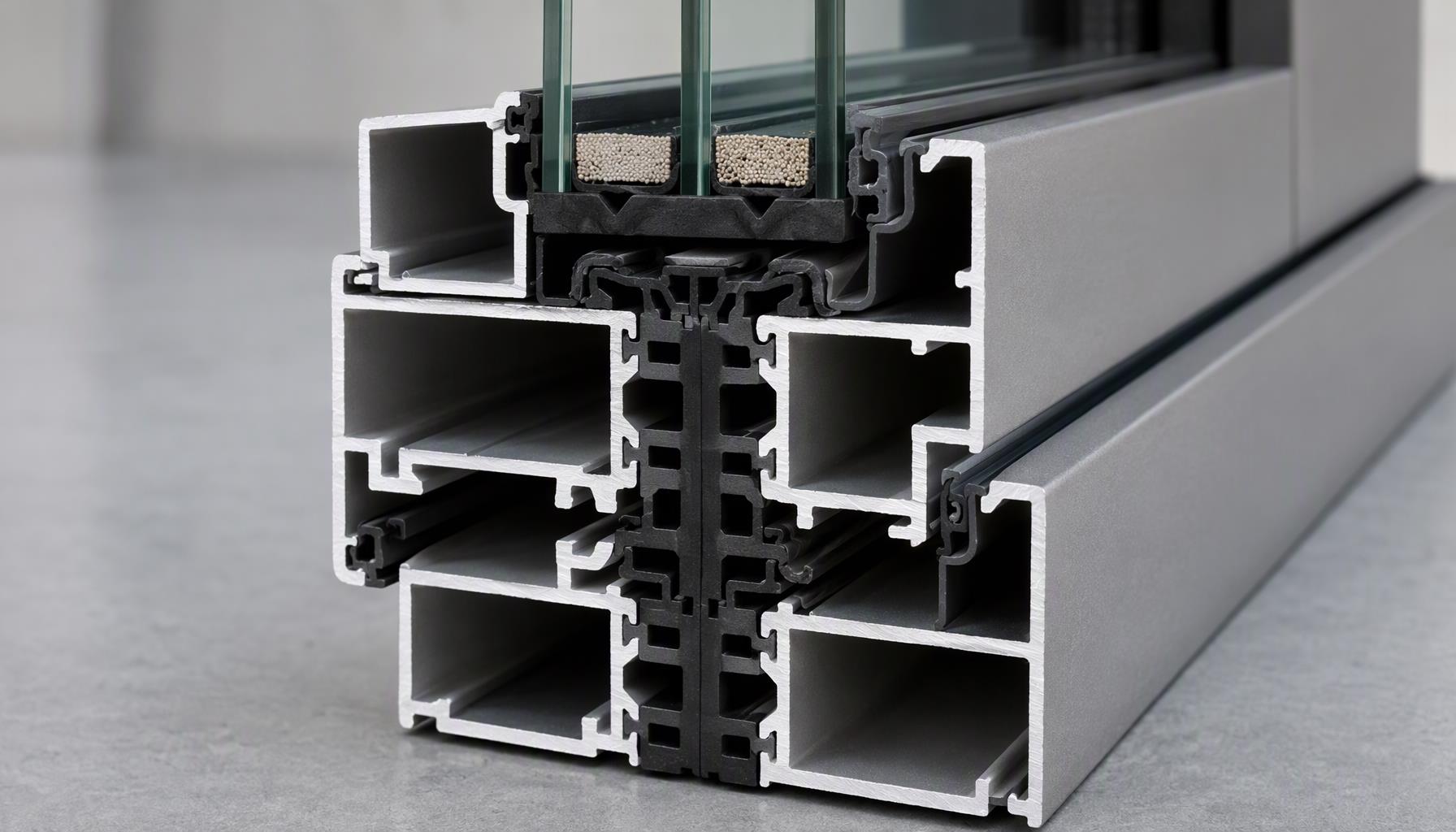
What Each U-Value Actually Measures
Each of the three numbers comes out of a different calculation with a different boundary.
Uf — frame U-factor. Heat flow through the frame section only, including the thermal break, the aluminum walls on either side of it, and the frame’s interior and exterior surfaces. Uf is not a single measurement; it is computed at several frame cross-sections (head, jamb, sill, meeting stile) and area-weighted. A wide polyamide barrier and multiple isolated chambers push Uf down; a shallow barrier or a conductive bypass through a hardware screw path pushes it up. Frame U-factors in thermally broken aluminum commonly land in the 0.40-0.80 range, and they vary a great deal between systems that look identical in a photograph.
Ug — center-of-glass U-factor. Heat flow through the middle of the insulating glass unit, away from the edges, where the spacer and frame no longer influence the result. Ug is driven almost entirely by cavity count, gas fill, Low-E coating properties and glass thickness. Center-of-glass values of 0.20-0.30 are routine for a good double-glazed Low-E argon unit. This is the number suppliers like to quote because it is the most flattering.
Uw — whole-window U-factor. The area-weighted combination of Uf, Ug and the glass-edge contribution, expressed over the total product area including the frame. Uw answers the question the building code and the energy model actually ask: how much heat does this window lose?
Why Center-of-Glass Numbers Mislead
A center-of-glass figure excludes the frame entirely, and the frame is where aluminum windows historically fail. On a large fixed picture window the frame might be 8% of the total area, and the gap between Ug and Uw is modest. On a casement with divided lites, a narrow tilt-turn, or a door with substantial stile width, frame and edge claim a much larger share of the area and the gap widens accordingly.
There is a second distortion. The glass edge — the zone a few centimeters in from the sight line, where the spacer sits — performs worse than the glass center, because heat travels along the spacer and through the frame around the glass. Warm-edge spacers exist specifically to shorten that path. A center-of-glass number describes a region with no edge, no spacer, no frame and no seals.
The practical rule: any performance number presented without stating its basis (Uf, Ug, Uw) and its rating authority is not a specification. Treat it as marketing until the basis is named.
Table: Uf vs Ug vs Uw Side by Side
| Term | What it measures, and the range it usually lands in | What moves it |
|---|---|---|
| Uf (frame U-factor) | Conduction through the frame cross-section only, including the thermal break, computed per frame section and area-weighted. Typically 0.40-0.80 for thermally broken aluminum. | Polyamide barrier width, chamber count, frame depth, hardware penetrations, spacer-to-frame interface |
| Ug (center-of-glass) | Conduction through the middle of the IGU, away from spacer and frame. Typically 0.20-0.30 for a double Low-E argon unit, lower for triple. | Cavity count, gas fill, Low-E coating, glass thickness |
| Uw (whole-window) | Area-weighted conduction through frame, glass and edge over total product area. Typically 0.28-0.40 for thermally broken aluminum with a double Low-E argon unit. | Everything above, plus product size and frame-to-glass area ratio |
Reporting authority is the other half of the row. Uf comes out of NFRC simulation output and component data used for energy modeling, Ug comes from glass fabricator data sheets and NFRC component libraries, and only Uw appears on the NFRC 100 rated label — the number a jurisdiction, an energy consultant or a LEED reviewer will accept. Uf and Ug are intermediate values that explain why a Uw came out where it did. When you ask a supplier for an aluminum window U-factor, this is the table to hold them to.
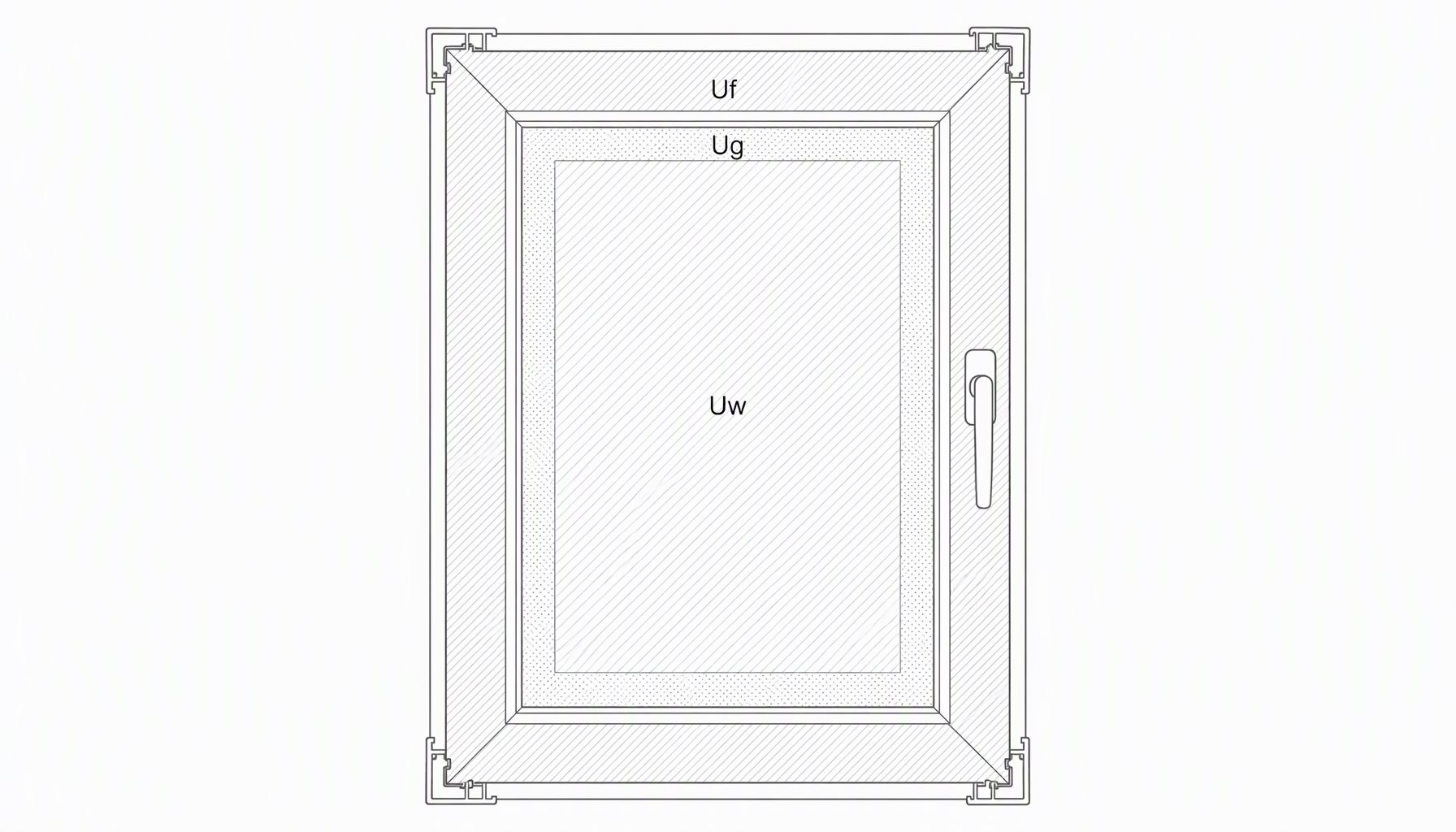
How Whole-Window Uw Is Actually Assembled
Under NFRC 100, Uw is primarily a simulation result, not a hot-box measurement. A validated two-dimensional heat-transfer model is built for each frame cross-section and each glass edge, combined with center-of-glass data, then area-weighted across the product geometry:
1. Frame sections are modeled in 2D — head, jamb, sill and meeting stile — with conductivities assigned to aluminum, polyamide, gaskets, glazing and any reinforcing steel.
2. Edge-of-glass effects are modeled, including spacer, sealant and desiccant, because heat bypasses the glass through the edge.
3. Center-of-glass performance is pulled for the specific IGU build from validated glass data.
4. Everything is area-weighted across the product’s actual dimensions and sight lines.
Step four is why Uw is size- and configuration-dependent. A casement and a large fixed unit from the same frame and glass will not carry the same Uw, and changing the gas fill, spacer, coating, frame finish or divided-lite layout moves it again. The only defensible source for a project number is the certified test data — confirm against the certified test data for your exact configuration before writing an aluminum window U-factor into a specification. The simulation is also only as good as the cross-sections it is built from, which is where the profile and assembly controls behind a system matter as much as the model.
Where Uw Fits Against Codes and ENERGY STAR
US energy codes are adopted state by state and generally reference IECC or ASHRAE 90.1, which set maximum U-factor by climate zone and window-to-wall ratio, with U-factor/SHGC trade-offs in some compliance paths. Because adoption differs by state and code cycle, the applicable maximum is a jurisdiction question, not a national constant. ENERGY STAR maintains separate performance tiers for its Northern, North-Central, South-Central and Southern regions. Two practical notes for specifiers:
- The compliance metric for an aluminum window U-factor claim is Uw, not Ug. A center-of-glass number will not satisfy a reviewer.
- U-factor and SHGC trade off. In cooling-dominated climates a slightly higher U-factor with a much lower SHGC can be the better building; optimizing U-factor alone in Miami or Phoenix is a common and expensive error. For the whole-building side of that trade-off, see our guide to aluminum window energy efficiency.
Air leakage is separately rated and separately important. ASTM E283 is the standard test method for air leakage through exterior windows, curtain walls and doors under a pressure difference, and it produces the figure that appears beside U-factor on a rated label. Infiltration is not part of Uw at all, so a tight window with a mediocre U-factor can outperform a leaky window with a good one in service.
Structural Ratings Are Not Thermal Ratings
U-factor says nothing about whether a window survives wind load or water, and a quote that offers one in place of a structural package is incomplete.
| Property | Governing standard | What it establishes |
|---|---|---|
| Thermal and optical performance | NFRC 100, validated under NFRC 200 | Rated U-factor, SHGC and VT for labeled products |
| Air leakage | ASTM E283 | Air infiltration rate at a specified pressure difference |
| Water penetration resistance | ASTM E547 | Resistance to water penetration under cyclic static pressure |
| Structural wind load | ASTM E330 | Structural performance under uniform static air pressure difference |
| Organic coating performance | AAMA 2605 | High-performance organic coating requirements for aluminum |
A product can be excellent thermally and inadequate structurally for a given exposure, or the reverse. Coastal high-wind zones, high-rise curtain wall work and storefront systems each add requirements a U-factor discussion never reaches. On the finish side, AAMA 2605 is the exterior durability benchmark worth confirming for coastal or high-UV exposure; a dark coating does not change U-factor, but it raises frame surface temperature, which affects condensation resistance and thermal movement.
Comparing Two Quotes Without Getting Fooled
Most bad comparisons are apples-to-oranges comparisons. Normalize two aluminum window U-factor quotes before you compare the numbers.
1. Establish the basis of every number. Ask each supplier to label performance data as Uf, Ug or Uw. Anything unlabeled gets set aside.
2. Match the size. Whole-window U-factor is size-dependent. Ask for the rating at the size you are buying, or for the range across the sizes in your package.
3. Match the glass build. Low-E type, coating surface position, gas fill, spacer type and glass thickness must line up. A quote with argon against a quote with air is not a U-factor comparison; it is a glass comparison.
4. Ask for the certified data, not a summary. Request rated label data for the exact configuration. Where a figure depends on the specific certified product, the supplier should point to the reported value rather than a rounded claim.
5. Confirm the structural package separately. Check ASTM E283, ASTM E547 and ASTM E330 performance against your project’s design pressure instead of assuming a good thermal rating implies a good structural one.
6. Ask what changes the number. A competent supplier will name which options move Uw and roughly how much — a different spacer, a heavier frame section, a triple-glazed upgrade. A supplier who says every configuration performs the same has not modeled the configurations.
Two failure patterns recur in sourcing. The first is a single flattering center-of-glass figure presented as the product’s rating. The second is a whole-window figure quoted for a small fixed unit and applied to a whole project that is mostly operable windows and doors, where frame area is a larger fraction and the real Uw is worse. Both are avoidable with one question: which size, which glass, which basis.
What Moves the Number, and What Does Not
Ranked by how much influence each lever has on whole-window U-factor in a thermally broken aluminum system:
- Glass package. Cavity count, Low-E, and gas fill move Ug substantially. This is the biggest single lever.
- Frame section. Barrier width, chamber count, and frame depth set Uf. This is where two visually identical thermal break window systems diverge.
- Spacer type. Warm-edge spacers reduce the edge penalty and therefore Uw, especially on smaller units where edge area is proportionally large.
- Product type and size. Frame-to-glass area ratio is a geometry effect, not a material one. Fixed units rate better than operable ones; large units rate better than small ones.
- Installation and air sealing. Not part of Uw at all, but it is the difference between a rated window and a rated assembly. Rough openings, flashing and perimeter sealant determine whether rated performance survives into the wall.
Finishes, hardware and screen type generally do not move Uw, though a dark frame finish does affect surface temperature and condensation behavior — a separate conversation from U-factor.
Frequently Asked Questions
What is the difference between Uf, Ug, and Uw?
Uf is the U-factor of the frame cross-section only, Ug is the center-of-glass U-factor of the insulating glass unit, and Uw is the whole-window U-factor that combines frame, glass, and edge over the total product area. Uw is the number used for code compliance and energy modeling. Uf and Ug are intermediate values that explain how the Uw was reached.
Is a lower U-factor always better?
For heat loss, yes — a lower U-factor means less heat transfer per degree of temperature difference. But U-factor is only one metric. In cooling-dominated climates, a slightly higher U-factor paired with a lower SHGC often produces a better-performing building. Structural ratings and air leakage also have to be satisfied separately.
Why does my supplier quote a center-of-glass number instead of whole-window?
Because center-of-glass values are typically lower and therefore more attractive in a comparison. A center-of-glass figure excludes the frame, the spacer, and the seals, which is exactly where an aluminum window loses heat relative to its glass. Any number that does not name its basis should be treated as unverified until the supplier labels it.
Can the same window have two different whole-window U-factors?
Yes. Whole-window U-factor depends on size and configuration, so the same frame and glass build can produce different Uw values at different dimensions, and different values again when you change the spacer, the gas fill, or the coating. Ratings apply to specific configurations, so confirm against the certified test data for your exact configuration rather than generalizing from one rated size.
Which standards should a U-factor specification reference?
Reference NFRC 100 for the thermal simulation and NFRC 200 for the validation procedure, and add ASTM E283 for air leakage, ASTM E547 for water penetration, and ASTM E330 for structural wind load so the thermal requirement is not standing alone. Where an exterior coating is specified, AAMA 2605 sets the high-performance benchmark for aluminum.
Lansen Windows & Doors manufactures thermally broken aluminum windows, doors, sunrooms, curtain walls, and skylights in Foshan, Guangdong, and exports to North American importers, contractors, and window brands. For NFRC-rated performance data on a specific configuration, or to discuss a project package, request a project estimate.