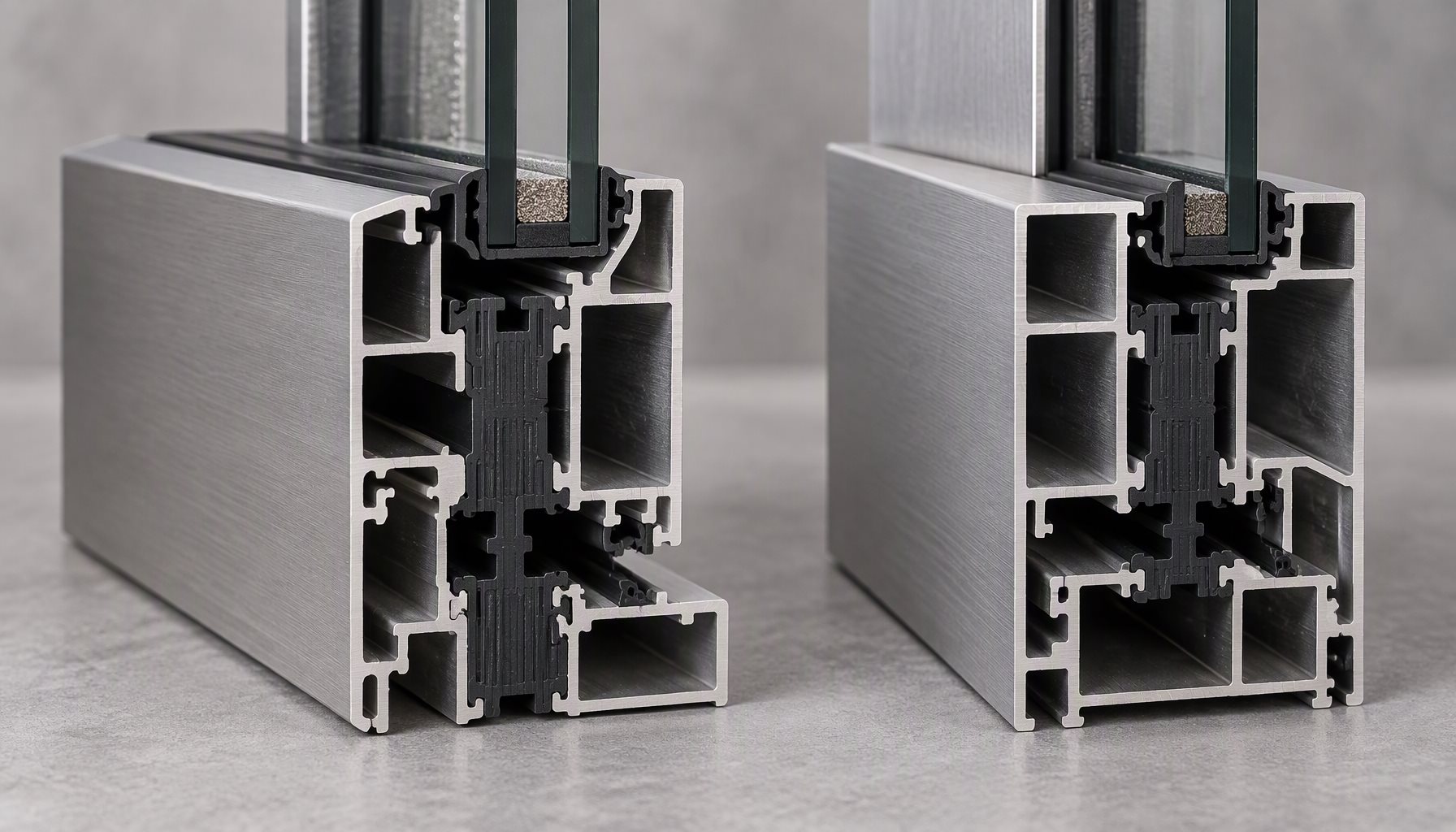
A thermal break is one design idea: separate the interior and exterior aluminum so heat has no continuous metal path through the frame. But there are two established ways to manufacture it — the poured vs crimped thermal break, i.e. poured-and-debridged and crimped strip — and they are not interchangeable.
This guide is about the process layer: how each thermal break is made at the extrusion, where the quality risks sit, and what to verify when you specify a thermally broken system for a window or door. It is deliberately not about finished-window performance numbers, which are a separate question answered by the whole assembly.

What a thermal break actually does
Aluminum is a good heat conductor; the polymer barrier inserted into the profile is a poor one — several orders of magnitude apart. Without a break, a frame becomes a thermal short circuit: cold on the interior face in winter, hot in summer, and a condensation surface in between. The break interrupts that path by replacing metal with a low-conductivity material between the interior and exterior chambers.
For a window, the frame is only part of the story — glass, spacer, and dimensions carry most of the whole-window performance. But the break is the one element that makes an aluminum frame able to meet modern energy codes at all. That is why the manufacturing method deserves scrutiny.
It is also the feature most often specified carelessly. “Thermally broken” describes an idea, not a process — and the two processes behind thermal break windows carry different risk profiles.
Poured-and-debridged: how it is made
The extrusion is designed with a continuous cavity running along the profile. Liquid polymer — typically polyurethane — is poured into that cavity and cured. Then a saw cuts away the thin aluminum bridges that still connect the interior and exterior halves, a step called debridging, leaving the cured polymer as the only structural and thermal connection between them.
The method has two inherent sensitivities. First, the saw cut must fully remove both bridges; any metal left behind re-establishes a thermal path and quietly undoes the break. Second, the polymer’s bond and long-term behavior depend on the pour chemistry and on shop control during curing. A well-run line produces excellent results; the process tolerates less sloppiness than the geometry suggests. Offcuts from the debridging step are a useful tell: a correctly processed extrusion shows a clean, consistent break along its full length.
One practical consequence of the in-line pour is scale. The cavity must stay continuous for the whole length of the extrusion, which suits long straight runs and makes tight formed geometries more demanding to keep consistent.
Crimped strip: how it is made
The crimped method inserts a glass-fiber-reinforced polyamide strip — commonly PA66 GF25 — between two separate aluminum profiles, then mechanically crimps or knurls the aluminum onto the strip so the parts lock together as one assembly.
Because the strip is a pre-manufactured component rather than a liquid poured in place, the barrier’s material properties are consistent from batch to batch, and the assembly relies on mechanical engagement rather than chemical cure. The trade-offs are in the crimping operation itself: consistent engagement along the full length matters, and the strip’s width and fiber content strongly influence both the structural capacity and the thermal resistance of the finished profile.
Crimp quality is checkable. An under-crimped section reduces the mechanical engagement between metal and strip, which shows up as reduced structural capacity long before it shows up as a thermal problem. That is why serious production of crimped systems includes documented roll or press settings and periodic section checks along the profile rather than a single glance at the first bar of the run.
Poured vs crimped thermal break: head to head
“Poured vs crimped thermal break” is the question buyers ask most often, and the honest answer is that the method decides the risk profile, not the performance ceiling.
| Factor | Poured-and-debridged | Crimped strip |
|---|---|---|
| Barrier material | Poured polymer, cured in cavity | Pre-made polyamide strip |
| Key process risk | Incomplete debridging; cure control | Engagement consistency along length |
| Batch consistency | Depends on pour chemistry | Consistent (component-based) |
| Typical use | North American systems | European and export systems |
Neither column is a verdict. The table is a risk map: it tells you which questions to ask the supplier of that profile, not which building to put the window in.

What decides performance — the break is not the whole answer
It is tempting to treat the method as the performance verdict. It is not. In a poured vs crimped thermal break at equal cavity depth and equal barrier width, both designs can deliver comparable thermal resistance; the finished performance depends on the whole frame design.
- Cavity depth and barrier width. A deeper, wider break resists heat flow better than a shallow one, regardless of how it was made.
- Continuity. The break must run continuously through the mullion, transom, corner, and any reinforcement. A single unbroken metal contact — a screw, a reinforcement insert, a corner cleat — short-circuits the whole assembly.
- Chambers and gaskets. Multi-chamber profiles and correctly seated gaskets reduce convection and infiltration inside the frame cavity; how much chamber space is left to work with is largely set by the window system you specify.
- Spacer and glazing. In a window, the warm-edge spacer and the insulating glass unit often matter more to whole-window thermal performance than the frame break does.
This is why “we use a thermally broken profile” is not a specification. The question is which break, how deep, and whether it is continuous through every junction.
The practical test is a drawing review, not a marketing claim. Ask for a section drawing of the frame and trace the aluminum path from the exterior face to the interior face — if there is any continuous metal route, the break is incomplete regardless of which process made it.
Where code compliance is involved, the finished unit is assessed against the code your project is under. In the US, most jurisdictions adopt a model code from the International Code Council, which references a fenestration performance framework rather than accepting a single manufacturer’s claim.
How the break is verified in production
Because both methods are process-driven, the evidence that a profile is properly broken lives in the production records rather than in the finished appearance. A poured line should be able to show its debridging inspection and cure control; a crimped line should show engagement checks along the profile length.
Ask for the in-process check that would actually catch the failure mode. For a poured profile that is a check that both bridges were fully removed; for a crimped profile it is a check that the strip is engaged at the specified setting along the full length. Neither is visible on a hand sample, which is why the question is about records, not samples.
Some fabricators buy broken profiles, some break their own extrusions, and a minority run both methods for different product lines. None of that is disqualifying by itself — what matters is that the party who controls the process owns the records, which is the same factory-versus-trader question asked in how to evaluate aluminum window manufacturers. Many suppliers work to system drawings from a licensed extruder rather than proprietary engineering, which is normal; what you are asking for is traceability from bar to window.
A second check is the finished-window label. Where the unit is rated, whole-window thermal values are established through NFRC procedures and shown on the NFRC label for the certified configuration — that label, not the profile brochure, is the performance evidence.

What to ask an extrusion or window supplier
- Which method is used — poured-and-debridged or crimped strip — and what is the barrier material?
- What are the barrier width and cavity depth, and how were they validated?
- How is continuity verified at corners, reinforcements, and hardware penetrations?
- Can you show the thermal assessment for the complete frame, not just the profile?
- What in-process checks catch an incomplete debridge or an under-engaged crimp?
- Which system or profile standard governs the product, and what is the tested performance of the finished window or door?
For the finished product, the answer should be traceable to a performance class and design pressure under the North American fenestration performance framework published through FGIA (which absorbed AAMA), with thermal values from NFRC procedures and structural, air, and water performance verified under ASTM test methods. The manufacturing method is a means; the tested result is the evidence.
Frequently asked questions
What is a poured-and-debridged thermal break?
It is a thermal break made by pouring liquid polymer into a cavity in the extrusion, curing it, then sawing away the aluminum bridges so only the polymer connects the interior and exterior halves of the profile.
What is a crimped thermal break?
Also called a strip break, it inserts a glass-fiber-reinforced polyamide strip between two aluminum profiles and mechanically crimps the metal onto the strip to lock the assembly together.
Which is better, poured or crimped thermal break systems?
Neither is universally better. At equal cavity depth and barrier width, both can deliver comparable thermal resistance. The decisive factors are barrier width, cavity depth, and whether the break is continuous through every junction in the frame.
Does a thermal break change the U-value of a window?
It improves the frame’s contribution — but the whole-window U-value also depends on the glazing, spacer, dimensions, and frame geometry. Frame U-value (Uf), glass U-value (Ug), and whole-window U-value (Uw) are different quantities and should not be swapped.
Can a poured thermal break be as good as a crimped one?
Yes, when the line is controlled. The poured method’s weakness is process discipline — an incompletely debridged section or poor cure control — not the chemistry itself. Both methods reach good frame performance when production checks catch their specific failure mode.
How can a thermal break fail in service?
The common failure modes are process-related rather than material-related: incomplete debridging that leaves a metal bridge, or inconsistent crimp engagement that weakens the assembly. Both are caught by in-process QC, not by looking at the finished profile.
How do I verify a thermally broken profile before ordering?
Ask which method is used, what the barrier width and cavity depth are, how continuity is verified at corners and reinforcements, and request the thermal and structural evidence for the complete assembly.
Specifying thermally broken aluminum windows or doors?
Send your drawings, climate requirements, and target performance. Our team can review the profile system, thermal break construction, and glazing package before production — see how the two methods differ on a physical section, and how we control the process, before you commit a schedule to a system. Contact Lansen or review our fabrication and QC process.