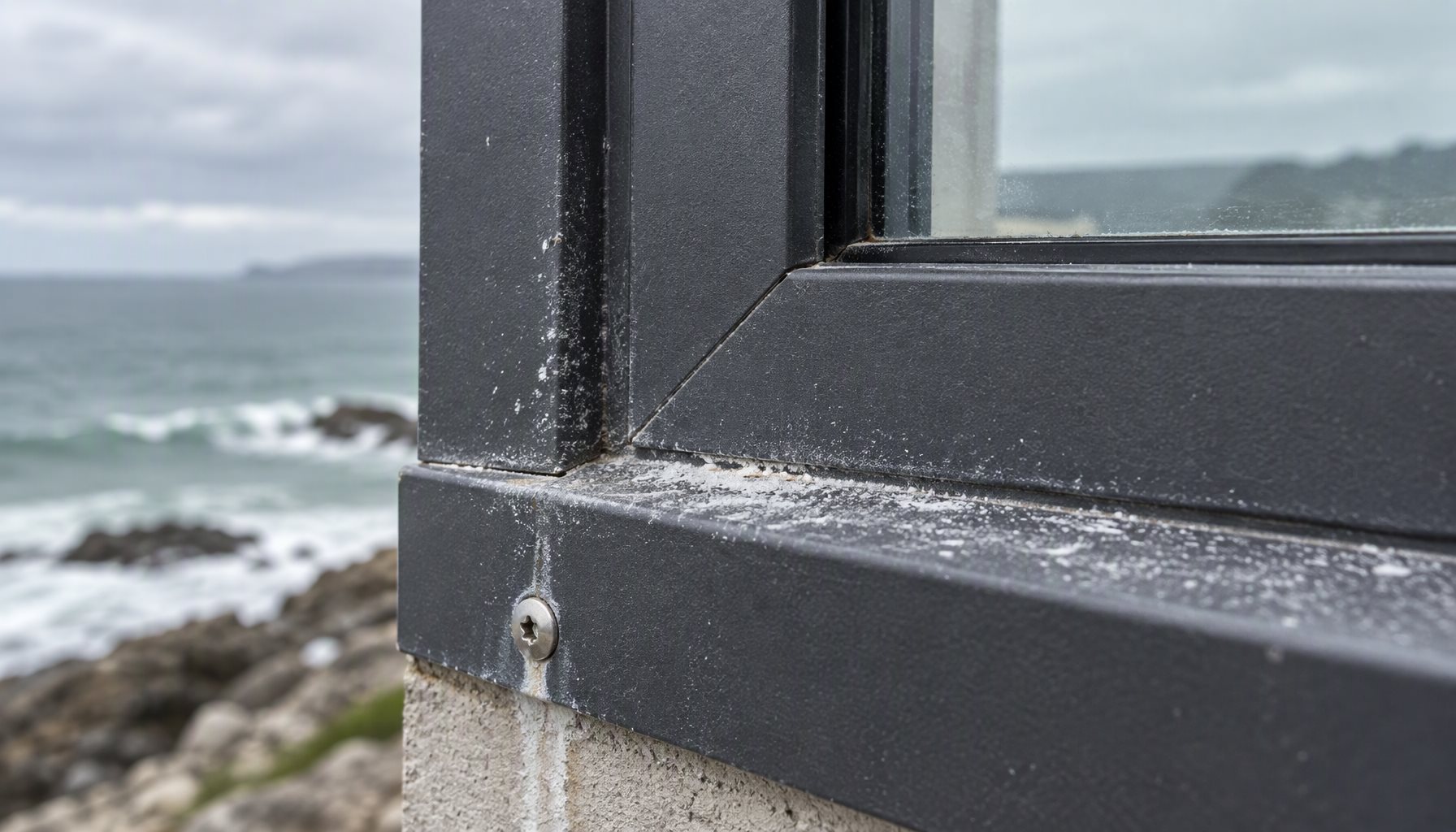
Aluminum window corrosion on a coastal project is almost never a material failure. Aluminum does not rust — it oxidizes, and the oxide on a clean surface is tightly adherent and self-limiting rather than flaking away like iron oxide on steel. What fails on salt-exposed facades is the protective system around that oxide: the finish, the isolation details between dissimilar metals, and the drainage path.
Chlorides are the specific problem. Airborne salt deposits on exposed surfaces and stays until rain or washing removes it. Where moisture and chloride ions are both present, the passive oxide film breaks down at discrete points, so marine attack concentrates into pitting rather than uniform thinning, leaving deep local damage and streaked run-off while the frame stays structurally sound.
Aluminum window corrosion control is therefore a finish-specification and detailing discipline, not a choice of material. Two frames of identical alloy and geometry perform differently on the same elevation because one carries a thick, weatherable coating with isolated contact points and free drainage.
Aluminum Window Corrosion: How Salt Air Attacks the Finish
Aluminum’s natural protection is the oxide layer that forms within minutes in air: thin, a few nanometres, but coherent and quick to reform when damaged. In rural or suburban air that layer plus a modest applied finish is often enough for decades. Salt air attacks it two ways.
Chloride ions are small and mobile, aggressive toward the passive film: they adsorb at weak points in the oxide and destabilize it locally. Salt deposits are hygroscopic, so a surface that looks dry can hold a thin electrolyte film overnight.
Three things protect aluminum: a continuous barrier — anodized or an applied organic coating — that keeps chloride off the metal; isolation wherever it touches a dissimilar metal or where water can sit against it; and geometry that drains, since no coating survives ponding.
Finish Systems: What Each One Does and Where It Belongs
Finish selection is the largest single lever on corrosion performance. The hierarchy below reflects typical behavior in marine service; durability depends on coating thickness, pretreatment quality, applicator qualification and exposure.
Anodizing electrochemically converts the aluminum surface into a thicker, denser oxide layer. Being integral, it cannot chip off as a film coating can. Its coastal weakness is appearance rather than structure: anodized surfaces bloom or chalk in aggressive chloride exposure, and dyed color anodizing is more ultraviolet-sensitive than clear or bronze architectural anodizing. AAMA 611 sets performance requirements for anodized architectural aluminum, including thickness classes.
Powder and liquid PVDF coatings are applied films, thicker than anodized and color-stable, but dependent on pretreatment and edge coverage. The AAMA finish standards step up in severity: AAMA 2603 for the basic tier, AAMA 2604 for a mid-tier architectural finish, and AAMA 2605 for the highest-performance architectural organic coating, the class specified for aggressive marine and high-UV environments. They differ in chalk and color retention, gloss retention, and salt spray resistance.
| Finish system | Marine performance | Film build and coastal specification notes |
|---|---|---|
| Mill finish (bare aluminum) | Poor | No applied film, natural oxide only. Acceptable for dry interior work, not for exposed coastal conditions. |
| Anodized, Class II | Fair to moderate | Thin decorative range. Integral and chip-resistant; appearance weathering is the limiting factor. Confirm class against AAMA 611. |
| Anodized, Class I | Moderate to good | Thicker architectural range. Preferred anodized option for exterior coastal work. Confirm thickness class in the certified test data for your system. |
| Powder coat, AAMA 2603 tier | Fair | Standard film range. Common on interior and low-exposure exterior products. Not the usual choice for beachfront elevations. |
| Powder coat, AAMA 2604 tier | Moderate to good | Standard film range. Viable mid-tier exterior option; verify chalk and color retention for your exposure. |
| PVDF (high-resin fluoropolymer) per AAMA 2605 | Good to very good | High-build film range. Usual baseline for aggressive coastal and high-UV projects. Edge coverage and touch-up discipline decide the result. |
| PVDF over anodized (“anodized look”) | Good | Combined system build. Metallic appearance with organic-coating weatherability. Confirm applied build against the certified test data for your system. |
Resin content and dry film thickness both matter: a coating labeled with a resin system name is not automatically an AAMA 2605-class coating. Nor is thickness durability — a thick film over poor pretreatment fails adhesively before a thinner film over correct pretreatment. Require the applicator’s qualification to the relevant AAMA standard, and require the pretreatment and cure records that back it; we describe our own coating-line controls at quality control.
A mill finish and a coated frame diverge quickly. Mill finish carries only the thin natural oxide and in a marine atmosphere develops a dull grey-white oxidation bloom within the first years, with pitting at inclusions, cut edges and dissimilar-metal contact. Cleaning removes the bloom but does not restore the surface. A coated frame keeps chloride off the metal and limits corrosion to breaches, moving the risk to cut ends and drilled holes.
Specifying Finish by Exposure Zone, Not by Aesthetic Preference
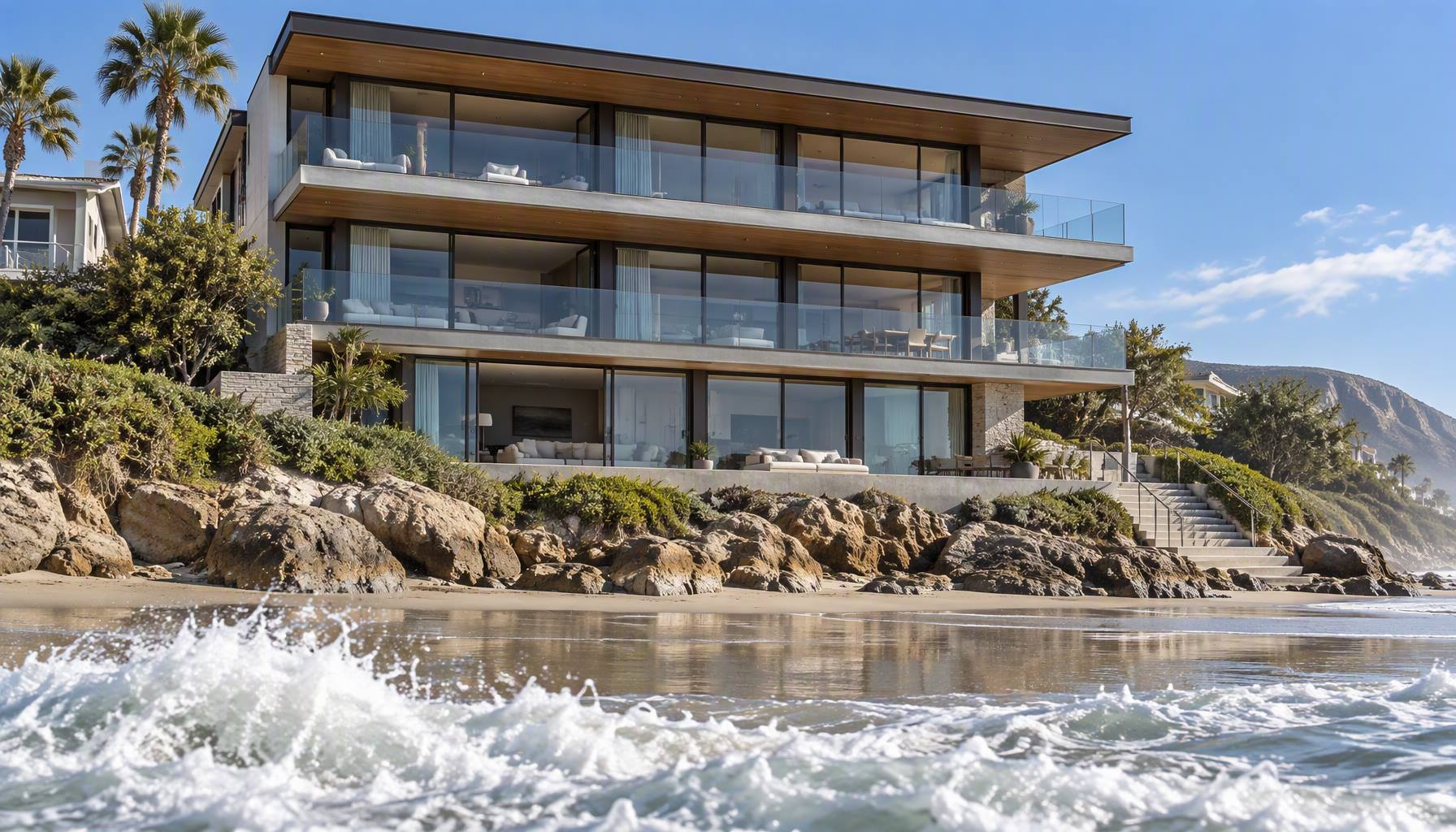
The most common coastal error is choosing a finish for appearance and applying it uniformly across very different conditions. An open oceanfront building, one behind a protective dune line, and one two kilometres inland sit in different ISO 9223 corrosivity categories and should not carry the same finish requirement.
Divide the project into exposure zones and assign a minimum finish class to each. Surf-zone and open-oceanfront elevations warrant the highest-performance architectural organic coating class, with anodized work reserved for sheltered and interior use. Sheltered coastal sites can carry a mid-tier architectural finish, and inland sites basic finishes where warranty and appearance expectations allow.
Exposure is directional: on a shoreline building the seaward elevation and the first few metres above grade see the most salt deposition and wetting cycles, and should drive the specification. Finish class must also match substrate condition. Where dry film thickness, salt spray hours or gloss retention drives an approval, confirm against the certified test data for your system.
Galvanic Isolation: Where Two Metals and One Electrolyte Meet
Galvanic corrosion occurs when two dissimilar metals are in electrical contact bridged by an electrolyte. Aluminum sits toward the active end of the galvanic series, so coupled to steel, stainless steel or copper alloys in a wet, chloride-rich environment it becomes the anode and corrodes at the contact point.
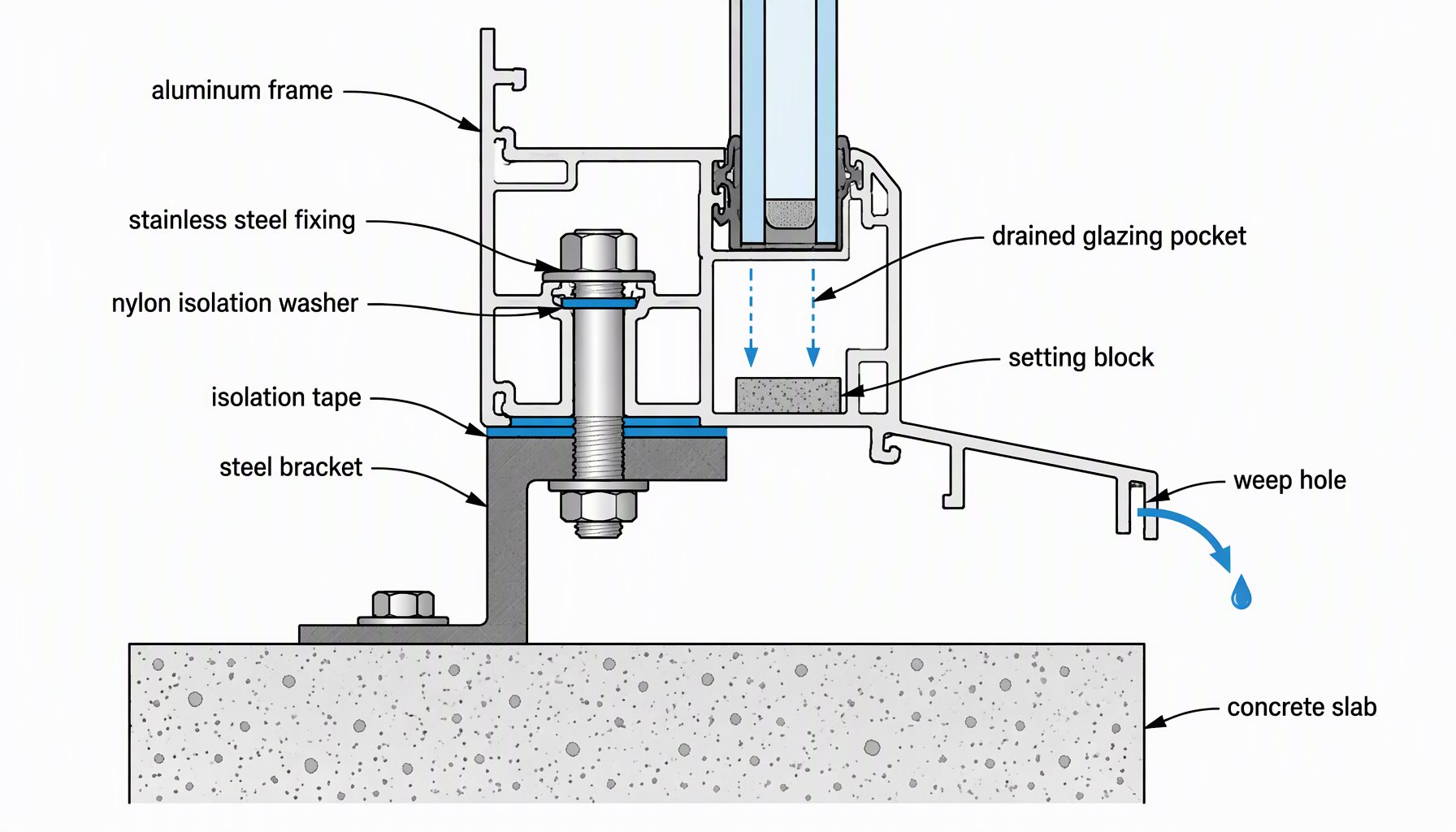
Risky contact points are predictable: bimetallic contact between fasteners or anchors and aluminum framing, especially at sills, base plates and slab edges where water collects; concrete interfaces where reinforcement or carbon steel embeds sit close to the frame, with alkaline pore water as the electrolyte; connections to steel brackets and balustrade posts; and assemblies fastened without an isolating washer.
The response is isolation: use stainless fasteners of a grade appropriate to the exposure, isolated with nylon or neoprene washers and sleeves where they bear on aluminum, and isolation tape or non-metallic shims at steel and concrete interfaces, keeping aluminum off embedded steel and fresh concrete. Sealant chemistry matters too: an acidic or amine-curing sealant in permanent contact with a coated surface can degrade the finish. Wind-load performance is verified through test methods such as ASTM E330 and water penetration resistance through ASTM E547; in North American jurisdictions those methods are referenced through the model codes and standards.
Drainage, Venting and the Problem of Trapped Water
Crevice corrosion is the failure mode drainage design exists to prevent. When water is trapped in a narrow gap — under a gasket, behind a glazing bead, inside an unvented sill channel or beneath a setting block — oxygen in that volume is consumed and cannot be replenished. The resulting differential aeration cell concentrates attack inside the crevice, invisible until corrosion products push the assembly apart or stain adjacent surfaces.
Coastal frames need drainage and airflow so surfaces dry. Weep openings belong at every sill and horizontal member that can collect water, positioned to drain outboard and kept clear of setting blocks, gaskets, sealant and sill flashing; where wind-driven rain is a design condition they should be baffled so they drain without becoming a water entry point. Glazing pockets should be vented and drained, and no sealant should bridge a drainage path. A blocked weep is also the most common cause of water appearing inside the room, which we cover in why aluminum windows leak.
Site Damage: Cut Edges, Drilled Holes and Scratched Coatings
Field fabrication is where most coastal coating failures begin: cutting an extrusion exposes bare aluminum at the cut face, with no coating and no thick natural oxide, and drilling a coated profile does the same inside the hole, creating fresh metal against the fastener. Handling scratches breach the barrier on visible faces and open a path for underfilm attack.
Two mechanisms follow. The first is pitting at the exposed aluminum. The second is filiform corrosion, a thread-like attack spreading from a coating defect — a scratch, cut edge or drilled hole — beneath the coating and away from the damage. Filiform is driven by humidity and chlorides; it is largely cosmetic structurally, but progressive and difficult to arrest.
Minimize field cutting on coastal sites: order extrusions cut to length, with holes and notches factory-fabricated and finished where possible. Treat every cut edge and drilled hole with the manufacturer’s approved two-component touch-up material — not a generic aerosol — applied to the full exposed face, never sealant. Frames stored on the ground or exposed to cement slurry and metal filings pick up damage before installation; mortar residue is alkaline and aggressive to anodized and organic finishes, so wash it off fresh. Confirm the approved repair method against the certified test data for your system, since unauthorized repairs can void warranties.
A Maintenance Regime a Coastal Building Can Sustain
Maintenance is the cheapest corrosion control available and the most commonly deferred: remove chloride deposits before they sit wet against the finish, and find coating breaches before they become filiform or pitting.
Start with fresh-water washing on a schedule matched to exposure. Oceanfront and surf-zone elevations need the most frequent attention, sheltered surfaces the least; set the interval from the site’s corrosivity category and how quickly salt residue returns, not a fixed annual date. Include drainage paths in the inspection — weep openings, sill channels, glazing pockets, head details — clearing debris and residue. Inspect damage-prone locations first: cut ends, drilled holes, mitres, sill corners, hardware interfaces, and anywhere aluminum meets steel or concrete. Keep a record of cleaning dates, products used, damage and repairs as evidence the specified maintenance was performed. General window care guidance for owners is published by Energy Saver; the coastal regime above is stricter than anything a temperate inland building needs.
Anodized and coated surfaces are not maintenance-free, and a manual that says “clean as required” is not a regime. Accelerated methods such as ASTM B117 and ASTM G85 give comparative data on coating systems under salt and salt-acid exposure, useful for evaluating finishes but not as service-life predictions.
Getting the Coastal Specification Right
The decisions that control aluminum window corrosion are made long before installation: the finish class per exposure zone, the pretreatment and applicator qualification behind it, isolation at every dissimilar-metal and concrete interface, the drainage path, and the site procedure for cut edges and repairs.
Write the exposure zones into the specification, tie the finish requirement to a named AAMA class for each zone, and require a maintenance regime in the closeout documents. For a coastal or high-humidity project, our engineering team can review your exposure conditions against the certified performance data: contact our engineering team to start that review, and see our windows and curtain wall systems built for salt-exposed applications. See also aluminum vs vinyl for frame choice and black aluminum finishes in coastal sun.
Frequently Asked Questions
Does aluminum rust in coastal environments?
No. Aluminum does not rust, because rust is iron oxide and aluminum contains no iron. Aluminum forms an oxide layer that normally protects it, but in salt air that layer can break down locally, producing pitting, galvanic corrosion and crevice corrosion rather than the uniform flaking seen on steel.
Which finish best resists aluminum window corrosion in a marine climate?
A high-performance architectural organic coating meeting AAMA 2605 is the usual baseline for aggressive coastal and high-UV exposure, with Class I anodizing as a chip-resistant alternative in moderate marine conditions. The right choice depends on exposure zone, appearance expectations and detailing. Confirm specifics against the certified test data for your system.
Can a scratched or cut coating be repaired on site?
Yes, but only with the coating manufacturer’s approved touch-up materials and method, applied to the full exposed cut face or hole rather than just the visible surface. Generic aerosol paint is not a substitute for a two-component repair coating, and unapproved repairs can void the finish warranty.
Why does corrosion appear at fasteners and steel interfaces?
That pattern points to galvanic corrosion. Aluminum sits toward the active end of the galvanic series, so when it contacts steel or stainless steel while both are wet with chloride-bearing electrolyte, the aluminum becomes the anode and corrodes at the contact point. Isolation washers, sleeves, separation tape and non-metallic shims are the specification response.
How often should coastal windows be cleaned?
No single interval fits every building. Oceanfront and surf-zone elevations need the most frequent fresh-water washing, while sheltered elevations need far less. Set the interval from the site’s corrosivity category and how quickly salt residue reappears, and check drainage paths and coating breaches at the same time.