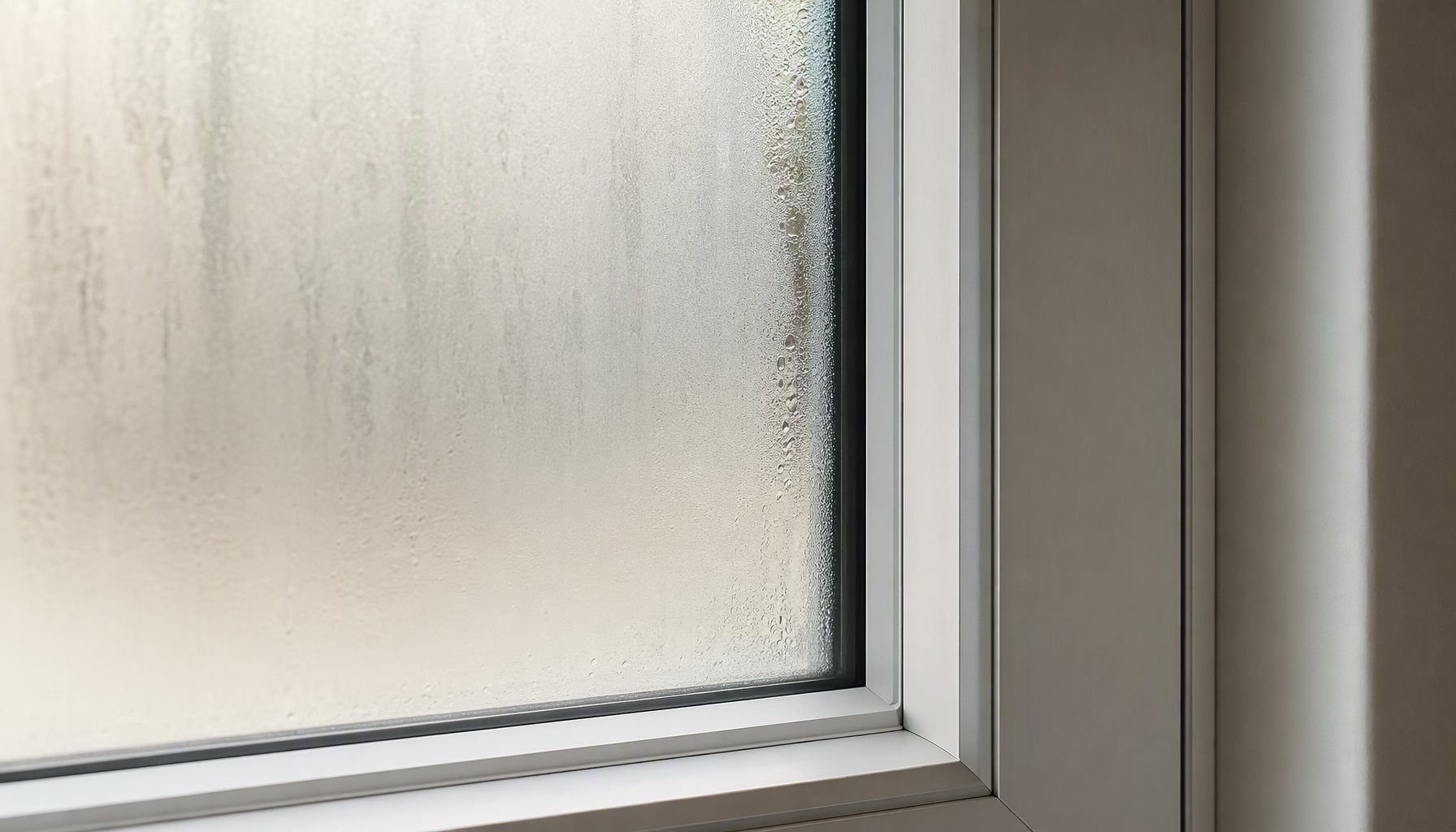
Condensation inside double glazing — moisture trapped between the two panes, where nobody can wipe it away — is a seal failure, not a cleaning problem and not a humidity problem. Once water vapor has entered the cavity, the desiccant in the spacer can no longer hold it and the unit fogs whenever the glass temperature drops. The insulating glass unit has reached the end of its serviceable life and needs replacing.
This article explains how an insulating glass unit manages moisture, how to tell cavity failure apart from surface condensation, what repair options exist, and what to specify to reduce the risk.
Condensation Inside Double Glazing Means the Edge Seal Has Failed
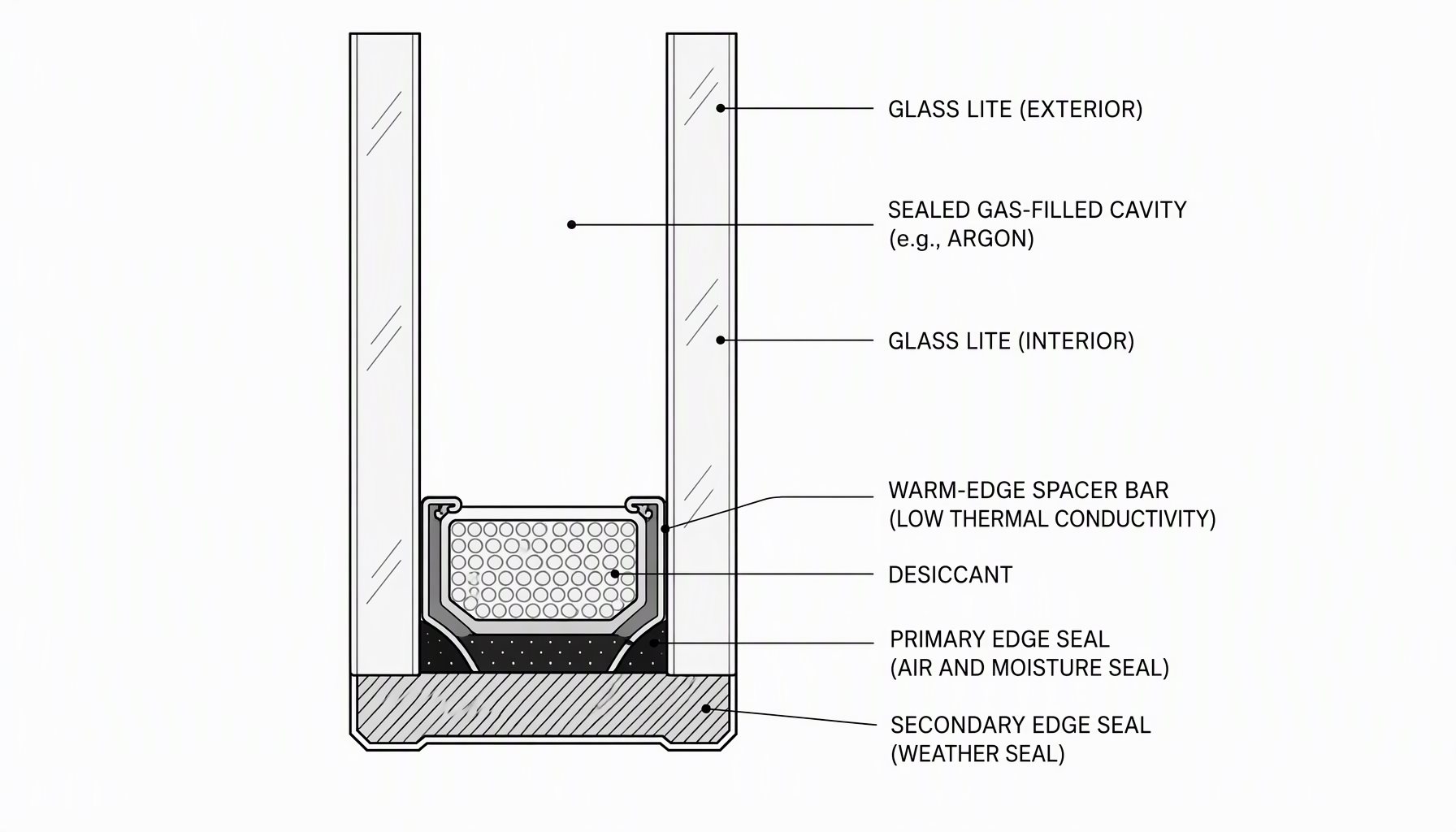
An insulating glass unit (IGU) is two or more panes of glass separated by a spacer and sealed around the perimeter. The cavity is filled with dry air or an inert gas, and the spacer contains a desiccant that absorbs whatever residual moisture remains at manufacture. The system works only while that edge seal stays intact.
Seal failure happens progressively. Cavity gas expands and contracts with temperature and barometric change, so the edge seal flexes on every cycle. Over time the primary seal loses adhesion or the secondary seal cracks, and the desiccant gradually saturates as outside air is drawn in.
The visible result is what most people describe as foggy double pane windows: a hazy film, droplets or a tide-mark residue between the lites. It appears when the inner cavity surface drops below the dew point of the trapped air, which is why fogging is often worst in early morning and clears as the glass warms.
Two consequences follow: the glass no longer looks clear, and the unit has lost part of its thermal function, because moisture-laden air and escaped inert gas both degrade performance relative to the original specification.
| Where the Moisture Is | What It Indicates | Typical Response |
|---|---|---|
| Between the panes, cannot be wiped | IGU edge seal failure, desiccant saturated | Replace the insulating glass unit |
| Room-side surface of the glass | High indoor humidity, cold interior surface | Ventilation, humidity control, better glazing |
| Exterior surface in the morning | Normal dew on a well-insulating unit | None required — it clears as glass warms |
| On the frame or sill below the glass | Possible water ingress or thermal bridging | Check drainage and seals as a separate issue |
| Intermittent haze with no droplets | Early-stage seal degradation | Monitor; plan IGU replacement |
How an Insulating Glass Unit Manages Moisture
Three components do the work.
The spacer separates the lites and carries the desiccant. Conventional aluminum spacers conduct heat readily, which makes the glass edge the coldest part of the unit and the most likely place for surface condensation. Warm-edge spacers use lower-conductivity materials to reduce that edge heat loss and raise the interior surface temperature at the perimeter.
The desiccant adsorbs moisture from the cavity and has finite capacity. Once saturated it cannot be regenerated in place, so any incoming vapor condenses on the glass instead of being absorbed.
The edge seal — usually a primary seal for moisture resistance and a secondary seal for structural integrity — keeps the cavity closed. Its life depends on sealant chemistry, fabrication quality, ultraviolet exposure and pressure cycling.
Gas fill is a separate question. Argon or krypton improves thermal performance relative to air, and gas loss is invisible: a unit can lose fill without fogging, or fog without significant fill loss. Both follow from the same imperfect seal, but they are not the same measurement.
Rating methods for the finished unit come from NFRC procedures, which define how U-factor, solar heat gain coefficient and visible transmittance are determined for a complete product rather than for glass alone.
Inside the Cavity Versus on the Surface: Two Different Problems
Condensation inside double glazing is frequently confused with surface condensation, and the distinction determines the entire response. Surface condensation on the room side reflects a relationship between indoor humidity and interior glass temperature. It is a building physics issue, and it can be legitimate — a high performing window in a humid interior may still show temporary surface moisture.
The practical differences:
- Cavity moisture cannot be wiped away. If a cloth on either face does not clear it, the water is between the lites.
- Surface moisture responds to humidity control. Cavity moisture responds only to unit replacement.
- Surface condensation indicates thermal or ventilation conditions. Cavity condensation indicates a defect in that unit.
- Isolated cavity failures are normal attrition. Widespread fogging across a project suggests a fabrication, handling or glazing-system problem worth raising with the supplier.
Frame thermal performance also influences surface conditions. A thermally broken frame reduces heat flow through the profile, but whole-unit behavior depends on frame geometry, thermal-break design, glazing, spacer, dimensions and the calculation or testing method used. Our thermal break window guide covers this; a thermal break alone does not guarantee freedom from surface condensation.
Reglaze, Replace the IGU or Replace the Window
Once the seal has failed there is no reliable way to restore the unit. Cleaning between the lites is impossible without dismantling the assembly, and defogging treatments that drill into the cavity neither restore the desiccant nor reseal the unit, so any clarity gained is temporary.
That leaves three real options, and the right one depends on the condition of everything around the glass.
Replace the IGU only. Viable when the frame, sash, gaskets and hardware are sound and the glazing rebate accepts a new unit of the same thickness. Usually the lowest-cost route, and it preserves the opening.
Replace the sash. Appropriate where the sash is distorted, gaskets are compressed beyond adjustment or hardware no longer holds alignment.
Replace the window. Justified when the frame is corroded or out of square, when current performance requirements are no longer met, or when the project is already opening the wall for other work.
Whatever the scope, specify against measured dimensions rather than assumed ones, and confirm glazing rebate depth, gasket compression and spacer thickness before ordering. The custom size and dimension page explains what we need to quote a bespoke schedule.
| Metric | What It Describes | What It Does Not Tell You |
|---|---|---|
| Ug (center-of-glass U-factor) | Heat transfer through glazing away from edges | Edge or frame losses, which dominate small units |
| Uf (frame U-factor) | Heat transfer through the frame profile | Whole-unit performance, which also depends on glass and spacer |
| Uw (whole-unit U-factor) | Combined performance of frame plus glazing | Performance of a different size or configuration |
| Condensation resistance rating | Relative resistance to surface condensation | Whether the unit will fog in a specific interior |
| Gas fill percentage | Proportion of cavity filled with inert gas | Future retention — it declines with seal quality |
These metrics should never be quoted interchangeably. A center-of-glass value is the most favorable number in the set and says nothing about the perimeter, where condensation starts.
Specifying Glazing That Resists Condensation
Prevention is a specification decision made before fabrication, not a maintenance task afterwards.
| Project Requirement | Recommended Choice | Why |
|---|---|---|
| Humid interior — pool, spa, kitchen-heavy | Warm-edge spacer with improved whole-unit performance | A warmer interior surface reduces condensation risk |
| Cold climate project | Thermally broken frame with a rated low-emissivity IGU | Frame and edge losses dominate in cold conditions — see low-e argon glass |
| Coastal or high-UV exposure | Sealant and coating selection matched to exposure | UV and salt accelerate edge seal and finish degradation |
| Existing units fogged, frames sound | IGU-only replacement to measured dimensions | Preserves the opening and avoids structural work |
| Fogging across many units on one project | Investigate fabrication and handling before replacing | A pattern indicates a systemic cause, not individual attrition |
| Performance claims required for approval | Request rated whole-unit data for the exact configuration | Ratings apply to the tested or calculated assembly only |
Certification context matters when a specification calls for energy performance. ENERGY STAR window and door criteria are climate-zone specific, and U.S. Department of Energy guidance explains how glazing selection fits whole-building energy use. Product and installation standards are published through FGIA.

Frequently Asked Questions About Condensation Inside Double Glazing
Can condensation inside double glazing be cleaned out?
No. The moisture is sealed between the lites where there is no access. Treatments that drill into the cavity may reduce visible haze temporarily, but they do not restore the desiccant, reseal the unit or recover the lost thermal performance. Replacing the insulating glass unit is the durable solution.
Does fogging between the panes mean the window has failed structurally?
Not usually. Seal failure affects the insulating glass unit, not the frame, sash or hardware. Many fogged units sit in sound frames, so IGU-only replacement is often viable and far cheaper than replacing the whole window.
Why does the fogging appear and disappear during the day?
Because it is temperature-driven. When the inner cavity surface drops below the dew point of the trapped air, moisture condenses and the unit fogs. As the glass warms, moisture evaporates back into the cavity and clarity returns. That intermittent behavior signals a saturated desiccant, not a self-resolving problem.
Will replacing the glass with argon fill stop it happening again?
Argon improves thermal performance relative to air, but it does not prevent seal failure on its own — gas retention depends on edge seal quality and spacer design. Specify the fill as part of a complete IGU build-up and ask for rated whole-unit data for that configuration.
Is surface condensation on the inside of the glass the same problem?
No. Room-side surface condensation reflects indoor humidity and interior glass temperature, and responds to ventilation, humidity control and better glazing. Condensation inside double glazing is a unit defect. A cloth clears one and cannot reach the other.
Does exterior morning dew mean my windows are failing?
Generally the opposite. Dew on the outside face means the glass is staying close to outdoor temperature, which happens when the unit insulates well and little interior heat reaches the outer surface. It clears as the sun warms the glass.
How long should an insulating glass unit last?
Service life depends on sealant chemistry, spacer and desiccant design, fabrication quality, exposure, pressure cycling and installation handling, so it cannot be stated as one number for all products. Ask the supplier for the IGU build-up, the edge seal system and applicable warranty terms for the configuration being quoted.
Request a Glazing Specification Review
If fogged units are appearing on a project, send the IGU build-up, unit dimensions, exposure conditions and photographs. Our engineering team can review the spacer, desiccant and edge seal specification, confirm whether the pattern points to fabrication or individual attrition, and propose a replacement configuration with the rated whole-unit data your approval process requires. See our quality and testing page or the window hub, and use the contact page to start a review.