If you specify, fabricate, import or distribute windows in the United Kingdom, Ireland, Australia, New Zealand, Southeast Asia or the Middle East, the decision in front of you is aluminum vs uPVC windows — unplasticised polyvinyl chloride, the standard term in those markets. If you work to North American codes, where the same polymer is sold as vinyl, read aluminum vs vinyl for the North American market instead; that article covers NFRC 100 ratings and North American sash conventions. This one covers uPVC profile construction, stabiliser chemistry, thermal movement and the code regimes that govern elsewhere. Where the two markets differ in hardware concept and ordering convention rather than in frame material, see European vs American windows.
Neither material wins outright. uPVC is a hollow extrusion with a low elastic modulus and a high coefficient of thermal expansion: cheap, naturally insulating, immune to corrosion. Aluminum is roughly twenty-five times stiffer, dimensionally stable, and an excellent conductor of heat unless deliberately broken. Choose by asking which material’s limits fall outside your project’s demands.
Why the Material Question Splits by Market
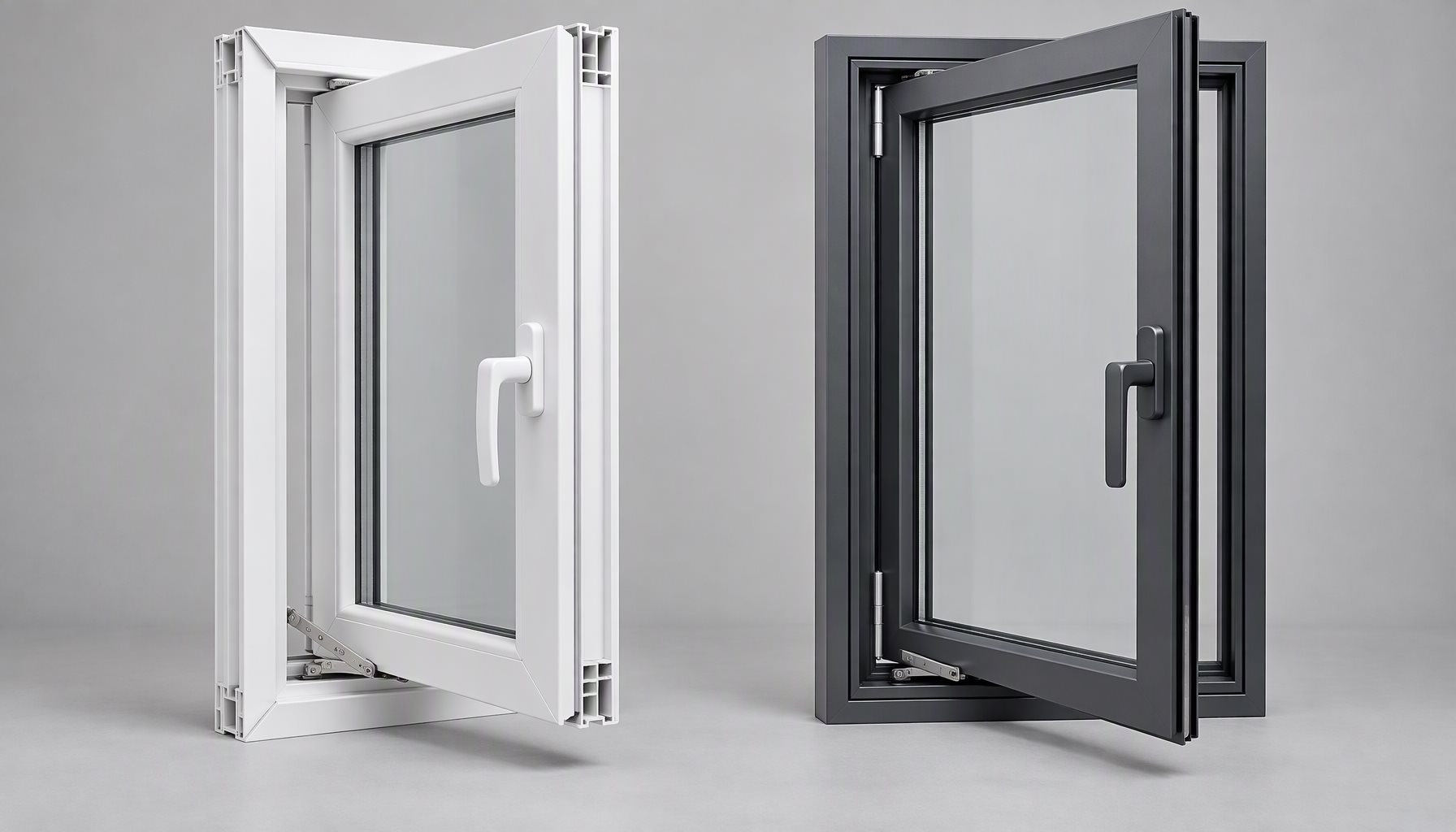
uPVC’s dominance is regional. In the UK and Ireland it takes the large majority of domestic replacement windows, and the same is broadly true in parts of Central and Northern Europe. Australia, New Zealand and most of the Gulf reverse the pattern, with aluminum holding the majority and uPVC in a smaller, price-sensitive share.
The reasons are structural. UK housing is dominated by small punched openings in masonry cavity walls, where a 1.2 m × 1.2 m casement is normal and design wind pressures are moderate, so aluminum’s structural advantage buys little while uPVC’s lower cost buys a great deal. Australian and Gulf construction leans toward larger openings, higher design wind pressures, cyclonic loading in places and slimmer sightlines — conditions where uPVC’s modulus and thermal movement become the binding constraint.
Codes reinforce the split. UK and Irish windows go to market against BS EN 14351-1, with uPVC profile grading under BS EN 12608; Australia uses AS 2047. In North American jurisdictions the reference documents are the model codes and standards published by ICC. Aluminum coatings are typically specified against AAMA 2605, with salt-spray exposure tested to ASTM B117 and structural performance under uniform load to ASTM E330.
How a uPVC Window Profile Is Built
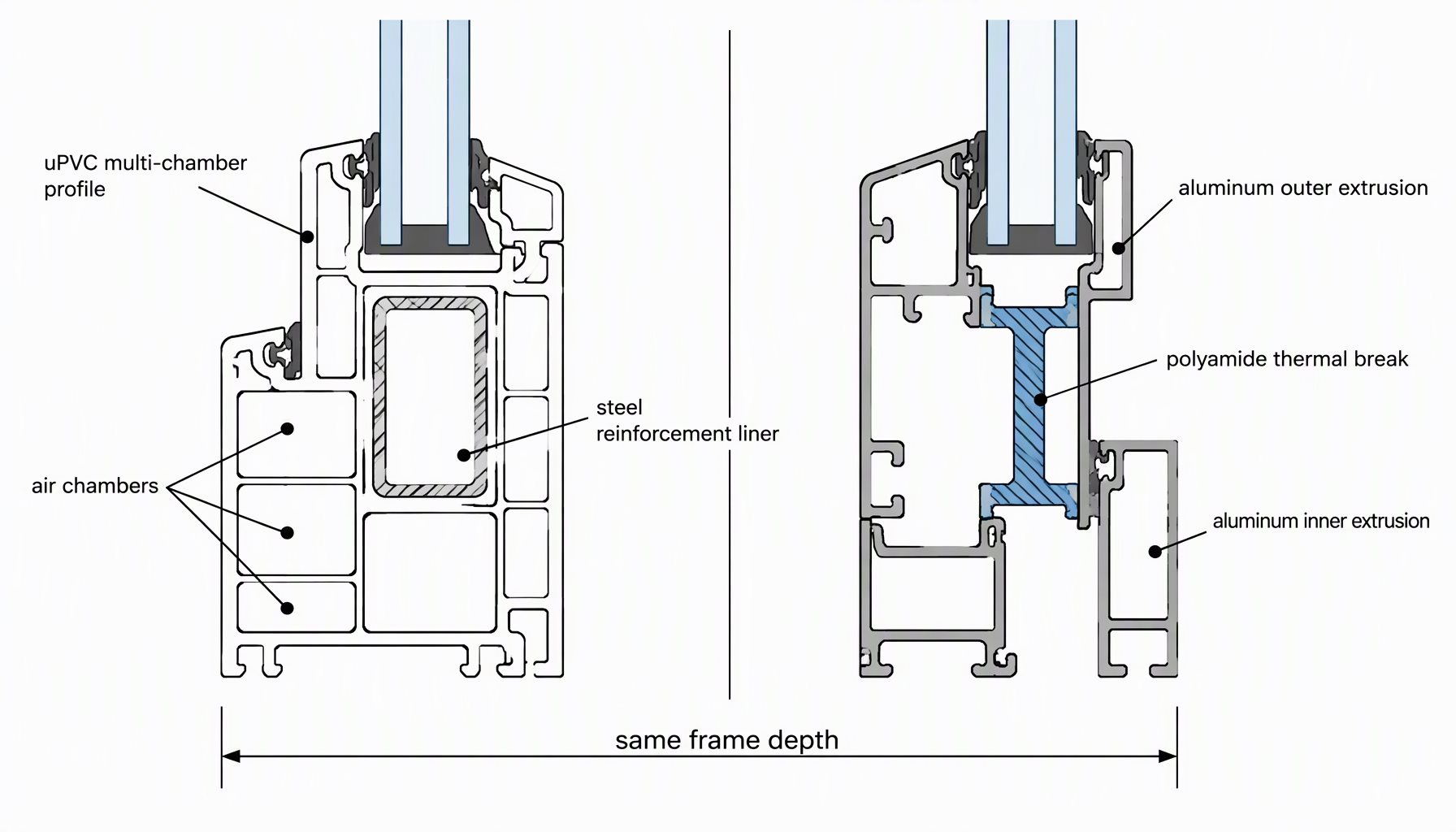
uPVC frames are hollow extrusions, typically two to six internal chambers separated by webs. The chambers trap still air, lowering frame thermal transmittance and stiffening the section against bending.
The walls are thin, and profile wall thickness is graded under BS EN 12608 into classes that set how much load an unreinforced profile can carry. Unreinforced uPVC suits small low-rise casements and little more, so every serious system inserts reinforcement — usually a galvanised steel liner, sometimes aluminum — into chambers behind sash and frame. The reinforcement carries wind and hardware loads; the uPVC carries the weather seal and the appearance.
Reinforcement is where uPVC quality diverges most. A profile with a 1.5 mm steel liner in the main chamber plus local stiffening at hinge positions is a different structural product from one with a single thin liner and nothing behind the hardware. Ask for the reinforcement schedule, not just the profile depth. Heavier reinforcement also costs thermal performance, because steel conducts across the chambers it occupies.
Corners are fusion welded: the ends are heated and pressed until the PVC fuses, giving a continuous sealed frame suited to a low-modulus material. Welding sets a floor on corner slimness, whereas aluminum frames are crimped or screwed with cleats, permitting tighter corner geometry. uPVC sealing relies on gaskets, a drained and ventilated rebate and clear weep paths.
Thermal Performance: What the Thermal Break Changes
uPVC’s thermal advantage is intrinsic. Its conductivity is typically quoted around 0.14–0.17 W/m·K, so the frame is itself a thermal break. Aluminum is roughly a thousand times more conductive, typically 160–200 W/m·K, so an unbroken frame is a thermal bridge at every glazing edge.
The fix is a structural insulating element between the inner and outer extrusions. Polyamide struts are roll-formed into the profile, giving a continuous barrier with predictable structural properties; pour-and-debridge fills a channel with polyurethane and mills away the aluminum web beneath it. See thermally broken aluminum window systems for how the break sits within the section.
Typical whole-window U-values, as ranges only: uPVC with double glazing commonly lands around 1.4–1.8 W/m²K, and with triple glazing and a warm-edge spacer roughly 0.9–1.3. Thermally broken aluminum typically sits around 1.6–2.2 with double glazing and roughly 1.0–1.5 with triple. Frame depth, chamber count, reinforcement, glass and spacer all move these numbers — confirm against the certified test data for your configuration.
Frame and sash account for roughly 20–35% of total area, so glazing and spacer do most of the work; on a small casement the frame dominates. See how Uf, Ug and Uw combine into a whole-window U-value for the area-weighting arithmetic behind any declared number.
Verify that declared performance exists for the exact configuration you are buying; BS EN 14351-1, AS 2047 and NFRC 100 define characteristics to be declared, not guaranteed outcomes.
Thermal Movement, Stiffness and Wind Load
The coefficient of linear thermal expansion for unplasticised PVC is typically 6–8 × 10⁻⁵ per kelvin; for aluminum it is around 2.3 × 10⁻⁵ per kelvin, so uPVC moves roughly three times as much. On a 1.5 m frame in a 40 K swing that is on the order of 3.6–4.8 mm against roughly 1.4 mm in aluminum. That movement governs expansion allowances at fixings, clearance behind beads, and dependable gasket compression at temperature extremes.
Dark profiles make it worse: a dark uPVC surface in direct summer sun reaches well above ambient air temperature, so the differential across the profile exceeds the ambient swing alone. Some systems restrict dark colours or require extra reinforcement, so ask what evidence supports a supplier’s claim.
uPVC is also viscoelastic. The elastic modulus of PVC-U is typically 2.5–3.0 GPa against roughly 70 GPa for aluminum, so an unreinforced uPVC section deflects far more under wind load than an aluminum section of the same geometry — hence the dependence on steel reinforcement.
Under sustained load uPVC creeps, deforming slowly over time in a way that is not recovered when the load is removed, whereas aluminum below yield is elastic. Creep matters most where loads are permanent: long sliding sashes, heavy triple-glazed sashes on friction stays, large fixed lights under wind pressure. Design uPVC on long-term modulus, not the short-term data-sheet figure.
The limits surface in panel size: uPVC casements and tilt-turns top out well below what aluminum carries, and large sliders are usually aluminum territory. Where the intent is a large pane with minimal visible frame, aluminum’s structural headroom is the enabling factor — see thin-frame aluminum windows. Uniform-load performance is normally verified to ASTM E330, and in Australia AS 2047 sets the wind-pressure basis. Confirm against the certified test data for your configuration.
Stabilisers, Lead and Why the History Still Matters
PVC cannot be extruded without stabilisers: the polymer decomposes at processing temperature, releasing hydrogen chloride, and stabilisers also protect the finished profile against UV and heat ageing.
Lead-based stabilisers, historically lead sulphate or lead stearate, were the industry workhorse — cheap, effective and forgiving in the die — and lead-stabilised profiles are still produced in some regions, remaining in the installed base and in recycled PVC streams.
Organotin stabilisers, typically methyltin or octyltin, replaced lead across much of Europe and North America and remain common. Calcium-zinc systems are the newer heavy-metal-free option, and their process window has improved considerably.
The concern for specifiers is not mainly in-service exposure: lead in a uPVC matrix is bound within the polymer. It is manufacturing exposure, waste handling, end-of-life processing and markets with explicit heavy-metal restrictions. If your project carries a materials declaration or a client restricted-substances policy, you need the stabiliser chemistry in writing — “uPVC” alone does not tell you.
The same discipline applies to filler content, impact modifiers and recycled regrind, all of which affect impact strength and long-term weathering. BS EN 12608 sets out how uPVC profiles are classified for these properties, which is why a class declaration beats a brand name. We describe our incoming profile and coating controls at how we control profile and coating quality.
Colour, Finish and Weathering
uPVC is not limited to white, but white dominates: pigmented white reflects solar radiation and stays relatively cool. Colour comes from foil lamination, co-extruded capstock or paint, each adding a bonded layer whose adhesion and UV stability must suit the substrate.
Aluminum offers anodising, powder coating and PVDF, with coating performance normally specified against AAMA 2605 and salt-spray exposure assessed under ASTM B117. On coastal work, alloy, temper, pre-treatment and isolation from dissimilar metals matter more than colour.
Coastal behaviour favours uPVC, which does not corrode; its failure modes there are UV chalk, discolouration and, in extreme heat, distortion. Aluminum in coastal service depends on coating integrity — a scratch exposing bare metal starts a corrosion cell, and contact with steel or alkaline mortar needs isolation.
Aluminum vs uPVC Windows: Side-by-Side Comparison
| Attribute | uPVC | Thermally broken aluminum |
|---|---|---|
| Stiffness / structural behaviour | Elastic modulus typically 2.5–3.0 GPa; viscoelastic and subject to creep under sustained load; stiffness depends on the steel reinforcement inserted into the chambers | Elastic modulus typically around 70 GPa; elastic within design limits, no creep in service; the extrusion itself carries the load |
| Thermal movement | Coefficient of linear expansion typically 6–8 × 10⁻⁵/K, roughly three times aluminum; expansion allowances and fixing details must accommodate it | Typically around 2.3 × 10⁻⁵/K; lower movement allows tighter tolerances and simpler fixing details |
| Thermal performance with a thermal break | Frame is inherently a poor conductor (typically ~0.14–0.17 W/m·K); the hollow chambers are the thermal break. Whole-window U-values typically ~1.4–1.8 double glazed and ~0.9–1.3 triple glazed | Requires a deliberate break — polyamide strut or pour-and-debridge. Whole-window U-values typically ~1.6–2.2 double glazed and ~1.0–1.5 triple glazed |
| Max panel size | Bounded by modulus, creep and reinforcement; suited to casements and modest fixed lights; large sliders and lift-and-slide doors are difficult | High structural headroom; supports large fixed glazing, sliding and lift-and-slide doors, and thin sightlines over long spans |
| Colour options | White dominant; colour via foil lamination, capstock or paint; dark tones raise surface temperature and may need extra reinforcement or be restricted by the system | Anodised, powder coated or PVDF coated; broad range including dark architectural tones without the equivalent thermal penalty |
| Recycled content / end of life | Established mechanical recycling route for post-industrial and post-consumer profile; regrind reusable in non-visible cores, but stabiliser and laminate content complicates the stream | Well-established, high-value recycling; aluminum scrap holds strong residual value and is recycled in closed-loop architectural schemes |
| Typical market share by region | Dominant in UK/Ireland and much of Central and Northern Europe residential replacement, commonly estimated around 70–80% of that segment; minor share in Australia, New Zealand and the Gulf | Dominant in Australia, New Zealand, Southeast Asia and the Middle East; substantial share of UK/Ireland commercial, heritage and large-opening work |
Figures in this table are typical ranges, not guarantees. Confirm against the certified test data for your configuration.
Regional Markets, Codes and What to Stock

Stock and specify for the fabrication base that already exists in the destination market.
In the UK and Ireland, BS EN 14351-1 and BS EN 12608 are the reference documents and uPVC is the domestic default. Aluminum competes on heritage work, large openings, commercial glazing and curtain walling, where its structural headroom and finish range justify the premium.
Australia and New Zealand run on AS 2047 and are aluminum-dominant, especially in cyclonic and high-wind regions where design pressures and water-penetration requirements push uPVC out of reach on exposed elevations; uPVC’s share there is concentrated in retrofit and cost-driven residential work.
Southeast Asia and the Middle East are aluminum-dominant by wide margins, on humidity, project procurement and locally extruded supply, plus extreme solar gain in the Gulf. Mainland Europe is genuinely mixed, so “European practice” is a poor guide for a specific project.
For a single project, work the aluminum vs uPVC windows decision in this order: design wind pressure and exposure category; largest panel and sightline target; target U-value and the frame’s contribution; colour; coastal atmosphere; end-of-life requirements. Whichever material clears all six without compromise is the answer.
Frequently Asked Questions
Aluminum vs uPVC windows: which is better?
Neither is better in absolute terms; each has limits that bind in different projects. uPVC wins on cost, intrinsic thermal performance and corrosion resistance, and suits small to medium casements in moderate wind zones. Aluminum wins on stiffness, dimensional stability and achievable panel size, and suits large openings, high wind loads and hot climates.
Which is more thermally efficient, uPVC or aluminum?
An unbroken aluminum frame is a thermal bridge and performs poorly, so the comparison is only meaningful against a thermally broken system. Even then uPVC typically holds a modest advantage, because the frame material itself conducts far less heat. Confirm against the certified test data for your configuration, since glass, spacer and frame depth often matter more.
Does uPVC expand more than aluminum?
Yes, roughly three times as much over the same temperature change. The coefficient of linear thermal expansion is typically 6–8 × 10⁻⁵ per kelvin for unplasticised PVC against around 2.3 × 10⁻⁵ per kelvin for aluminum. The practical effect is that uPVC systems need larger expansion allowances at fixings and behind trims, and dark profiles in hot sunny climates need more allowance again.
Is lead still used in uPVC window profiles?
Lead-based stabilisers were voluntarily phased out by the European window industry from the late 1990s and are restricted or discouraged in many markets, but lead-stabilised profiles are still produced in some regions. Organotin and calcium-zinc systems are the common alternatives today. If your project has a restricted-substances requirement, ask your supplier to state the stabiliser chemistry in writing.
Can uPVC windows be used in coastal or hot climates?
Coastal exposure suits uPVC well because it does not corrode, though it can chalk and discolour under strong UV. Sustained high temperature and intense solar gain are the harder case: dark profiles approach their thermal limits, and that is where thermally broken aluminum with a stable coating is usually the safer specification. Verify against the supplier’s declared data for the specific profile and colour.
If you are specifying a project and want the frame, glazing and thermal break assessed together rather than in isolation, talk to our engineering team with your design wind load, panel sizes and target U-value. We will settle the aluminum vs uPVC windows question for your exposure, and tell you which system fits and which one does not.