Part of our curtain wall specification series — see the full curtain wall systems page.
On a glass facade, not every panel is a window. The panels that cover the floor slab, columns, and mechanical zones between floors are spandrel glass — opaque glass that hides the structure behind the vision glazing so the elevation reads as one continuous surface. Getting the spandrel glass detail right is what separates a facade that looks deliberate from one that looks patched together.
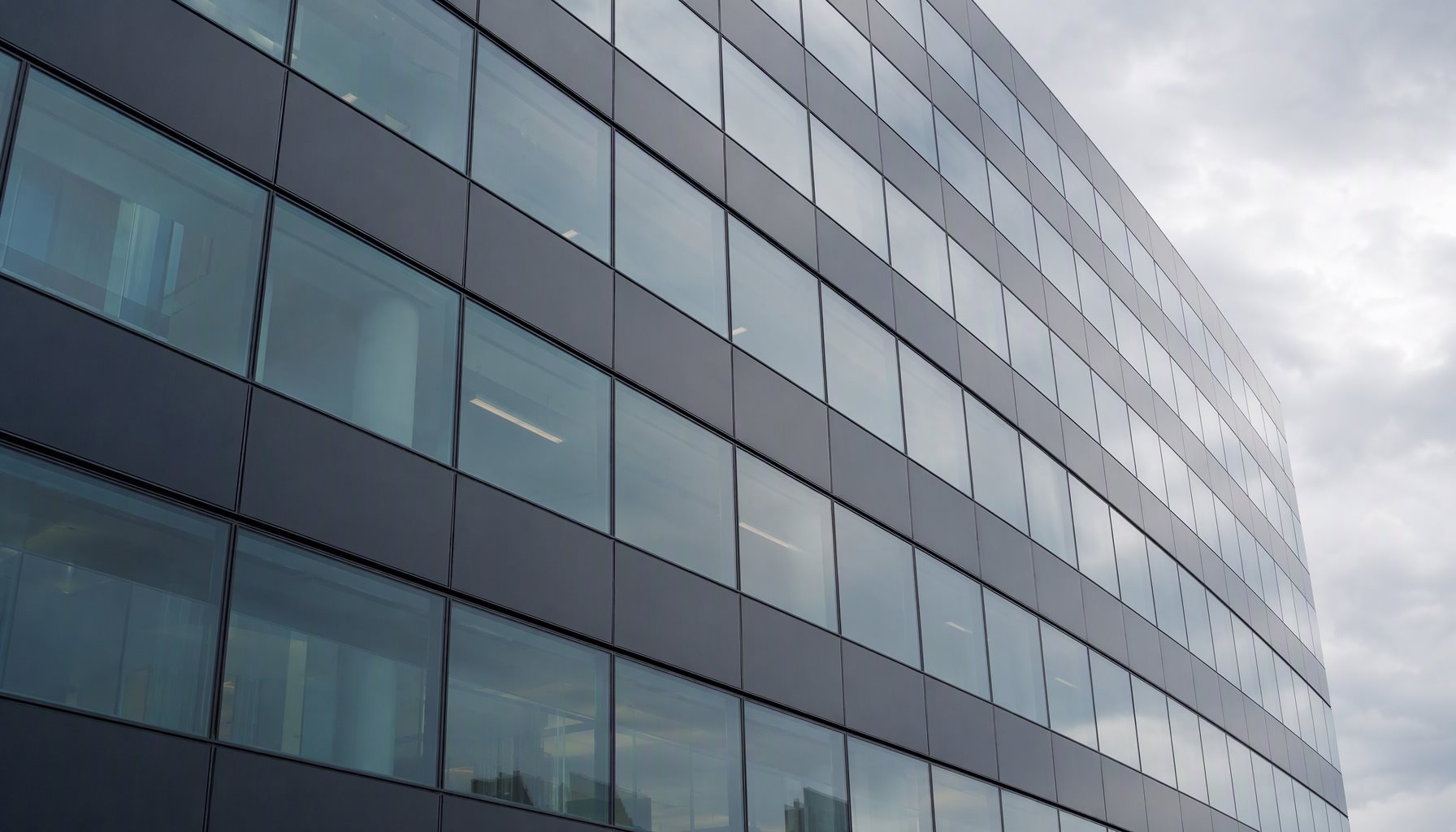
This guide explains what spandrel glass is, how it is made, the detail that decides whether it performs, and how to specify it so the opaque panels match the vision glass.
Quick Summary
| Question | Short answer |
|---|---|
| What is spandrel glass? | Opaque glass that hides floor slabs and structure behind a facade |
| How is it made opaque? | Ceramic frit (fired), silicone opacifier (back-painted), or a shadow box |
| Why does the detail matter? | Opaque glass absorbs solar heat and must match the vision glass |
| What sits behind it? | Insulation and a backpan, to meet the energy code |
| Biggest spec risk | Color mismatch between spandrel and vision glass |
What spandrel glass is — and why a facade needs it
The word “spandrel” names the band between the top of one vision window and the sill of the window above — in a curtain wall, that is exactly where the floor slab and its fire-safe, insulated edge live. Left visible, that band breaks the glass envelope with a strip of structure.
Spandrel glass has two jobs. First, it hides the slab, insulation, and framing. Second, it matches the vision glass closely enough that the eye reads the whole elevation as one surface. The second job is the hard one: a panel that reflects light differently, or reads darker at night, announces itself as a patch.
This is different from a vision panel in one fundamental way. You look through vision glass; you look at spandrel glass. That single change drives everything else — how the panel is made opaque, how it handles heat, and how it is specified.
Spandrel Panel Meaning: What the Word Actually Refers To
Spandrel panel meaning is simpler than the vocabulary suggests. A spandrel panel is the opaque infill panel that occupies the band between the vision glass of one storey and the vision glass of the next — it hides the floor slab edge, the structural frame and the mechanical zone behind it. It is not a window and it is not glazed to be seen through.
That is why the term appears both as spandrel glass (the glazed version) and as spandrel panel (the general element). When a specifier asks what is spandrel panel, the useful answer is: the non-vision band of the facade, and the decision that matters is how its appearance is matched to the vision glass either side of it.
Spandrel Panel Window: Where It Sits in the Elevation
Spandrel panel window is a looser usage you will see in the market. It usually means a spandrel band that sits within a window-wall elevation rather than in a continuous curtain wall. The element is the same — an opaque panel hiding the slab edge — but the framing system around it is different, and that difference drives how the band is drained and how it is fixed.
In a window-wall elevation the spandrel band is set storey by storey inside or in front of the slab edge, so the panel has to accommodate floor-to-floor tolerance and slab deflection at the same joints as the vision units either side of it. In a continuous curtain wall the band is part of a spanning assembly and movement is handled at the stack joints instead. The same panel, detailed two different ways.
When a drawing office writes spandrel panel window on an elevation, ask which of the two systems it belongs to before pricing the panel. Confirm the drainage path and the movement strategy against the certified test data for the system you are buying.
How spandrel glass is made: the three common methods
| Method | How it works | Best for |
|---|---|---|
| Ceramic frit | Ceramic ink is printed and fired into the glass surface, usually during heat treatment | Durable, standard commercial facades |
| Silicone opacifier (back-painted) | An opaque coating is applied to the interior surface, often after tempering | Tightest color match to vision glass |
| Shadow box | Clear vision glass in front of an opaque metal panel set back a few inches | Premium facades, depth, night appearance |
The method you choose is really a color and durability decision. Ceramic frit is tough — the coating is fired into the surface — but it carries a visible pattern, and color can shift slightly between production runs, so batch consistency needs care. A silicone opacifier applied after heat treatment gives more consistent color because it is not fired, provided the coating stays compatible with the panel’s rear-exposure environment. A shadow box removes the opacity problem from the exterior glass entirely — the depth does the hiding — but it adds components and needs a deeper frame pocket.
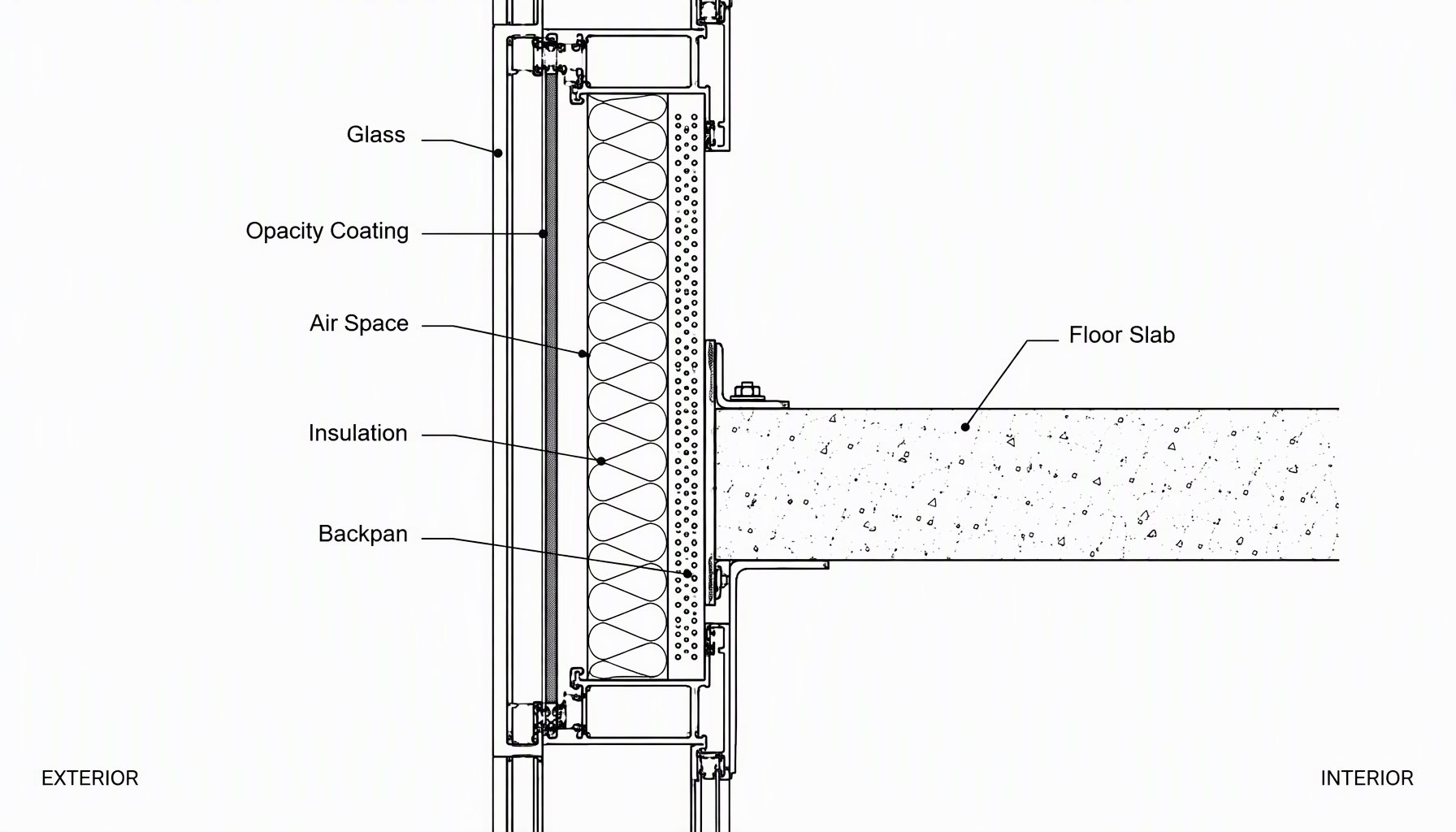
Spandrel Detail That Decides Whether It Performs
Four points decide whether a spandrel panel lasts and looks right:
- Heat treatment. Because spandrel glass is opaque, it absorbs solar energy instead of transmitting it. That thermal stress is why spandrel panels are typically heat-strengthened or tempered (heat-treated glass is covered by ASTM C1048). Confirm the opacity coating is either fired with the heat treatment or applied after it — a coating applied before tempering can fail in the furnace.
- Insulation and backpan. A spandrel panel is only the front face of an assembly. Behind it, insulation and a metal backpan carry most of the thermal and acoustic work. The build-up — not the glass alone — determines whether the spandrel zone meets the energy code, so specify the whole assembly rather than a pane.
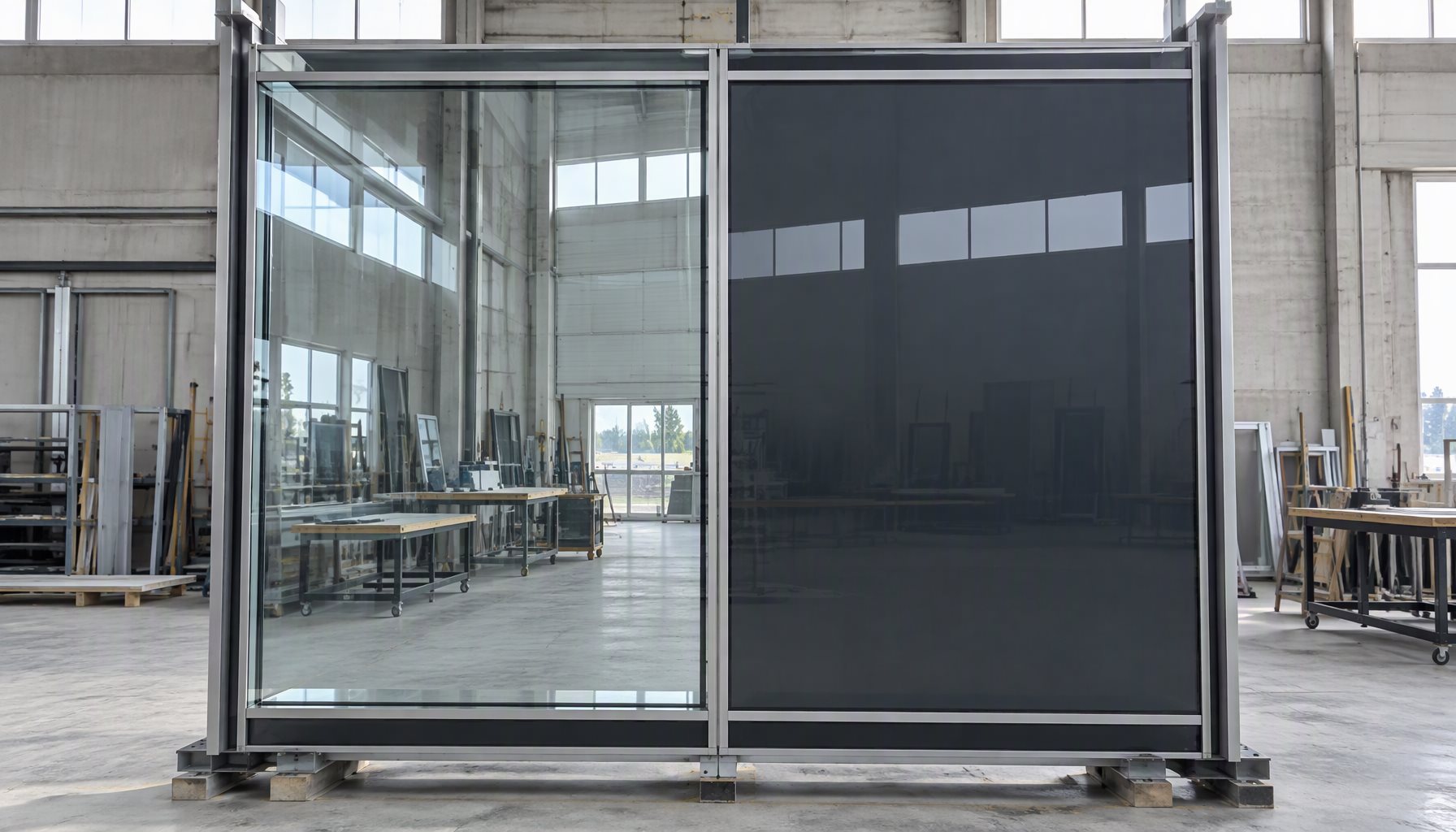
- Color match. A color that matches in the showroom can shift in the field because glass reads one way in transmission (vision glass) and another way in reflection (spandrel). Specify the match against the vision glass’s exterior reflected color, and approve a full-size mockup in daylight before production.
- Condensation and drainage. The back of an opaque panel can run cold if the build-up is not insulated and drained. The spandrel cavity should be treated like the rest of the facade — insulated, ventilated or sealed per the system, and detailed to drain.
How to specify spandrel glass
A complete spandrel glass detail names more than “opaque glass.” Include:
- The substrate and its heat treatment (heat-strengthened or tempered).
- The opacity method — frit, silicone opacifier, or shadow box — and, for frit, the pattern and coating side.
- The color and finish, referenced to a specific vision glass make-up rather than a vague “gray.”
- The insulation and backpan behind the panel.
- Dimensional tolerances and the mockup approval requirement.
For energy performance, the spandrel assembly’s thermal values come from the whole build-up, not a single U-factor printed on the glass. Ask for the tested or calculated performance of the complete spandrel assembly, and remember that a report for one specimen does not automatically cover every size and configuration on your job.
Spandrel Insulation: the Layer Behind the Panel
Spandrel insulation sits behind the opaque panel and does two jobs: it closes the thermal gap where there is no vision glass, and it controls the surface temperature on the interior face so the panel does not become a condensing surface in winter. Where the spandrel band sits in front of a heated slab edge, the insulation also decides how much of that edge’s heat escapes through the facade.
Specify it as a system, not an add-on: the insulation type and thickness, how it is retained against the panel, and how the assembly is sealed at the head and sill of the band. An uninsulated spandrel reads as a cold band on a thermal image and as a condensation risk on the interior. Confirm the assembly against the certified test data for the system you are buying.
Decision guide: which spandrel approach to specify
| Project Requirement | Recommended Choice | Why |
|---|---|---|
| Standard, cost-sensitive facade | Monolithic back-painted panel | Simplest, one component |
| Tightest color match to vision glass | Silicone opacifier after tempering | Most consistent color, no frit pattern |
| Premium facade with depth and night appearance | Shadow box | Depth hides structure, no exterior coating |
| High solar exposure | Heat-strengthened or tempered + insulated build-up | Resists thermal stress |
Frequently asked questions
What is spandrel glass?
Spandrel glass is opaque glass used on a facade to hide the floor slabs, columns, and mechanical zones behind the vision glazing, so the elevation reads as a continuous surface. On drawings, the spandrel glass detail shows the whole assembly behind that pane: insulation, backpan, framing, and seals.
What does a spandrel glass detail include?
A complete detail includes the glass substrate, its opacity method, the insulation and metal backpan behind it, the framing that carries the panel, and the seals and drainage that treat it like the rest of the facade.
What is the difference between spandrel glass and vision glass?
Vision glass is transparent and you look through it; spandrel glass is opaque and you look at it. Because spandrel is opaque it absorbs more solar heat, which is why it is usually heat-treated and why it must be color-matched to the vision glass.
Is spandrel glass tempered?
It is typically heat-strengthened or tempered because an opaque panel absorbs solar energy and must resist thermal stress. Confirm the opacity coating is compatible with the heat-treatment process.
How do you match spandrel glass to vision glass?
Match against the vision glass’s exterior reflected color, not its interior transmitted color, and approve a full-size mockup in daylight. The same color can read differently in transmission and reflection.
Why does spandrel glass look different at night?
At night, interior lighting backlights the vision glass while the opaque spandrel stays dark, so the spandrel can read as a dark band. A shadow box or a closely matched reflective coating reduces the mismatch.
Can spandrel glass be insulated?
Yes, and it should be. The insulation and backpan behind the panel do most of the thermal work; the spandrel’s energy performance is the whole build-up, not the pane alone.
What is spandrel panel in facade construction?
A spandrel panel is the opaque band of a facade that sits between the vision glass of one floor and the next, covering the slab edge and the structure behind it. It can be glazed (spandrel glass) or a solid panel. What are spandrel panels for, in one line: they close the facade where you do not want to see through, and they have to match the vision glass in appearance.
What are spandrel panels made of?
Most are a coated glass unit, a ceramic-fritted glass panel, or a metal-faced composite. The choice is driven by how closely the band must match the vision glass in daylight and at night, and by whether the band needs to contribute to the thermal envelope. Confirm the make-up and the coating against the certified test data for the system.
What does spandrel detail include?
A spandrel detail covers the panel make-up and coating, the edge treatment where the panel meets the vision unit or the frame, the insulation behind it, and the seal at the head and sill of the band. The detail is what determines whether the band matches the vision glass in daylight and at night, and whether it stays dry.
Specify your facade with confidence
Spandrel panels sit inside a glazed facade, and how that facade is put together — stick-built or unitized — decides where the panel edge is assembled and sealed.
Need spandrel or curtain wall glazing for your facade? Send your elevation and glass build-up. Our team can review the panel type, opacity method, and thermal assembly before production — contact Lansen.